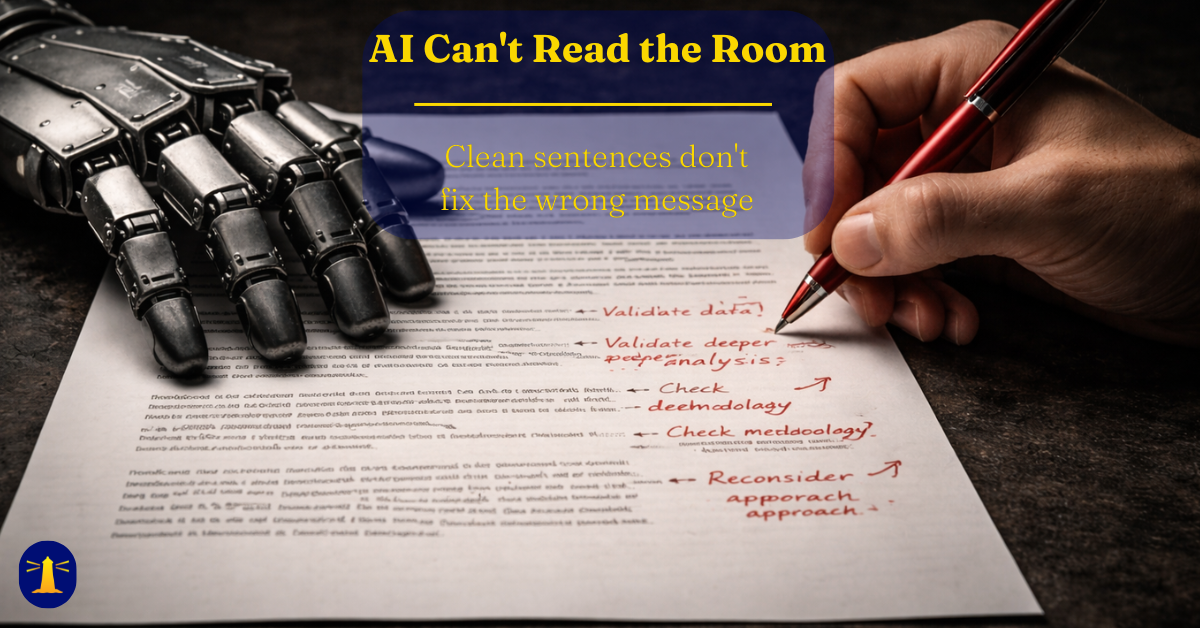
Better wording isn’t always better writing. If you used AI proofreading on your draft, and it still isn’t persuading, connecting, or sounding like you, the problem probably isn’t grammar. The real issue sits deeper, in structure, judgment, audience fit, and message clarity.
If you write your own emails, site copy, articles, proposals, or thought leadership, this can feel confusing. You can see the polish, but you can also feel the miss.
Key Takeaways
- AI can improve grammar and flow, but it can’t decide what your reader needs to hear first.
- Most weak business writing fails because of structure, message clarity, and judgment, not sentence-level errors.
- A polished sentence can still miss the reader’s real concern, bury the point, or weaken trust.
- If AI flattens your voice or makes your message generic, the writing sounds polished but doesn’t work.
- When a draft still feels off after cleanup, the next step is often editorial diagnosis, not more proofreading.
Estimated reading time: 12 minutes
AI Proofreading Polishes the Page. It Can’t Read the Room.
AI is good at surface cleanup. It can trim clunky phrasing, smooth transitions, and catch repeated words. For a rough draft, that’s useful. I wouldn’t dismiss that. Still, clean writing and effective writing are not the same thing. Your reader doesn’t care that a sentence flows. Your reader cares whether the sentence answers the right concern at the right moment.
When you run business writing through AI, the result can appear more finished than it really is. That matters because solopreneurs, coaches, and consultants often write in places where trust is being formed. A homepage, a welcome email, or a proposal isn’t judged like a school paper. It’s judged by how clearly it helps someone decide.
A smoother sentence can still carry the wrong message
I’ve seen plenty of drafts that became more readable after AI editing but less useful. Why? Because sentence-level polish doesn’t tell you whether the point itself is strong. A line can sound calm and confident while saying almost nothing. It can sound smart while avoiding the hard part. It can even sound persuasive while missing the reader’s actual concern.
If you’re explaining a service, the issue may not be wording. The issue may be that you never said what changes for the client. If you’re writing an article, the problem may be that you sound informed but not grounded. If you’re sending a proposal, the weak spot may be that the reader still can’t tell why your approach fits their situation. A smoother sentence is like fresh paint on a door that still sticks. While the door looks better, the paint doesn’t solve the sticking problem.
If your draft doesn’t match the moment, better wording won’t save it
Audience awareness is where many drafts start to slip. Sometimes your reader needs reassurance. Or sometimes they need proof. And, now and then, they need a sharper next step. If your draft offers a polished paragraph when the reader needed plain clarity, the edit won’t land.
This shows up all the time in small business writing. A coach writes a sales page that sounds thoughtful, but never addresses the risk a buyer feels. A consultant writes an email that sounds polished but buries the point under context. A service provider writes an About page that reads well but doesn’t help the reader see what it’s like to work together.
Your reader isn’t grading your prose. They’re deciding whether you understand them. That’s the gap. AI can improve the page. It can’t reliably decide what your specific reader needs from you, right now, in this piece.
Most Drafts Fail at Structure, Not Grammar.
Once you get past typos and awkward phrasing, most struggling drafts have deeper issues. They don’t highlight what deserves the most space. The writing has the wrong point coming first. It’s too hard to see what to cut. That’s where AI writing editor limitations become obvious. The draft may be cleaner, but the order is still wrong. The main point is buried. The payoff comes too late. Or the piece tries to say five things at once and lands none of them. Grammar fixes don’t solve those problems. Structure does. Judgment does.
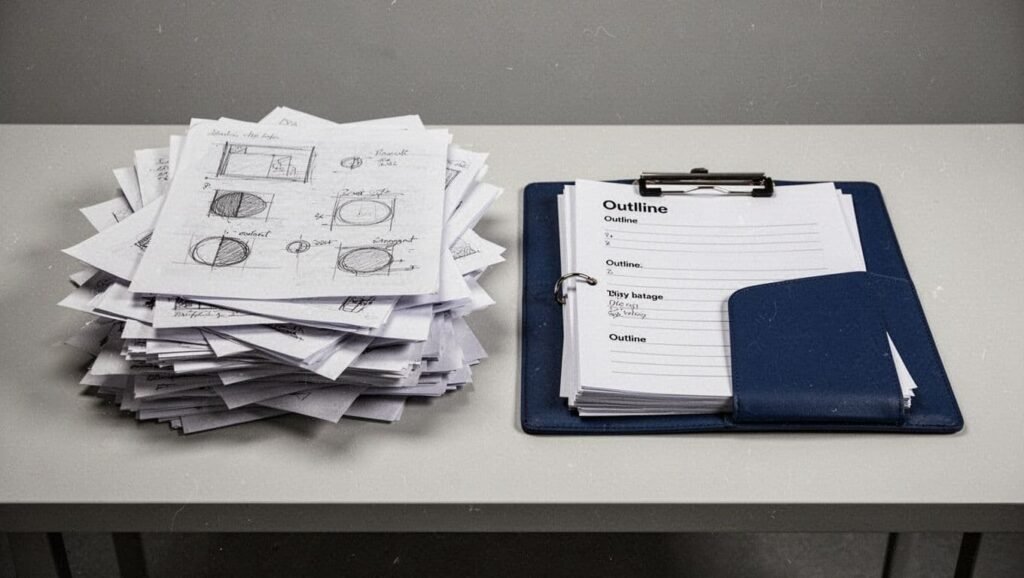
When the real point is buried, readers stop before they get to it
A lot of business writing asks too much patience from the reader. You may open with background when the reader needs the point. Or you have stacked disclaimers before saying what you do (a pet peeve of mine!). You may spend half an article warming up to the insight that should have led. This happens on sales pages, newsletters, About pages, service descriptions, and client-facing articles. You know what you mean, so you can tolerate the slow start. Your reader can’t. They just don’t owe your draft that much time.
A weak opening often has one of four problems. It delays the payoff, hides the stakes, and tries to sound polished instead of clear. Or it loads too much into the first paragraph. If the main point shows up late, many readers won’t reach it. That’s not a style issue. That’s exactly what an outside read catches.
Good editing means making choices, not just making fixes
Real editing is less like dusting a shelf and more like staging a room when selling a house. You don’t just clean what’s there. You decide what belongs. That means cutting repetition, moving sections, combining ideas, and trimming lines that sound fine but pull focus. It also means deciding where the draft should slow down and where it should move faster.
This is where many writers get stuck on their own. You’re as close to the material as you are to your own home clutter. Every sentence feels necessary. So you keep revising at the word level because your focus narrows to finding just the right words to be perfect. But sometimes the right move is to cut a paragraph you spent an hour writing. Sometimes it’s to move your best line to the top. Sometimes it’s to drop three examples and keep one. Those are judgment calls, and they shape meaning, not just grammar.
Is this your draft right now?
If you’ve cleaned it up and it’s still not doing its job, the problem probably isn’t the sentences. The Strategic Diagnostic gives you a clear outside read: what’s working, what’s buried, and what needs to happen next. Request a Strategic Diagnostic
They’re deciding whether you understand them.
When AI Flattens Your Voice, Your Reader Notices.
For independent professionals, voice isn’t decoration. It’s part of the offer. When your writing goes flat, over-smoothed, or oddly generic, your reader notices, even if they can’t name it. They might think, “This sounds AI edited.” More often, they just feel the distance. The writing feels less grounded, less human, less sure of itself.
Your voice is part of how clients decide whether to trust you
People don’t only judge what you say. They judge how you say it, meaning tone. Tone tells them whether you’re steady, thoughtful, warm, blunt, practical, careful, or vague. It gives shape to your judgment. That’s especially true if you are the business. When someone hires you, they aren’t buying a brand voice from a large company. They’re deciding whether they trust your mind.
So if your copy becomes polished but generic, that works against you. Generic writing creates less friction, but it also creates less belief. It sounds like it could belong to anyone. If your writing stops sounding like you, it stops helping the right reader recognize you. Your voice doesn’t need to be quirky or loud. But it needs to feel true. It has to match the way you think and the way you serve.
What works on paper can still feel wrong in your business
This is the strange part. A draft can be technically fine and still feel off. Maybe the tone is too formal for how you actually work with clients. Or the language sounds bolder than your real offer. Maybe the copy promises a kind of certainty you don’t sell. Or maybe the edits smoothed out the texture that made you believable.
When that happens, the problem isn’t that the writing is bad. The problem is mismatch. You can often feel this before you can explain it. You read the AI-edited version and think, “That sounds better than me. I should probably use it.” That’s the trap. Pay attention to that. It usually means the text has drifted away from your actual business, your actual client relationships, or your actual point of view.
Proofreading, Editing, and Editorial Diagnosis Aren’t the Same Thing.
Proofreading catches errors: spelling, punctuation, typos. It assumes the draft is structurally sound and just needs a final check.
Editing works at the sentence and paragraph level: tightening language, improving flow, smoothing transitions. It assumes the argument is in place and needs shaping.
An editorial diagnosis does something different. It reads the draft as your reader will and tells you what the piece is actually doing on the page. That helps you figure out where you missed what you meant or what you hoped. The diagnosis tells yu what’s landing, what’s buried, what’s working against you, and what needs to happen next.
If your draft went through AI cleanup and still isn’t working, you may have been solving a proofreading problem when you had a diagnosis problem. That’s what the Strategic Diagnostic is for.
What You Need Isn’t More Cleanup.
Sometimes you start by looking for proofreading help because that seems efficient. But the draft might not need “proofreading.” What you may need is a clear outside read from someone who can tell you what the piece is doing on the page. Not what you meant, and not what you hope the reader gets, but what’s actually in a reader’s perception.
That kind of read changes the work. It can show you what’s working, what’s confusing, what should move, what should go, and where the reader is likely to hesitate or leave.
Frequently Asked Questions About Fixing AI-Edited Business Writing
Yes, especially if the draft looks cleaner but still feels wrong. AI-assisted drafts often need help with order, tone, and trust-building. Those are structural and judgment problems, not grammar problems, and that’s exactly what the Diagnostic looks at.
I read for what the draft is actually doing on the page, not what you meant it to do. Then I flag what to move, cut, sharpen, or support, so you know whether the piece needs light shaping or a deeper rewrite. You get a written assessment and a conversation to work through it.
The editorial read can be very quick. A two-page document takes an hour or two. What takes time is the setup: confirming scope, getting the contract in place, and scheduling the follow-up conversation. That’s why reaching out before your deadline matters more than the deadline itself.
Yes. Heavily revised drafts are common. Sometimes the revision history is part of what we need to talk about, because repeated revision at the sentence level can obscure a structural problem that was there from the start.
A copy editor works at the sentence level: grammar, consistency, style. The Strategic Diagnostic works at the level of argument, structure, and reader response. It answers the question your copy editor can’t: is this draft doing its job?
Send the draft in whatever state it’s in, plus a sentence or two about who it’s for and what you want it to do. Use the contact form to reach out and mention the Strategic Diagnostic in your message. I’ll confirm scope and we’ll go from there.
A Real Editorial Pass Shows You Why the Draft Isn’t Working
A human editor reads for logic, flow, emphasis, tone, and reader response all at once. That means noticing when your opening asks too much. It means catching when a claim needs proof. And seeing that paragraph three should be paragraph one. Also, pointing out when the strongest idea is getting crowded by weaker ones.
It also means reading with your reader’s likely reaction in mind. Where do they trust you more, and where do they get lost? Where do they need a clearer example? And where does the draft sound polished but oddly empty? This matters because endless surface revision can waste hours. You keep changing words, but the same problem remains. A good editorial read stops that cycle. It tells you, plainly, what the draft needs next.
The relief here is simple. You don’t have to guess whether the piece is almost done or built on the wrong frame. You can find out. Your draft may look cleaner after AI. That doesn’t mean it’s doing its job. If the message is off, the order is weak, or the voice no longer feels like yours, more cleanup won’t solve it.
The strongest takeaway is this: writing works when judgment is doing the heavy lifting. AI can help with the surface. But when you need clarity, trust, and real connection, you need a read that can see past the sentence and into the message.
Want a Quick Way to Check Your Own Draft First?
Before you hire anyone, run this checklist.
Ten-Minute Clarity Edit Checklist
It helps you spot clarity traps, evaluate your tone and trust signals, and tighten the structure of your business documents in about ten minutes.
👉 Download the Ten-Minute Clarity Edit Checklist
Your Draft Is Clean. So Why Isn’t It Working?
If you’ve revised the same document more than twice and still can’t say why it isn’t working, the next step isn’t another round of editing.
Start with the Strategic Diagnostic
Pricing is by document length, starting at $175, with no future commitment required. You’ll get a written assessment plus a conversation to work through it.
👉 Strategic Editorial Diagnostic

Thanks for reading — here’s to clearer writing and stronger ideas.
~~ Susan