
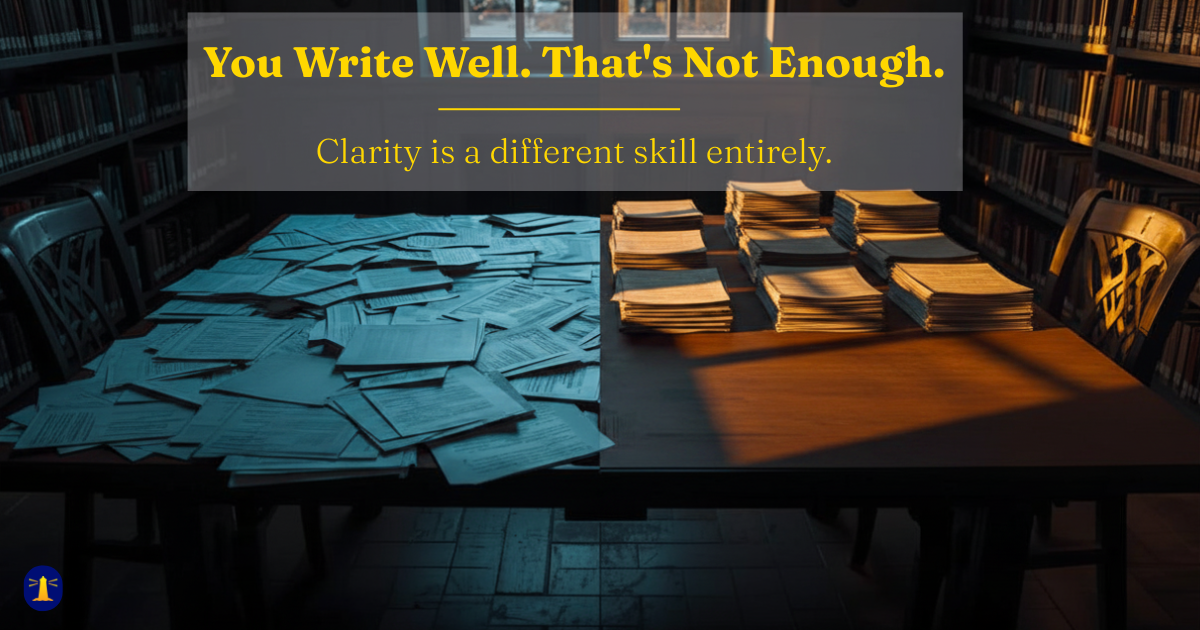
You finish a proposal. Or a report, a white paper, a blog post. Maybe course material you’ve been building for months. And then you send it, publish it, or hand it off. Here’s the kicker: Nothing comes back that tells you it didn’t land.
You only get success feedback, and you get no way to know how big the unsuccess was. That’s because the people who found it hard to follow didn’t say so; they moved on. They lost the thread before they reached your point. They filed the proposal and chose someone else, or they read half the article and closed the tab. Maybe they sat through the course material and came away vaguely unclear on what to do next. But nobody tells you any of that. The consequences of unclear writing are almost always silent.
Here’s what’s actually happening. Writing competence and editorial clarity are two different skills, and most capable writers have only ever been trained in one. That’s not an insult. It’s a distinction most people have never had reason to make.
and not getting the response you expect,
the problem probably isn’t your sentences,
and this post is for you
Writing Well and Writing Clearly Are Not the Same Skill
Writing well means you know how to shape a sentence. You choose precise language, and you build an argument. You’re careful to control tone and rhythm. You sound like someone worth reading. Writing clearly means something different. It means the reader never has to work to find the point. The structure does the orienting. The argument surfaces early. The main claim doesn’t wait behind context, caveats, or careful setup. The reader moves through the writing without friction.
If you write well, this problem is particularly hard to see. Your drafts sound finished: the sentences are good and the argument is intelligent. There’s no visible signal that anything is wrong. You’re going to have to change your approach to see what you are missing.
Here’s the gap in plain terms:
| When You Write Well | When You Write Clearly |
|---|---|
| You shape strong sentences | You shape the order of ideas |
| You choose vivid or precise language | You help the reader know what matters first |
| You polish tone and rhythm | You reduce strain on each paragraph |
| You add depth and detail | You cut what delays understanding |
These are different decisions. Strong writers make the left column instinctively. The right column requires a different kind of attention, and most people never develop it, because most feedback they receive is about the writing, not the reading experience. Nobody tells you your sentences are beautiful but your argument took too long to arrive. They just tell you the writing was hard to follow — if you ask and if they tell you anything at all.
Strong Writing Can Hide the Clarity Problem
Strong writing is exactly why capable writers miss their clarity problem. Unclear writing from a weak writer is obvious: the sentences fall apart; the logic is thin; the problems announce themselves. Unclear writing from a strong writer looks finished. The sentences are good. The language is precise. The argument is intelligent. The writing sounds like it’s working. And so the clarity problem hides underneath prose that gives no outward signal that anything is wrong.
When I read documents from consultants and coaches, I rarely see a lack of intelligence or effort. I see strong language carrying ideas that arrive too late, rely on too much unstated context, or ask the reader to assemble the point on their own. The prose is good. The reading experience is still heavy.
Readers don’t grade your intentions. They respond to how much effort the page asks from them. If they have to pause, backtrack, or work to find what matters most, trust starts to thin. They may still respect you. They may stop following you.
Clear Writing Means Decisions About Order, Emphasis, and Load
When was the last time you wrote a draft until you felt it was done and then ripped it apart and reordered it entirely? But you have to revise sequence after you figure out exactly what you’re trying to say because clarity in writing depends on sequence. What comes first? What needs framing before detail? What can wait? What can go. You don’t get those answers by polishing a sentence in place. You get them by reading for burden. Where does the reader have to infer too much? Where does the paragraph carry two jobs at once? Where does emphasis fall on the wrong line?
Clear writing also respects cognitive load. If a section opens with caveats, side paths, or dense abstraction, the reader spends energy before they even know the main claim. When a draft repeats the same point in several forms, the reader starts to feel drag. And if key terms stay fuzzy, the reader can’t build trust in the argument.
Good prose can hide all of that. Editing exposes it. The clearest writing is shaped by an outside reading experience, not just a better writing process

Expertise Makes the Gap Harder to See, Not Easier
Here’s the specific mechanism, and it’s worth understanding because it explains why smart, experienced writers are often the last to notice this problem.
- You know your subject so well that the missing steps stop looking missing.
- You leave out the frame that would help a new reader enter the argument because it feels obvious to you.
- You skip a definition because you’ve used the term a hundred times.
- You move from one idea to the next because the logic is clear in your head while on the page, that logic may only be implied.
Your reader fills in those gaps if they’re patient and motivated. Many won’t. They don’t know what you meant to include. They only know where the writing got harder than it needed to be.
This is also why revision doesn’t fix it, at least not the kind of revision most writers do. When you revise, you return to a draft you already know. You tighten wording or add a stronger phrase. You clarify one paragraph by adding more explanation. Those moves feel productive because the draft sounds better after each pass. But better wording only improves the surface. The real issue sits underneath, and it tends to be structural. The argument starts too late. The section order asks the reader to hold too much in memory before the point arrives. The core claim is buried beneath context that belongs later in the piece, not at the front. No writer changes the structure of their manuscript once they have chosen it and gotten started writing.
The result is that you can revise the same piece three or four times and still get the same feedback. Each pass improved the writing. None of them changed the reading experience. That’s a frustrating place to be, especially when you know the work is good and you can’t figure out why it isn’t landing.
What makes this particularly stubborn is that sentence-level revision feels like clarity work. It isn’t. Cutting a wordy phrase, sharpening a verb, tightening a transition are all good writing decisions. Deciding where the argument begins, which section needs to move, and what the reader needs to know before they can absorb your main point are editorial decisions. They require a different kind of reading, and they’re virtually impossible to perform on your own material.
Familiarity Reads as Clarity, and That’s the Trap

You can’t fully test clarity from inside your own head. This is the limitation of self-editing. You can catch a lot on your own, especially if you’re an experienced writer. But you cannot possibly fully recreate the first read once you know the material.
At a certain point, you’ve gone blind to your actual words. You already know what every sentence is trying to do. Your brain supplies the missing links before your eyes reach them. So you read a paragraph and think, yes, that makes sense. What you’re testing is recognition, not comprehension. The draft feels coherent because you know it. That tells you very little about what a reader experiences on a first pass.
False clarity is common among strong writers precisely because strong writers can make almost any paragraph sound intentional. The prose covers the problem. Familiarity confirms it. And the gap between what you think you’ve communicated and what a reader actually receives stays invisible until someone tells you that your writing was hard to follow.
This is what an editor actually brings. Not a superior eye for language. Distance from your material. A first read you can’t give yourself on a draft you know too well to see clearly.
If you’re already wondering whether your document has a structural problem, that question is worth answering before your next revision pass. The Strategic Diagnostic was built for exactly that moment.
What Outside Editorial Help Actually Changes About Clarity
Useful outside help doesn’t fix individual sentences or comma problems. Useful help typically restructures your piece in order to change what readers feel as they move through it.
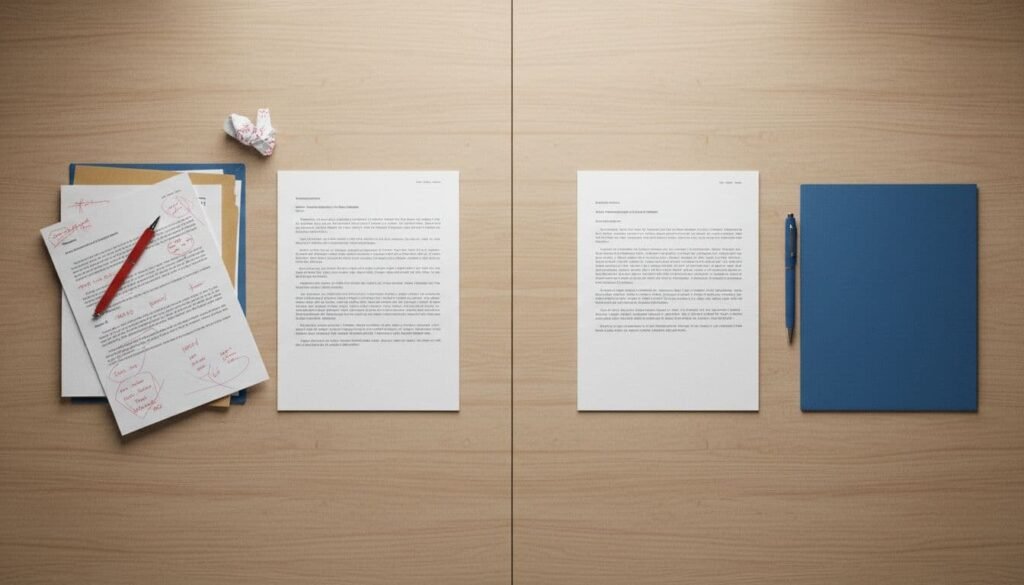
A fresh reader can spot where you clearly aren’t making the point you want to make. They can see when two sections need to switch places. They can cut repeated explanation that makes the piece feel slow. They can smooth a jump that made sense only because you knew what came before. They can name the places where trust drops, where logic slips, and where the message asks for more effort than it should.
That kind of read changes the draft because it changes the path through the draft. You stop revising around the problem and start fixing the right one. If you’d like to explore what that looks like, here’s where to start.
You can put a draft down for a week and come back to it. That helps. But you still know what you meant to say. The context you left out, the frame you assumed, the logic you implied rather than stated, your brain supplies all of it before your eyes reach the gap. An editor’s distance is permanent. Yours isn’t. That’s not a limitation of your ability. It’s a limitation of familiarity, and it applies to every writer, at every level, on every draft they care about enough to have lived inside for a while.
The Real Cost is Lost Sales, Not Just Confused Readers
Reader confusion is only part of the problem. The larger cost is trust, which means lost sales. And it accumulates in ways that are easy to miss because they’re quiet.
If the value of your thinking takes too long to become clear, people hesitate. They delay a decision. Buyers miss the point of your offer. They lose confidence in your argument even when the argument is solid. Some readers drop out before they reach the part that would have won them over. And because the consequences are silent, you don’t get to know that’s what happened. The proposal didn’t convert. The article didn’t get shared. The report got acknowledged and then quietly set aside. You move on to the next piece, writing the same way, working more and working harder for the results you want.
For consultants and coaches, that cost shows up in specific places. You can lose buy-in in a proposal when the value of your approach takes two pages to surface. You’ll lose authority in an article when the argument is buried under careful qualification. Your momentum is lost in a course or a report when the reader has to work to find the throughline. Often nobody tells you they stopped trusting the piece. They just move on, and you’re left with strong writing that didn’t do the job you needed it to do.
A strong writer can still produce that outcome. A clear writer works to prevent it. The difference between those two writers isn’t talent or effort. It’s knowing that writing competence and editorial clarity are separate skills, and choosing to close the gap.
This is post 65 on this blog. I’ve been writing about editing and clarity for over a year. And I’ll tell you honestly: I didn’t fully understand the argument I just made to you until somewhere around post 40. I was writing for quite a while before that, and I wasn’t always writing clearly. The distinction took time to develop inside me before I could teach it.
Ready to Find What’s Actually Wrong?
If you’ve revised the same document more than twice and still can’t say why it isn’t landing, the next step isn’t another editing pass. It’s a different kind of read entirely.
The Strategic Diagnostic
Pricing is by document length, starting at $175, with no future commitment required. You’ll get a written assessment of what’s affecting the reading experience, with specific observations about structure, argument sequencing, and clarity load. Plus a conversation to work through it together.
👉 Strategic Editorial Diagnostic
Want to Start With the Surface?
If you’d like to clean up the grammar and mechanics before you tackle the bigger structural questions, the Mistake Finder Checklist is a free 3-5 minute sweep you can run before you hit publish or send. It won’t fix a structural problem, but it will get the surface out of the way so you can see what’s underneath more clearly.
Download the Mistake Finder Checklist
And if you’re carrying the writing load yourself across proposals, client documents, and service pages, Premium Access is how we make ongoing editorial support easy. One setup. No rescoping. On-call editing for the work that matters most.
If you’re carrying the writing load yourself, proposals, client documents, service pages, it’s easy to lose perspective. Strategic editing gives you a partner in clarity, so your message lands and your time is better spent.
Only a few Premium Access clients are active at any given time. If you’re thinking about it, now is a good time to reach out.

Thanks for reading — here’s to clearer writing and stronger ideas.
~~ Susan
Frequently Asked Questions About Clear Writing and Editorial Clarity
It’s designed for consultants, coaches, and nonfiction professionals who write their own materials and have started to suspect that revision isn’t fixing the problem. If you’ve revised a piece multiple times and it still isn’t landing the way you intended, that’s the situation the Diagnostic is built for.
A Strategic Diagnostic looks at the reading experience, not the sentences. It identifies where the argument starts too late, where the structure asks the reader to work too hard, and what needs to move or go. A full edit works at the line level. The Diagnostic tells you whether you have a structural problem before you invest in editing the wrong thing.
The Strategic Diagnostic Pricing is by document length, starting at $175, with no future commitment required. It includes a close read of your document and a written summary of what’s affecting the reading experience, with specific observations about structure, argument sequencing, and clarity load.
The Diagnostic typically takes a few business days from submission to written assessment, depending on document length and current availability.
Any nonfiction document where clarity and argument structure matter: proposals, white papers, reports, articles, blog posts, course materials, executive briefs, or service pages. If you’re not sure whether your document fits, send a quick note and I’ll tell you directly.
You receive a written summary of what’s affecting the reading experience, with specific observations about structure, argument sequencing, and clarity load. We then schedule a short conversation to work through it together. If you want to move forward with editing after that, we scope it as a separate engagement.
No. Submit the draft you have. The Diagnostic reads for structural and argument problems, not surface polish. A heavily revised draft can actually make some problems harder to see.