
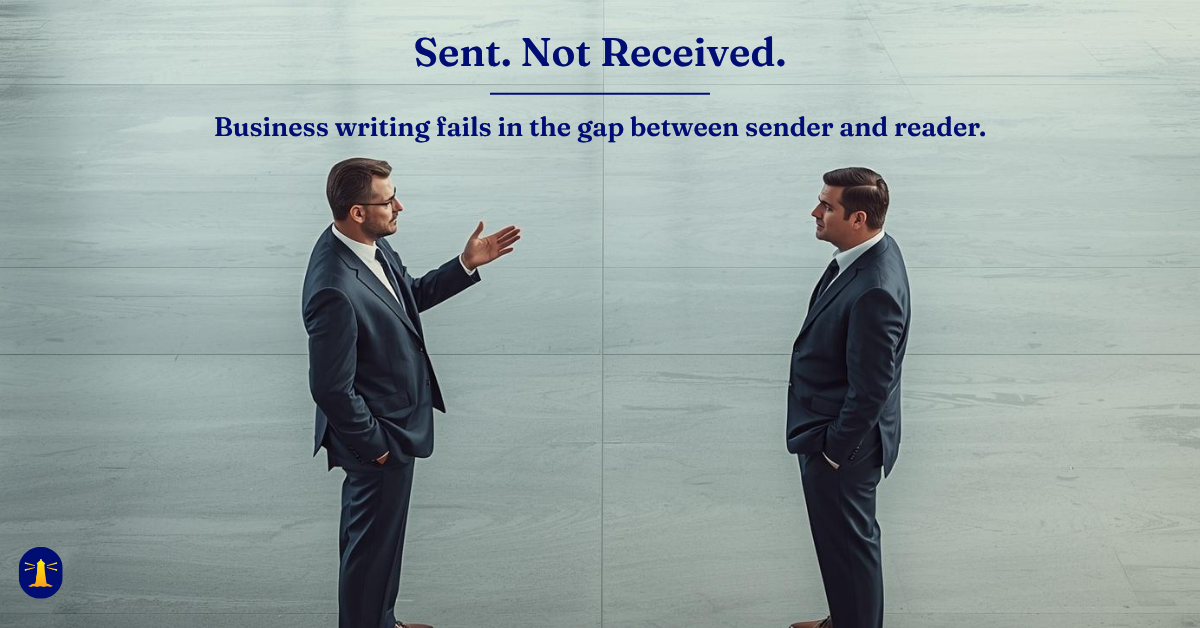
If your reader has to reread a sentence, you’ve already lost momentum. Most business writing doesn’t fail because it’s bad. It fails because readers can’t tell what matters fast enough.
I’m talking about clarity. That word gets thrown around a lot, and it’s fair to wonder whether it means anything at all these days. It does. In business writing, clarity isn’t one virtue among many. It’s the foundational requirement. Everything else depends on it. That means that spending all your budget on marketing and none on your business writing can be costing you clients.
Here’s why clarity is foundational, and why it’s harder to achieve than most people think.
Why Business Writing Has to Earn Its Own Clarity
Academic writing has standardized forms. A literature review follows a known structure. A methods section has expected components. A journal article moves through introduction, argument, evidence, and conclusion in a sequence that readers of that genre already understand. The form itself carries some of the meaning. Readers arrive with a map.
Business writing doesn’t work that way. There’s no equivalent standard form for a memo, a white paper, a strategic recommendation, or a client-facing report. There’s no knowledge accumulation the way there is in a field of study, where each paper builds on a shared body of work. So no specialized jargon is grown, which means you can’t rely on technical shorthand to compress meaning efficiently.
Every piece of business writing stands alone. On its own, the piece has to build its own context, carry its own argument, and land with a reader who may be impatient, distracted, or skeptical. Nothing about the form does that work for you.
Clarity does the work instead. It’s the mechanism by which a standalone document communicates on its own terms, without the reader needing prior knowledge of the genre or the field. That’s not a soft skill. That’s the core structural requirement of the work.
This realization means the reader’s behavior under pressure isn’t just context. It’s the whole game.
Your Reader Decides Before They Finish the First Paragraph
Before you can write clearly for a business audience, it helps to understand how that audience reads. The answer is: not the way you hope.
Business readers are processing a high volume of documents under real time pressure. Your document is competing with others for a full read, for time to comprehend the message. Readers are scanning for the point before they commit to reading. The average reader scans and decides almost immediately whether to keep going. If the point isn’t made quickly, they don’t conclude that the document is complex or that the important point is simply buried. They conclude that the document isn’t worth their time.
This isn’t laziness. It’s professional reading behavior, and it’s completely rational. A senior leader reviewing a stack of briefing documents doesn’t have the bandwidth to excavate an argument from dense prose. A client comparing proposals isn’t going to read yours twice to find the recommendation that should have been in the first paragraph. A colleague deciding whether to escalate an issue is going to act on what they understood, not on what you meant.
Clear writing meets readers where they are. It doesn’t demand effort. It delivers. That distinction is the difference between writing that moves things forward and writing that generates follow-up questions, missed steps, and silent disengagement.
So if clarity is this critical, and business writers are capable people, why doesn’t it happen automatically?
Why Smart Writers Still Struggle With Clarity
The answer has less to do with skill than with mindset, and with a specific trap that expertise sets for the people who fall into it most.
Most Writers Blame the Reader
There are two kinds of people when it comes to clarity.
The first kind assumes their writing is clear. When someone misunderstands them, they yell at their listeners because the communication failure is the listener’s fault. This first kind doesn’t distinguish between formats. To this mindset, communication is communication, whether it’s a memo, a meeting, or a hallway conversation. If you didn’t understand, you weren’t paying attention. The failure is always yours.
As writers, this kind of person revises once, maybe twice, then concludes the reader must have missed something. The problem, in their view, is always downstream: the audience didn’t pay attention, the colleague didn’t read carefully, the committee wasn’t focused. The writing itself couldn’t be the issue, because to the writer, it’s obvious.

The second kind understands that getting a meaning from one mind into another is actually a rare miracle. Words are imprecise. Readers are under pressure. Context doesn’t transfer automatically. For this group, misunderstanding is the default condition, not an aberration. They assume the problem is the writing, not the reader. As writers, this group seeks feedback, checks understanding, and cares equally about marketing and the writing of the rest of their business documents. And they hire good business editors for expert assessment on clarity. When readers get materials from these business people, they relax into the experience, get more informed, and see those writers as far more professional. All those outcomes lead to more clients, more sales.
Knowing Too Much Makes You Harder to Understand
But caring about your reader’s needs isn’t enough. There’s a specific trap that catches good writers more than bad ones. The more you know about your subject, the harder it is to write clearly about it for someone who doesn’t.
Expertise creates invisible assumptions. The consultant who has spent six months diagnosing a client’s operations knows exactly why the recommendation is right. The reasoning feels obvious, because to them it is. So they write a recommendation that makes complete sense if you’ve been in every meeting, reviewed every data set, and already agree with the framing. Their reader has done none of those things.
This isn’t a knowledge problem. It’s a translation problem. The expert knows what they mean. What they haven’t done is made the journey from their conclusions back to the reader’s starting point, which is the actual work of clear writing.
It compounds in a specific way. The more technical your subject, the more your expertise insulates you from your reader’s experience of your writing. You stop noticing the gaps because you’ve filled them in automatically. A policy analyst writing for a general audience, a specialist writing for a cross-functional team, a founder writing for investors who don’t know the industry as well as they do all face this problem. All of them benefit from a reader who can see the gaps they’ve stopped seeing.
That’s precisely what clarity editing does.
Clarity Editing Finds What You’ve Stopped Seeing
Clarity editing isn’t proofreading. It isn’t about grammar, though grammar matters. It isn’t about style, though voice matters, too. It’s about the gap between what you meant and what your reader will understand, and closing that gap deliberately.
That means making the request explicit, not buried in context. Making the logic visible, not assumed. Making the action unambiguous, not open to interpretation. Making the tone appropriate for the audience and the stakes, not just comfortable for the writer.
Here’s what that looks like in practice. A consultant sends a proposal. The offer is strong, the pricing is fair, the credentials are solid. But the problem statement takes two paragraphs to arrive, the recommendation is buried in the middle of page two, and the call to action is softened to the point of invisibility. The prospect reads it, thinks “maybe,” and moves on. Not because the offer was wrong. Because the writing made the reader do too much work to find the yes.
Clarity editing finds that and fixes it. The problem statement moves to the front. The recommendation gets its own clear sentence. The call to action says what you actually want the reader to do. The document now works as hard as the offer it’s presenting.
These aren’t decorating choices. In a document that has to stand on its own, they’re load-bearing.
When a piece of business writing goes out without that work, one of two things happens. Either the reader follows it anyway, which means you got lucky with a forgiving audience. Or someone misunderstands, pushes back, escalates, or simply disengages, and you never find out why.
And the cost of that disengagement is rarely what it appears to be.

Unclear Writing Doesn’t Just Confuse It Erodes Trust
There’s a consequence of unclear writing that goes beyond comprehension, and it’s the one most business writers don’t see coming.
When a reader struggles through your document, even if they eventually understand what you meant, their experience of that struggle becomes their experience of you. A document that makes them work hard reads as unprepared. One that buries the point reads as uncertain. One that hedges every claim reads as lacking conviction. None of that may be true, but the writing said it.
Clarity isn’t just functional. It’s a trust signal. A document that is well-structured, direct, and easy to follow tells the reader that the writer knows what they’re talking about, respects the reader’s time, and is confident in what they’re saying. That impression forms before the reader has evaluated a single argument. It shapes how every argument lands after that.
This is why two proposals with equivalent offers don’t get equivalent responses. The clearer one gets the call. Not because the offer was stronger, but because the document made the reader feel confident, not cautious.
Unclear Writing Costs You Opportunities You Never Knew You Lost
The cost of unclear business writing is easy to underestimate because it’s almost always invisible. You don’t get a bill for it. You just don’t get the call.
A proposal that doesn’t land clearly doesn’t usually generate a rejection. It generates silence. The prospect moves on and you assume it was the price, or the timing, or the fit. It might have been the writing.
An email that buries the ask doesn’t usually generate pushback. It generates a slow response, a partial answer, or a follow-up meeting that didn’t need to happen. The friction is real, but it’s diffuse. It looks like a busy client, not an unclear document.
A report that doesn’t structure its argument visibly doesn’t usually generate complaints. It generates a meeting where someone asks you to “walk us through it,” which is a polite way of saying the document didn’t do its job.
None of these failures announce themselves as writing problems. That’s exactly why they persist. And that’s why the cost compounds quietly, proposal by proposal, email by email, report by report, until the pattern is visible only in retrospect.
Clear writing doesn’t just communicate better. It removes the friction that was costing you opportunities you didn’t know you were losing.
The question is whether you’re too close to your own work to see where that friction lives.
Who Benefits Most From a Clarity Read
If you write proposals, reports, white papers, client-facing documents, or internal communications that carry real stakes, this applies to you. Not because your writing is bad. Most business writers are competent. But competent writing and clear writing are not the same thing, and the gap between them is exactly where readers disengage.
Independent consultants, small business owners, analysts, program managers, anyone who writes documents that have to persuade, inform, or move a decision, these are the people who benefit most from a clarity read. Not because they need to be corrected. Because they’re too close to their own work to see what a reader sees on the first pass.
That’s not a flaw. It’s just how writing works. You know what you meant. Your reader doesn’t.
One Document Can Tell You Everything You Need to Know
If you’re here because you already know your writing needs work and you’re not sure what kind, that’s a useful instinct. The gap between “something isn’t landing” and “I know exactly what to fix” is exactly where a fresh read pays off.
Keep the Key Points Close
If this post resonated, you might want to download:
Where Did Your Reader Get Lost? A Two-Part Writing Diagnostic
This guide helps you identify where your writing stops working for your reader, before it goes out. If you’ve revised the same document more than twice and still can’t say why it isn’t landing, the next step isn’t another round of editing.
👉 Where Did Your Reader Get Lost? (in the Freebie Library)
Curious About Working Together?
If someone you respect has already told you your writing needs work, that’s enough of a starting point.
Start with the Strategic Editorial Diagnostic
Pricing is by document length, starting at $175, with no future commitment required. You’ll get one focused conversation about your document, your reader, and what’s standing between them.
👉 Strategic Editorial Diagnostic

Thanks for reading — here’s to clearer writing and stronger ideas.
~~ Susan
Frequently Asked Questions About Business Writing and Clarity
Because clarity is about the reader’s experience, not the writer’s craft. A document can be grammatically correct, well-researched, and professionally written and still fail to communicate if the structure buries the point or the logic assumes more than the reader brings. Good writing and clear writing overlap, but they are not the same thing. Good writing can still make the reader work. Clear writing doesn’t.
Any standalone business document that has to persuade, inform, or move a decision. Proposals, white papers, reports, client-facing summaries, executive briefs, grant applications, and internal memos with real stakes are all good candidates. If the document has to work without you in the room to explain it, it qualifies.
Proofreading catches errors. A clarity read diagnoses whether the document is doing its job: whether the argument is visible, the request is explicit, the logic holds, and the reader can find what matters without working for it. A proofread document can still be completely unclear. A clarity read addresses that layer.
You can try, and experienced writers do develop self-editing instincts. But the core problem is proximity. You know what you meant, which makes it very hard to read what you actually wrote. The gaps you’ve filled in automatically are invisible to you. A fresh reader sees them immediately. That’s the value of an outside read: not skill, just distance.
Yes. The stakes scale with how much the document has to do on its own. A proposal competing against others, a report that drives a budget decision, a white paper that establishes credibility with a new audience: these documents carry more weight than an internal update or a routine email. The higher the stakes and the less context the reader brings, the more clarity does the heavy lifting. A document your reader will share with others, forward to a decision-maker, or use to evaluate you is worth a clarity read. A document that lives and dies in one inbox probably isn’t.



🕒 Comments are open for 30 days to support timely conversation. Thanks for being here while the post is fresh.