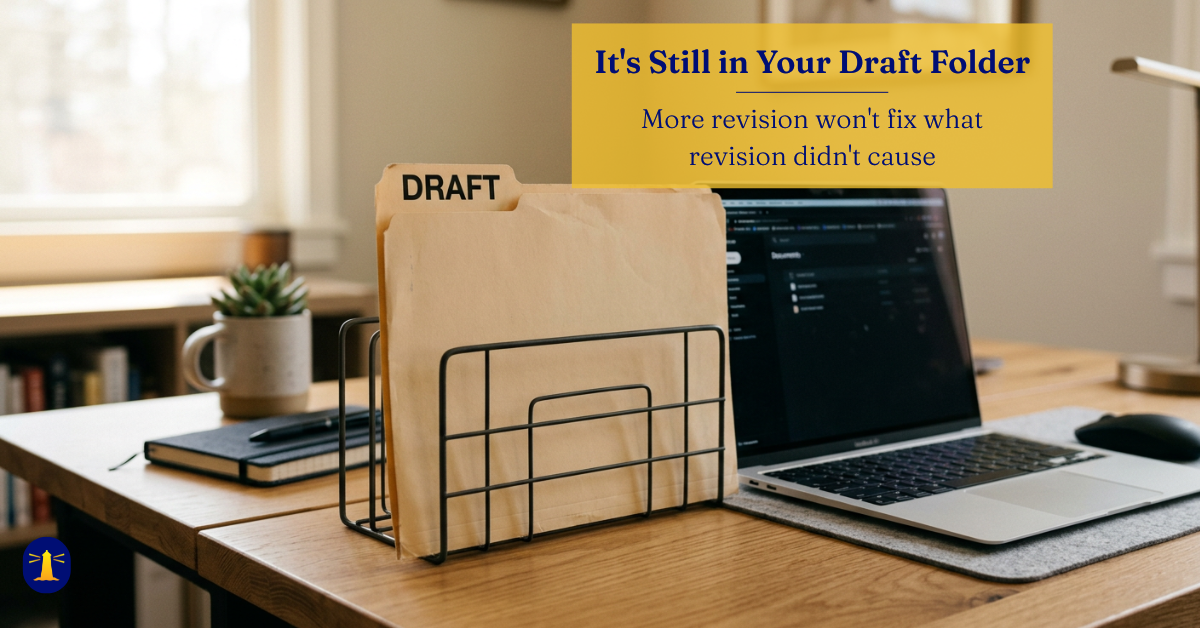
You know the document. Every time you open it, you change a few sentences, close the file again, and somehow feel worse. Your stalled writing project is still sitting in the Draft folder, gathering dust. You haven’t abandoned it, but you haven’t moved it forward either.
If you’ve been circling the same file for weeks, or months, I’m not going to tell you that you need more discipline. A stalled writing project usually isn’t a character flaw. It’s a sign that something in the document still hasn’t been decided. But stalled documents are silently expensive. A stalled document quietly delays everything attached to it: decisions, launches, client conversations, visibility, revenue.
That’s why the draft feels heavy every time you open it. Before you push harder, you need to see what the stall is trying to tell you.
Why A Capable Writer Still Gets Stuck On One Document
Smart, capable people get stuck on important documents all the time. I see it with consultants, founders, subject-matter experts, and business authors who know their field cold. The draft stalls because the stakes are real. It has an audience and a real purpose. It may affect money, reputation, trust, or timing.
So no, this isn’t the same as avoiding a task you don’t want to do. This is what happens when a document matters and the writing problem sits below the sentence level. If you write well and still can’t get this draft to land, What Strong Writers Get Wrong About Editing names why that happens.
The draft is carrying more than one job
A single document often gets asked to do too much at once. Your proposal starts sounding strangely stiff because half the document is trying to win the client and the other half is trying to protect you legally. Or worse, maybe your proposal needs to explain the offer, sound polished, prove your expertise, calm a worried client, and protect you from being misunderstood. That’s a lot of weight for one draft.
When a document is carrying that many jobs, the writing slows down because the purpose gets muddy. You keep tweaking sentences, but the real issue sits higher up. The piece doesn’t know what kind of thing it’s trying to be.
That’s common in business writing. Your About page starts trying to sell, reassure, summarize your career, and sound personal. Your white paper wants to teach, persuade, and pre-answer objections before the reader has even agreed with the premise.
You may be waiting for a decision you haven’t named
A stuck draft often looks like delay. Underneath, it’s usually an unnamed decision.
You may not have decided who the reader is. Or how direct the tone should be. You could be torn about how much context belongs up front, or whether the piece is supposed to inform, persuade, invite, or document. Until that decision is named, the draft can’t settle.
That’s why rereading doesn’t help after a while. You’re asking line edits to solve a structural question. They can’t.
Perfectionism is often a symptom, not the source
Perfectionism usually shows up after the real problem is already there. You start polishing because something about the draft feels risky, exposed, or unsteady.
That doesn’t mean you’re precious about your writing. It means part of you knows the piece isn’t holding together yet. So you protect it. You add qualifiers. Then you smooth one paragraph again. Maybe you postpone the sharper claim to think about it twice.
A stalled writing project often carries that kind of tension. You’re not trying to make it flawless. You’re trying to make it feel safe. If that pattern feels familiar, When Self-Doubt Shows Up in Your Draft looks at how that tension shows up on the page and what to do about it. That’s close to why fiction-book-writers stall (see one sharp take on why writers stall), and I think it’s right for business writers, too: the issue is rarely effort by itself.
What The Draft Is Actually Telling You
When a document won’t move, I don’t treat it like a dead end. I treat it like a signal. The draft isn’t broken. It’s showing you where the message, structure, or expectations have gone soft.

That shift matters. Once you stop reading the draft as evidence that you’re failing, you can start reading it as evidence that the document needs a clearer shape.
Look for the missing audience decision
If the audience is fuzzy, everything else gets fuzzy with it. Your examples drift. Your tone wobbles. The level of detail keeps changing because you haven’t picked one real reader.
This happens constantly in business writing work. A consultant writes as if the piece is for prospects, peers, referral partners, and skeptical stakeholders all at once. A business owner drafts a guide that half-explains the basics and half-assumes expert knowledge. The result feels stuck because the document isn’t aimed.
When facts, usefulness, and reader trust all matter, you have more decisions to make before the sentences can settle.
Check whether the structure matches the real message
Sometimes the problem isn’t what you’re saying. It’s the order.
I’ve seen drafts with strong material that still wouldn’t finish because the sequence was wrong. The opening tried to warm up too long. The proof showed up before the claim. Side points kept interrupting the core message. The outline looked tidy, but it didn’t support the argument the draft was trying to make.
A weak structure creates drag. You feel it as resistance. And you react; you rewrite the opening six times. You keep moving sections around. Mentally, you get tired before page two.
That’s not because you’re lazy. It’s because the document has no clean path through itself.
Notice where the draft starts to feel defensive
Defensive writing has a texture. You know it when you read it.
The main point gets buried under setup. Claims arrive with hedge words stacked in front of them. You start overexplaining simple things because you’re trying to prevent every possible objection before you’ve earned the reader’s attention.
If you keep revising the same paragraph, you’re probably editing around a decision you haven’t made yet.
When a draft starts protecting itself, it’s usually pointing to fear about the message. Maybe the claim is stronger than you’re used to making. Or the audience matters more than you’d like to admit. The document might ask you to take a position you don’t fully trust yet.
That’s useful information. It tells you where the real editorial work is.
What Breaks The Stall Is Outside Judgment, Not More Revision
There comes a point where more self-editing stops helping. You’re too close to the material. You already know what you meant, so your brain keeps filling in the missing pieces. That makes diagnosis harder, not easier. That’s the proximity problem I look at in detail in How to Know If You’re Too Close to Your Own Writing, and why more re-reading rarely solves it.
What usually breaks the stall is outside judgment: one clear, experienced read. Not random feedback from five people. If you’re not sure whether your draft is ready for editing at all, Is My Draft Ready for an Editor? can help you figure that out first.
A diagnostic read finds the real bottleneck
A good diagnostic read doesn’t start by polishing sentences. It names the blockage.
Is the problem audience fit? Structure? Logic? Tone? Missing support? Too much support in the wrong places? A document can stall for any of those reasons, and they don’t all need the same fix.
That’s why I like diagnosis first. You don’t need thirty comments in Track Changes if the draft’s real problem sits in the opening logic. You need someone to tell you, plainly, what kind of mess this is.
If you want a lower-pressure place to start, the Freebie Library gives you practical checklists and guides that can help you inspect a stuck draft with fresh eyes.
When clarity comes first, editing gets faster
Once the structural issue is named, the next step usually becomes obvious. You may need a sharper audience choice. A new opening. A cleaner section order. A claim that gets stated earlier and more directly.
That kind of clarity gives you momentum back. Not fake momentum, the kind that comes from a timer or a pep talk. Real momentum, because the document finally has somewhere to go.
I’ve watched writers spend months circling a draft, then make solid progress in a day once the actual problem was named. That’s the difference between effort and direction. More effort on a confused draft only makes you tired. Once you know what your draft needs, a Polish & Professionalism Review could be the perfect service to take your document the rest of the way.
How To Move Your Draft Forward Without Guessing
If your document won’t budge, don’t start with a full rewrite. Start with one question.
Choose the one question the draft still can’t answer
Every stalled document has a question sitting under it. Often it’s one of these: Who is this really for? What does this piece need to do? What am I asking the reader to believe, understand, or decide?
Pick the one question your draft still can’t answer cleanly. Not ten questions. One.
When you name that missing decision, the draft gets smaller in a good way. You stop treating it like a giant personal failure and start treating it like a work problem with a shape. If you want a structured way to do that, How to Sharpen Your Vision Before You Hire an Editor walks through the process.
That’s the shift you need. A stuck document isn’t asking for more willpower. It’s asking for a clearer decision.
Get a clear outside read before you rewrite again
If you’ve already reread the file too many times, don’t spend another weekend pushing words around. Get an honest editorial read first.
That’s exactly what a Strategic Editorial Diagnostic is for. It’s a one-time assessment (starting at $175) for business professionals who need to know why a document won’t move before they invest more time revising it.
You don’t need encouragement disguised as feedback. You need someone to tell you what’s structurally off, what’s working, and what the next step is. Once that happens, the draft usually stops feeling mysterious.
🐾 Finnegan’s Advice
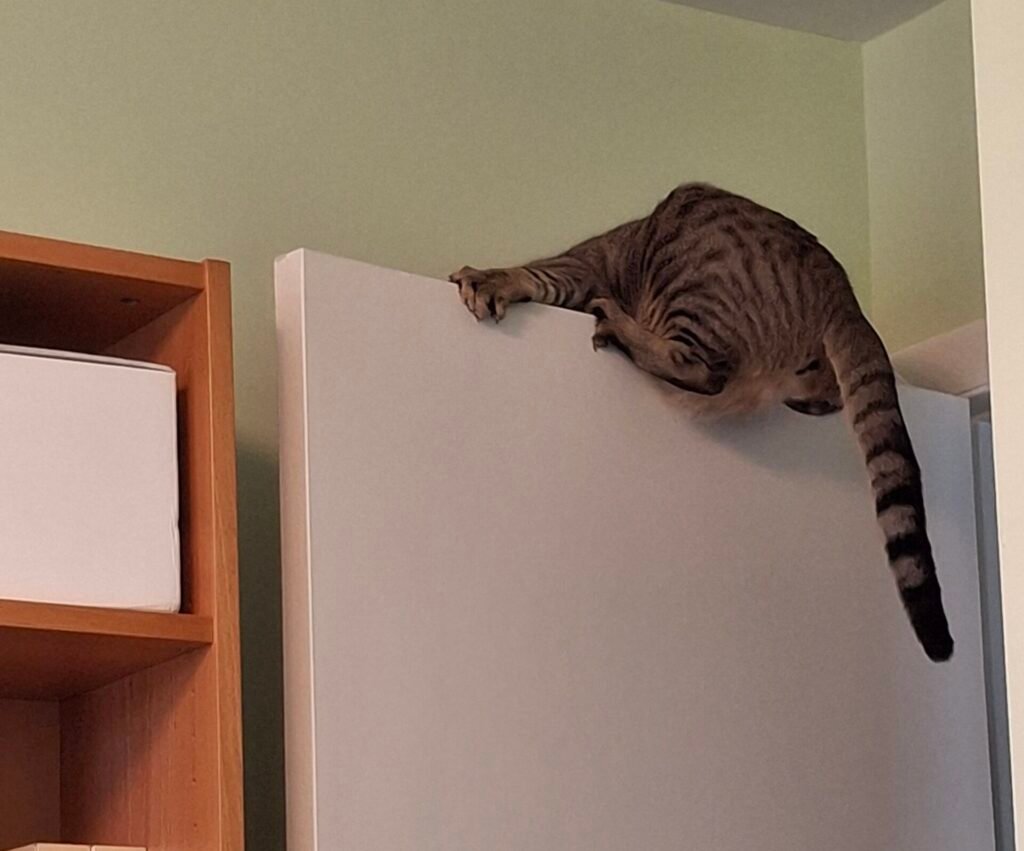
As Finnegan no-longer-the-kitten has gotten older, he’s challenging himself more and more. He took on too much this day but landed on his feet, unharmed, when the inevitable happened. He’s smarter now.
Finnegan advises business writers to stop trying to do too much and to get help instead of insisting on doing everything yourself.
When The Document Finally Makes Sense Again
That file in your draft folder isn’t stuck because you’re weak, scattered, or undisciplined. It’s stuck because something structural still hasn’t been named. And if part of what’s keeping the draft stuck is a quiet doubt about your own ability, You’re a Good Writer addresses that directly.
Once you see what the document is asking for, the pressure changes. You’re no longer trying to force movement out of a foggy draft. You’re making a clear decision and building from there.
That’s when the work starts moving again, not because you became a better person overnight, but because the document finally has a shape you can trust.
Take This With You
The worksheet below takes five minutes and tells you exactly where your draft stands.
Ready to Publish? Self-Check for Editing vs. Proofreading
This short worksheet helps you figure out whether your draft needs a final polish or something more structural first. Answer a few honest questions and you’ll know whether proofreading is enough or whether an editor should step in before it goes out.
👉 Ready to Publish? (in the Freebie Library)
Curious About Working Together?
If your draft has been sitting longer than it should, that’s enough of a starting point.
Start with the Strategic Editorial Diagnostic
Pricing is by document length, starting at $175, with no future commitment required. You’ll get one focused conversation about your document, your reader, and what’s standing between them.
👉 Strategic Editorial Diagnostic

Thanks for reading — here’s to clearer writing and stronger ideas.
~~ Susan
Frequently Asked Questions About Stalled Drafts
There’s no fixed deadline, but the signal isn’t time. It’s cost. If the document is attached to a decision, a launch, a client conversation, or revenue, every week it sits is a week that thing is also delayed. When you notice the stall is starting to affect something outside the document, that’s when it stops being a writing problem and starts being a business problem.
Yes, and it’s more common than people expect. A round of editing that addressed sentence-level issues without naming a structural problem can leave a draft cleaner but still stuck. If you’ve been edited and still can’t move the piece forward, the earlier editing may have solved the wrong thing first.
A draft worth diagnosing has a real purpose and a real audience. It’s stuck because something hasn’t been decided, not because the underlying reason to write it has disappeared. If the document no longer has a clear use, abandoning it is the right call. If it still matters and still has somewhere to go, a diagnostic is faster than starting over.
The surface looks different but the root causes are usually the same: fuzzy audience, unresolved purpose, or a structure that doesn’t match the argument. What changes is where the stall tends to show up. Proposals often stall on tone and scope. Reports stall on sequence and claim placement. Articles stall on the opening. The diagnostic question is the same regardless of format: what hasn’t been decided yet?
If your sentences are clear but the piece still isn’t landing, the problem is usually thinking, not writing. Writing problems show up at the sentence level: clunky phrasing, passive constructions, unclear word choices. Thinking problems show up at the argument level: the point keeps shifting, the reader can’t follow the logic, the claim never quite arrives. Most stalled drafts are thinking problems wearing writing problem clothes.