
Our Story: Jeff’s Dilemma
Jeff is a management consultant. He spent three months writing a 30-page white paper on a niche regulatory issue, the kind of document that’s supposed to establish his firm’s thinking, demonstrate expertise, and land with decision-makers. Then he hired an editor to make sure his document was perfect.
Jeff paid over $1,000 for a professional edit with a tight turnaround, asking “Is this ready to send?” That’s not an unusual price. If he’d gone to one of the major editing platforms (Scribendi, Scribbr, Proofed, Wordvice), he’d have paid somewhere between $200 and $450 for the same word count at standard turnaround just for proofreading (instead of editing), and paid more if he needed it fast. A mid-size agency with a dedicated project manager and account layers would have charged him $3,000 to $5,000 for the same manuscript. He chose the middle path: a skilled independent editor, real professional judgment, real relationship, real turnaround.
Jeff got exactly what he paid for: clean prose, consistent style, and one thing that stopped him in his tracks. The editor delivered twelve pages of notes, clean tracked changes, and one structural observation near the top: his argument in section two assumed the reader already understood why the regulation mattered, so Jeff needed to establish stakes earlier.
The note wasn’t wrong. Jeff could see that. Jeff just didn’t know what to write. He opened section two, then moved a paragraph. Then moved it back because the flow was wrong then. He added two sentences, but they felt clunky and so Jeff deleted them. He closed the document and told himself he’d come back to it tomorrow.
The next day, Jeff opened it again … but had the same problem. The editor had named what was wrong, and Jeff believed her. He just couldn’t get from the note to the solution, because all he could see was that fixing that gap meant restructuring, and restructuring section two meant he wasn’t sure section three held anymore, and now he was looking at a rewrite that felt like he was back at step one, with no more budget and a near-term deadline now.
Jeff was treating a structural note as a sentence-level task. That’s the gap causing his dilemma.
Why The Editor Stopped Where She Did
The editor did exactly what she was hired to do, and a bit more. Jeff’s “Is this ready to send?” was interpreted as line editing, copyediting, and proofreading. She covered style, consistency, and flow, word choice, and grammar in three separate passes for Jeff. When she flagged the structural issue, she was doing Jeff a favor — noting something outside her scope because it was too important to ignore. She didn’t write a two-page explanation that also outlined possible solutions for Jeff, which would have been way out of scope for the job. A good editor doesn’t expand scope without being asked, and an unexpected bill for unrequested work isn’t professional practice.
This is worth naming clearly because it’s not obvious to clients. Jeff didn’t feel shortchanged by his editor. He felt stuck, though. First, he really didn’t have more budget. He understood the contract and expected a big charge if he went back to his editor on a completed job to open a can of worms. Jeff was correct that this issue was out of scope, and he would have to pay some kind of fee.
Jeff’s stuckness felt like his own failure, which made it worse. He assumed the solution was obvious and he was simply missing it, so he kept trying to solve it himself instead of asking. He couldn’t even articulate what to ask: he knew he was stuck but couldn’t form a specific question. And underneath all of that was something harder to admit: he didn’t want to look like he hadn’t understood the feedback. He’s a senior consultant. Admitting he can’t execute a note feels like a competence failure, even to himself.
Not only is Jeff stuck on his white paper, he was also unaware of the skill he needed or the choices he had.
The Business Editing Ladder Isn’t The Book Editing Ladder
You may have seen the “editing ladder,” which shows the common stages of editing based on the book publishing industry. Manuscripts are passed from the top down so that each rung deals with more and more fine-grade issues. Developmental edits deal with structural issues like plot sequence, character development, and dialogue versus action sequences. Book formatting is at the bottom as the final step in the process. This model maps cleanly onto fiction, non-fiction, memoirs, and other large projects in book publishing. It applies to self-publishing authors as well.
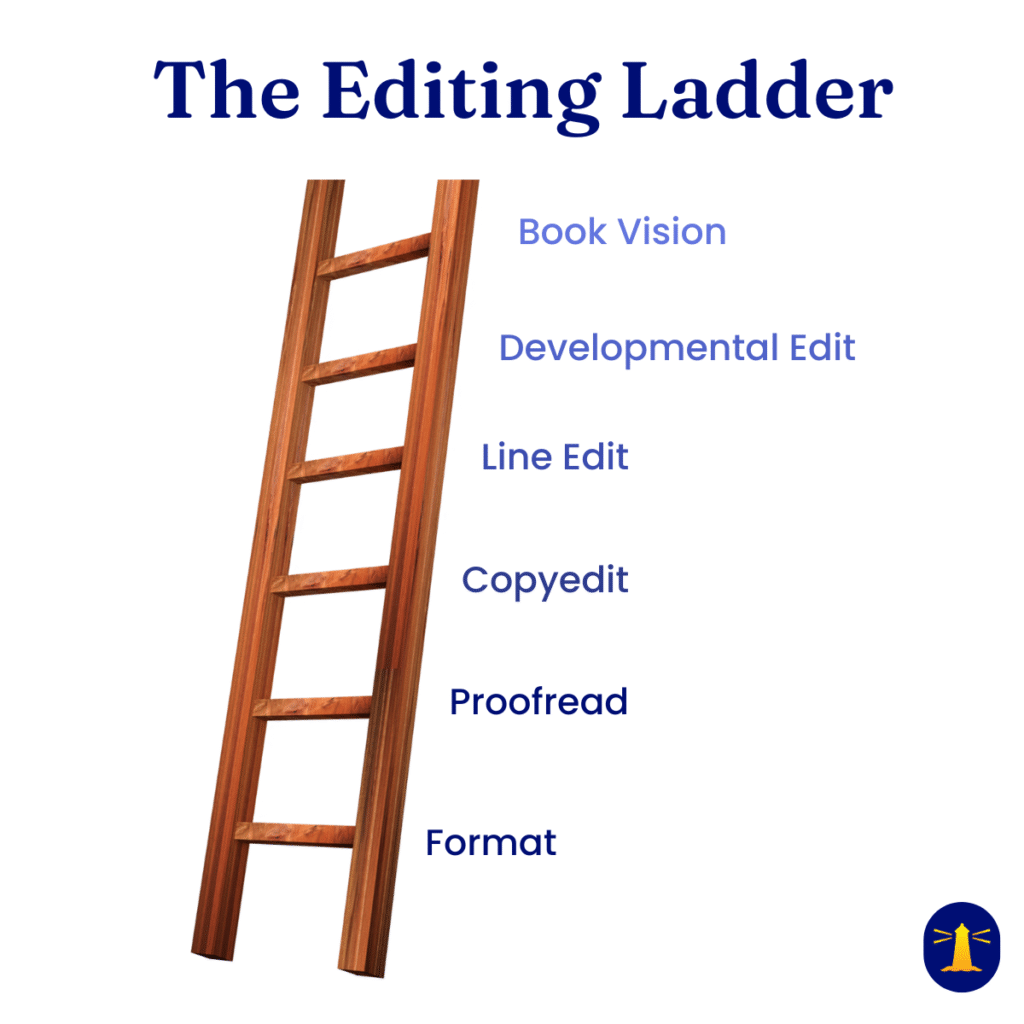
But business writing is in a different realm. Pieces are much shorter, and the rungs also need to be somewhat different to adequately deal with the challenges unique to business writing. A good process still works down the ladder, from larger issues to more granular errors, but most of the rungs are better defined by different terms … because they address different writing issues. The message frame is parallel to a book vision but is much more detailed. A strategic edit is focused on the rhetorical argument and its clarity, not something that’s a typical concern in book publishing. To understand each of these stages and their distinctions, see my post explaining the ladder in more depth. Jeff had a structural edit problem popping up after the entire ladder was already complete. Any writer has emotional trouble making a big change like that when a project is complete.
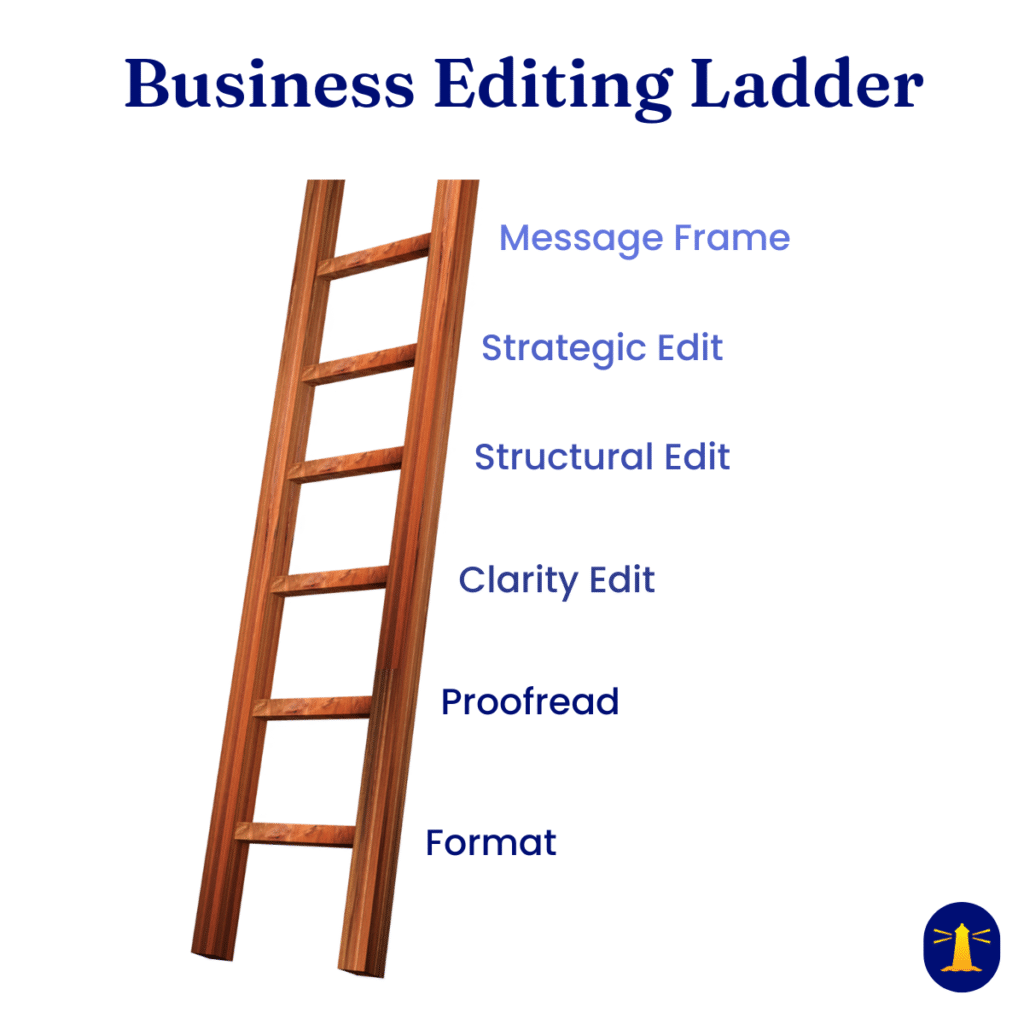
A regulatory white paper isn’t a book. Its structural layer isn’t about pacing or character arc. That layer is about the argument architecture, audience calibration, and document logic: whether each claim is sequenced correctly for a skeptical reader, whether the stakes land before the evidence, whether the recommendation is visible or buried. Those are different skills with different vocabulary, and the book publishing ladder doesn’t have the vocabulary for those needs.
Jeff’s editor wasn’t wrong about his argument assuming too much, but she did assume Jeff’s writing skill was up to restructuring his white paper. But Jeff didn’t have a background in rhetoric and argumentation, claims and evidence, or the various choices to correct his situation.
Here’s what a solution could look like in Jeff’s case. Minimally, “Establish stakes earlier” could mean just one new sentence as the second sentence in section two, something like: “The regulation matters here because non-compliance exposes the firm’s clients to three specific risks.” But if the risks were not obvious to the audience, Jeff faced a larger task, and an even larger one if he had to explain what non-compliance would look like, or what additional resources would be needed to accomplish compliance. That’s a rewrite, figuring out how to more clearly define the problem before proposing solutions, or even diving into solution criteria. Those are two completely different interventions. One takes ten minutes. The other takes a day or more. And only Jeff can really make the judgment call, understanding his audience in depth. Knowing which one the white paper structure actually needs is the judgment call, and it’s not a sentence-level judgment.
Jeff’s problem isn’t unusual at all. Failing to fully understand a problem, much less explaining the problem in writeups, is the most common thinking error humans make. If people make the error all the time, extending the error in writing about the problem is almost a given.
Jeff’s Real Editorial Need
What Jeff needed was a pause at the top of the ladder at rung two before he spent money on “editing.” I would have recommended a Strategic Editorial Diagnostic before he worried about word choices and grammar. This is a structured review and a discussion, typically 60 to 90 minutes, where I discuss the document and the needs it is meeting with my client. Together, we name what’s happening structurally, how it aligns with the message frame, and map two or three concrete writing paths forward. If this step is done early in a white paper-writing effort, it will be planning rather than a rewrite. It won’t be an additional editing contract. Instead, Jeff will have a clear picture that enable faster writing as well as faster editing later in the process.
For Jeff, in the midst of his dilemma, the experience would first feel like setting up a contract that had more clear tasking than “Is this ready to send?”, then to share his paper and his understanding of the writing need to an editor who understood supporting business writers specifically. A day later, we’d meet virtually and spend an hour working through what “establish stakes earlier” actually required in this specific document. Does it mean a new opening paragraph? A reframed section header? A single sentence added to the introduction that does the work the rest of section two can’t do alone? Those different interventions have different downstream consequences. Naming which one fits is judgment work, not sentence work. After that, Jeff would get a writeup about the issues we discussed, solutions we discussed, and as appropriate an edited manuscript back. The diagnostic would cost $350.
That’s what Jeff was missing. Not more editing. A different understanding of what he needed and a map.
How Jeff Could Have Done This Differently
As Jeff was hiring an editor for his high-stakes business document, the most useful aspect would have been to more carefully scope the editing job with an understanding of Jeff’s needs and the document’s needs. Not just an assumed understanding but actual engagement in advance of a finalized tasking. Either the editor or Jeff needed to address likely scope gaps, such as: what happens if the feedback surfaces something structural? Does this job scope include a conversation about how to address it, or just the notes themselves? How would scope changes be handled? What are the complete set of needs here?
Most editors will tell you honestly. Some will offer a follow-up session. Some won’t, which is a legitimate business decision, not a failure of care. What matters is that you know going in whether you’re buying notes or buying a path forward.
A Strategic Editorial Diagnostic can also be the right first step before you hire an editor at all. If you’re not certain your argument holds, or how strong your argument is, a pre-editing judgment session is cheaper than paying for a line edit on a document that needs structural work first. That’s not a knock on line editors. It’s sequencing.
If You’re In Jeff’s Situation Right Now
You received feedback you believe. But you can’t act on it, and that deadline can’t move. That’s exactly what a Strategic Editorial Diagnostic is for. Bring the document, bring the notes, and we’ll work out what the path forward actually looks like.
Keep the Key Points Close
If Jeff’s situation sounds familiar, you might want to download:
Where Did Your Reader Get Lost? A Two-Part Writing Diagnostic
This guide helps you identify where your writing stops working for your reader, before it goes out. If you’ve revised the same document more than twice and still can’t say why it isn’t landing, the next step isn’t another round of editing.
👉 Where Did Your Reader Get Lost? (in the Freebie Library)
Curious About Working Together?
You have feedback you believe. You just can’t get from the note to the page. That’s exactly the situation the Strategic Editorial Diagnostic is built for.
Start with the Strategic Editorial Diagnostic
Pricing is by document length, starting at $175, with no future commitment required. You’ll get one focused conversation about your document, your reader, and what’s standing between them.
👉 Strategic Editorial Diagnostic

Thanks for reading — here’s to clearer writing and stronger ideas.
~~ Susan
Frequently Asked Questions About the Strategic Editorial Diagnostic
An editor works on your document. A Strategic Editorial Diagnostic works on your understanding of what the document needs. If you already have editor feedback and can’t act on it, more editing won’t solve that. The Diagnostic gives you a clear picture of the structural situation and two or three concrete paths forward. You leave knowing what to do next, which is different from having a cleaner draft.
A focused 60-to-90-minute conversation about your document, your reader, and what’s standing between them. After the session, you receive a written summary of what we discussed: the structural issues identified, the options we mapped, and the recommended next step. No tracked changes. No rewrite. A map.
Yes. The Diagnostic isn’t limited to work I’ve edited. If you have professional feedback you trust but can’t execute, that’s exactly the situation it’s designed for. Bring the document and the notes, and we’ll work through what the feedback is actually asking for and what fixing it requires.
Often it’s the better time to do a Diagnostic. If you’re not certain your argument holds before you hire an editor, a pre-editing Diagnostic is cheaper than paying for a line edit on a document that needs structural work first. It’s sequencing: identify the right problem before spending money on the wrong solution.
You can, and if your editor offers that, take it. But most editing engagements don’t include open-ended structural consultation after delivery, and the kind of question Jeff needed to ask wasn’t a quick clarification. It was a 90-minute conversation about argument architecture. That’s a different service, and it’s worth knowing it exists before you assume your only options are to figure it out alone or start over.