
You can be a strong writer and still miss what is off in your own draft. In fact, your strength often makes the miss harder to see.
When sentences come easily, strong writers start trusting the whole document more than it deserves. They assume one more pass will fix it. They treat editing like cleanup. Most of the time, the real issue is not grammar. It’s judgment.
That is the tension behind why strong writers often avoid editors. Not because they’re careless, and not because they can’t write, but because their habits have worked well enough to earn their trust.
that’s exactly why this post is worth reading.
Writing Strength Hides the Very Problems Editors Catch
If you write well, your draft usually sounds competent early. That is helpful, but it can also cover the places where the document stops doing its job.
A fluent draft creates a false sense of stability. The sentences move. The tone sounds assured. The page looks finished.
But smooth writing can hide thin reasoning, weak sequence, and claims that do not carry enough support. A document can read well and still fail with the reader who matters. That happens all the time in proposals, white papers, and executive summaries. The language sounds smart. The argument does not land.
Think of it like good lighting in a room. It flatters everything. It doesn’t tell you whether the floor is level.
Self-editing cannot create distance
You can improve wording in your own draft. You can tighten a paragraph. You can catch repetition. What no one can do, at least not fully, is step outside our own assumptions.
That missing distance matters more than most writers want to admit. You know what you meant. You know why paragraph four comes before paragraph five. You know the context behind the sentence that now looks too compressed for anyone else to follow.
An editor sees what the strong writer no longer notices. Not because the editor is smarter than they are, but because the editor isn’t trapped inside the draft’s original logic.
Good judgment in writing can turn into overtrust
If your writing has served you well for years, trust in your own judgment feels earned. And it is earned! That’s why this problem is so common among capable writers.
You don’t skip help because you think editing is useless. You skip it because your past results suggest that your draft is probably close enough. That belief sounds reasonable. It often feels efficient, yet it’s also the point where skill starts protecting the wrong thing.
Strong writing is not proof that the draft is finished.
What Capable Writers Tell Themselves
Most resistance to editing doesn’t sound dramatic. It sounds practical, and that’s what makes it persuasive.
I only need a polish, not a real edit
This is one of the clearest answers to the question of why strong writers avoid editors. If you think editing means fixing typos, smoothing a few lines, and cleaning up punctuation, then of course a full editorial read feels excessive.
But editing in business writing is often about structure, logic, pace, tone, transitions, and fit for the reader. A polished document can still wander. If you’ve ever wondered why clean copy still isn’t landing, this post names the reason. And a polished document can still bury the point or ask a busy reader to do too much interpretive work.
Surface cleanup is useful. It’s not the same thing as making the document work.
I know my audience, so the draft already makes sense
I expect you do know your audience. You know their pressures, their language, their constraints, and the subject itself. That knowledge matters. Yet it also creates a problem. Familiarity with the material can make gaps look smaller than they are. You fill in missing steps without realizing it. You compress background that the reader still needs. That’s not a writing weakness. It’s a proximity problem. You assume a sentence is clear because it’s clear to you. Knowing the field is not the same thing as guiding a reader through the document. One is expertise. The other is reader management.
An editor would slow me down or take over
This concern is common, and it’s not irrational. Plenty of writers have seen edits that flatten voice or push a draft in a direction they never wanted.
Good editorial help is different, though. In strong business editing, the work is not ghostwriting and not a takeover. It’s thinking with you. It’s someone reading for argument, evidence, audience fit, and the places where the document slips out of alignment. The right editor doesn’t replace your expert thinking. The right editor makes your thinking easier for other people to trust.
The Real Cost Shows Up Later
Most editorial blind spots do not produce a spectacular failure. They produce a quieter loss. The document goes out. Nobody throws it back. But it does less than it should.
Your message can sound smarter than it actually is
Strong prose can create the impression of substance even when the underlying logic is thin. That’s dangerous in professional writing because the reader may feel briefly impressed and still finish unsure what you want them to believe, approve, fund, or do.
This is common in consulting reports and service descriptions. The language performs competence while the structure doesn’t carry the point far enough. By the end, the reader has a general sense that you know your material but not a clean grasp of the claim. That’s not a style problem; it’s a decision problem.
A consultant sends a capability statement to a prospective client. The writing is clean. The credentials are real. But the document leads with the consultant’s background rather than the client’s problem, buries the specific offer on page two, and never names what the engagement would actually produce. The prospective client reads it, feels generally impressed, and moves on. Nobody said the writing was bad. The document just didn’t do its job.
Small gaps in logic can become big credibility problems
Missing context, unsupported claims, fuzzy sequence, and abrupt transitions do not always look dramatic on the page. They still weaken trust.
In a proposal, one skipped step can make your budget sound less grounded. In a board memo, one weak sequence can make sound judgment look rushed. In an executive-facing document, tonal drift can signal that you don’t fully understand the room.
Readers rarely announce these reactions. They simply become less confident in the document. That is the kind of damage strong writers often underestimate because the draft still feels polished.
You may spend more time fixing late-stage problems than you would have spent getting the right help early
When you skip an outside read, the work doesn’t vanish. It reappears later, often under pressure. You revise after confused feedback. You rewrite whole sections after a stakeholder meeting. Or patch tone problems after the document has already circulated. Basically, you spend hours trying to solve a problem that should have been named much earlier.
For independent professionals and small business writers, that’s not only frustrating, it’s expensive. Time goes where judgment should have gone first.
Why a Diagnostic Is Not the Same as Hiring an Editor
Sometimes you don’t need an edit yet. You need a clean read on what kind of problem the document has. That’s what a Strategic Diagnostic is for. It’s a pre-edit judgment read for business professionals who write their own high-stakes documents. The point is not to mark every sentence. The point is to assess what’s working, what isn’t, and what the next move should be.
That kind of read has value when it comes from real editorial judgment. At Future Perfect Services, that judgment is shaped by Dr. Susan Grant’s background in organizational communication and decades of high-level government and intelligence-community writing and editing. If you’re not sure what that kind of editorial help actually looks like, this post explains it. The value isn’t markup; the value is informed assessment.
You get a diagnosis before you commit to the full edit
A diagnostic tells you whether the problem is structure, argument, evidence, tone, audience fit, or something else. That matters because different problems need different fixes.
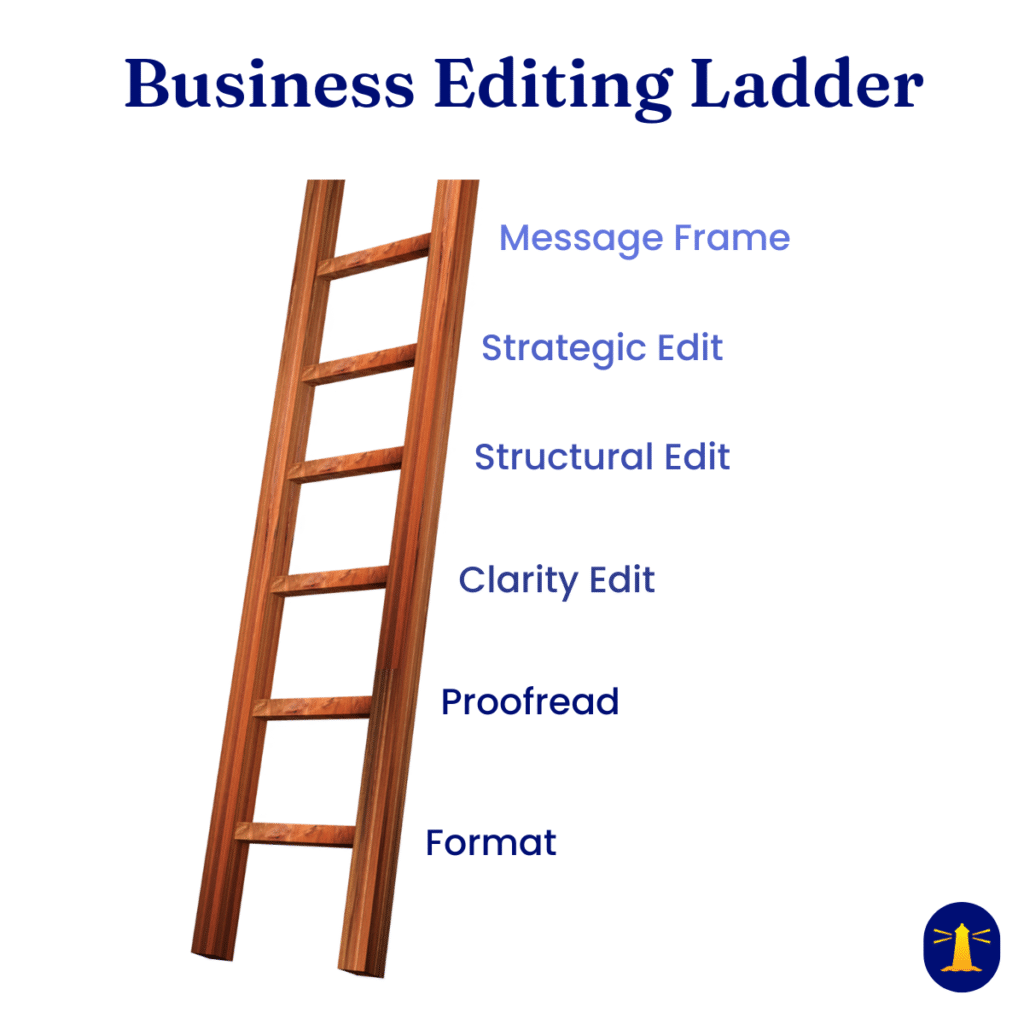
If you choose the wrong intervention, you can spend money and time without solving the real issue. A proofread won’t fix a weak sequence. A line edit won’t solve an unclear ask. Sometimes the problem isn’t the editing level; it’s the intervention type. A heavier edit may be unnecessary if the draft mainly needs re-framing.
This is why a pre-edit read is useful. It names the problem before you commit to the remedy.
The right outside read protects your voice; it doesn’t replace it
This matters if you’ve been hesitant to ask for help. You’re not handing over the document to be rewritten by someone else. You’re getting a serious read from someone who can tell the difference between a sentence problem and a thinking problem. In strong business editing, that distinction is everything. The goal isn’t to make the document sound like the editor. The goal is to help the document say what you mean, in a way the reader can follow and trust.
That’s why getting a read often feels lower-threat than hiring an editor. It gives you clarity without asking for a full commitment.
say what you mean.
This is the best fit when you know something is off but can’t name it
That feeling is common. “I know what I mean, but something isn’t working” is not a small complaint. It is the whole reason this kind of service exists.
It fits documents like proposals, white papers, consulting reports, executive summaries, board memos, policy briefs, grant narratives, strategic plans, capability statements, and client-facing reports. It’s fast and focused. It doesn’t require a future commitment. If you’d like to see the full range of editing support available, here are the small business editing services.
If you’re at “something isn’t working” or have a doubt that you’ve built the strongest possible message, Request a Strategic Editorial Diagnostic.
If you’re waiting until you can explain what is wrong with the draft, you may be waiting for the very thing you need help identifying. If you could already name the problem clearly, you probably wouldn’t need the read.
Your Skill Isn’t the Problem But Your Certainty Might Be
Your expertise and writing skill are often the reason the blind spot stays hidden. The cleaner the prose, the easier it is to miss the places where the document loses force, sequence, or reader trust.
Editing isn’t a last-minute polish for weak writers. It’s a judgment check for capable ones. If you have a document that feels close but not right, get a read on it before you keep revising in circles. If you already know the document matters, the better move is to stop guessing and get a clear read.
Keep the Key Points Close
If this post resonated, you might want to download:
Where Did Your Reader Get Lost? A Two-Part Writing Diagnostic
This guide helps you identify where your writing stops working for your reader, before it goes out. If you’ve revised the same document more than twice and still can’t say why it isn’t landing, the next step isn’t another round of editing.
👉 Where Did Your Reader Get Lost? (in the Freebie Library)
Curious About Working Together?
If someone you respect has already told you your writing needs work, that’s enough of a starting point.
Start with the Strategic Editorial Diagnostic
Pricing is by document length, starting at $175, with no future commitment required. You’ll get one focused conversation about your document, your reader, and what’s standing between them.
👉 Strategic Editorial Diagnostic

Thanks for reading — here’s to clearer writing and stronger ideas.
~~ Susan
Frequently Asked Questions About Strategic Editorial Diagnoses
Proposals, white papers, consulting reports, executive summaries, board memos, policy briefs, grant narratives, strategic plans, capability statements, service descriptions, and client-facing reports. If you wrote it yourself and the stakes are real, it qualifies. Fiction and marketing copy are outside scope.
Pricing is by document length, starting at $175. The fee includes a written assessment and a conversation to work through the findings together. No future commitment is required.
A complete draft produces the most useful read. A nearly complete draft works well, too. If the document is still in outline form, the Diagnostic isn’t the right tool yet.
A written summary of the read: what’s working, what isn’t, what kind of problem the document has, and what the most useful next step would be. Not a marked-up document. A clear-headed assessment you can act on.
Both of those activities are a full restructuring engagement. The Diagnostic is a single read that names the problem and identifies what kind of help would serve it best with no further obligation from you.