If your writing is unclear and you can’t figure out how to fix it, the instinct is to revise again. That’s usually the wrong move. As an editor, I’ve asked this question more times than I can count: “What’s the main argument here?”
The silence that follows is always the same. Not because the writer doesn’t know their subject. They know it well. The silence is shock that a trusted reader can’t see the point that the writer worked so hard to say. The resignation. That main point felt so obvious when they were writing, and then it’s suddenly, blindingly clear that the point was never really stated plainly. And my writer has that sinking feeling of Back to the drawing board while I watch closely for any signs of unhelpful self-criticism or unwarranted despair.
Because this situation is nearly universal for EVERY … SINGLE … WRITER … ALWAYS. Including me.
When you’ve been inside a piece long enough, you stop reading what’s on the page. You read what you meant to put there. The gap between those two things is invisible to you and completely visible to your reader.
This is why you can revise the same piece four times and still feel like something’s off. You’re not failing at writing. You’re failing at distance. And distance isn’t something you can manufacture alone.
Key Takeaways
- Every writer is too close to their own work to read it the way a stranger will. That’s not a flaw. It’s how the mind works with material it already knows.
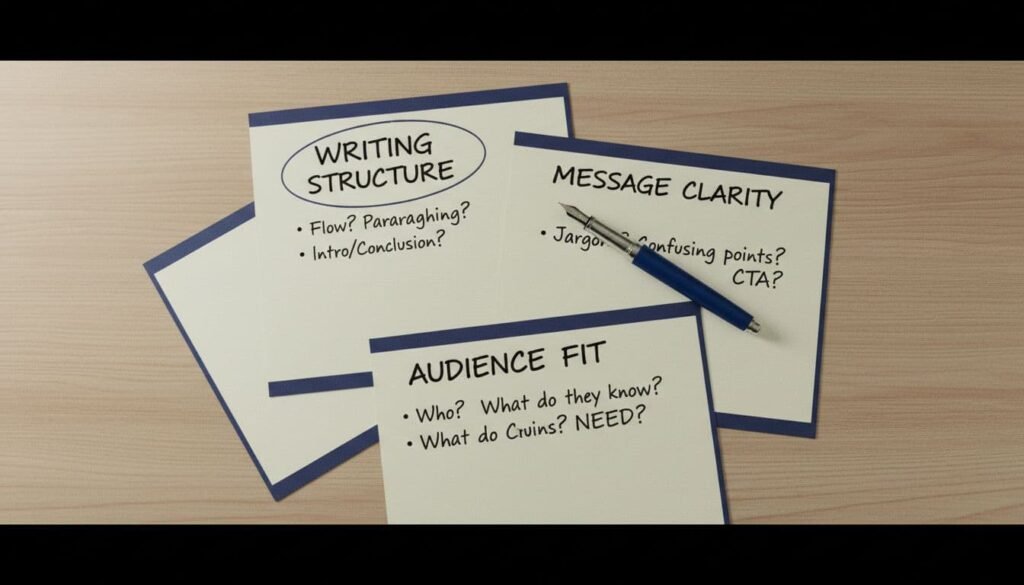
- When revision isn’t working, the problem is usually upstream of the sentences: the argument isn’t clear, the structure doesn’t hold, or the piece is aimed at the wrong reader.
- The documents with the highest stakes (proposals, service pages, client reports) are almost never the ones that get an outside read before they go out.
- If you can’t name what’s wrong after multiple revisions, more editing isn’t the next step. A diagnostic is.
- This kind of pre-editing judgment work exists. It hasn’t historically been priced for independent professionals and small business owners. Now it is.
Estimated reading time: 11 minutes
Your Draft Makes Perfect Sense to You. That’s the Problem.
This isn’t a beginner problem. Every published book ends with an acknowledgment thanking an editor. Not as a formality. Because even the most accomplished, experienced writers can’t read their own work the way a fresh reader will. Nobody sits down to write a wandering document. Nobody thinks their main point is buried. Nobody decides to write for the wrong reader.
It happens because writing follows thinking, and your thinking already knows where it’s going. The shortcuts feel like clarity. The assumptions feel like common ground. The structure follows the order in which you learned things, which is almost never the order your reader needs them.
I see this with experienced writers as often as with beginners. A consultant who has given the same pitch a hundred times writes a services page that assumes the reader already understands the problem. A researcher who knows their field writes a report that buries the finding on page four because the context felt essential. A business owner writes their About page as a chronological history because that’s how the story happened, not how the reader needs to receive it.
The writing isn’t bad. The distance is missing.
More revision can make the draft feel tighter, but not stronger
You can spend hours trimming, rearranging, and swapping words to achieve concise language. The draft may get shorter. It may even get cleaner. When revision isn’t fixing your writing, the problem is usually upstream of the sentences.
That’s a common pattern, and it’s useful because it tells you something. Effort isn’t the missing piece. The wrong kind of fix is. If you’re wondering why copyediting keeps falling short, that’s worth understanding before you hire anyone.
Think of it like straightening picture frames in a room with the wrong floor plan. The details may look better, but the space still doesn’t work. Writing works the same way. If the message, structure, or audience fit is off, more revision often gives you a neater version of the same problem.
My Writing Is Unclear: How to Fix the Right Problem
A draft can sound smooth and still leave your reader unsure what you mean. The grammar may be fine. The rhythm may be fine. Yet the idea itself stays cloudy. A clean sentence can still carry a muddy thought. When that’s the problem, line-by-line editing won’t fix it. The confusion started before the sentence level.
From my side of the desk, I don’t start with commas. I start by asking what the piece is trying to do, who it’s for, and whether the draft supports that job. There’s a practical version of that check you can run yourself before you bring in outside help.
Here’s a quick way to sort the problem before you spend money on editing:
| What you notice | What’s likely wrong | What helps first |
|---|---|---|
| The draft says many things, but no clear central theme emerges | Message problem | Get outside eyes on the argument before you revise further |
| The piece repeats itself or wanders | Structure problem | Have someone map what they think the order is before you reorder it |
| The writing sounds polished, but not persuasive | Audience-fit problem | Ask a real reader from your target audience what they took away |
| You can’t name what feels off | Diagnosis problem | Stop revising. Get a diagnostic before you spend more time or money |
The short version is simple: if you can’t tell what kind of problem you have, revisions become guesswork.
The Signs You Need a Diagnostic Before You Pay For More Editing
Good editing improves expression. If your writing is unclear and you can’t name why, that’s the signal. It doesn’t change who the draft is speaking to. And it can’t tell you which problem you have. That’s what a diagnostic does.
If you’re trying to decide between hiring an editor and stepping back first, look at your pattern, not just your draft. Not sure which situation you’re in? This post walks through the readiness question directly. Identifying that pattern is key to getting unstuck, and repeated frustration usually tells the truth faster than one sentence ever will.
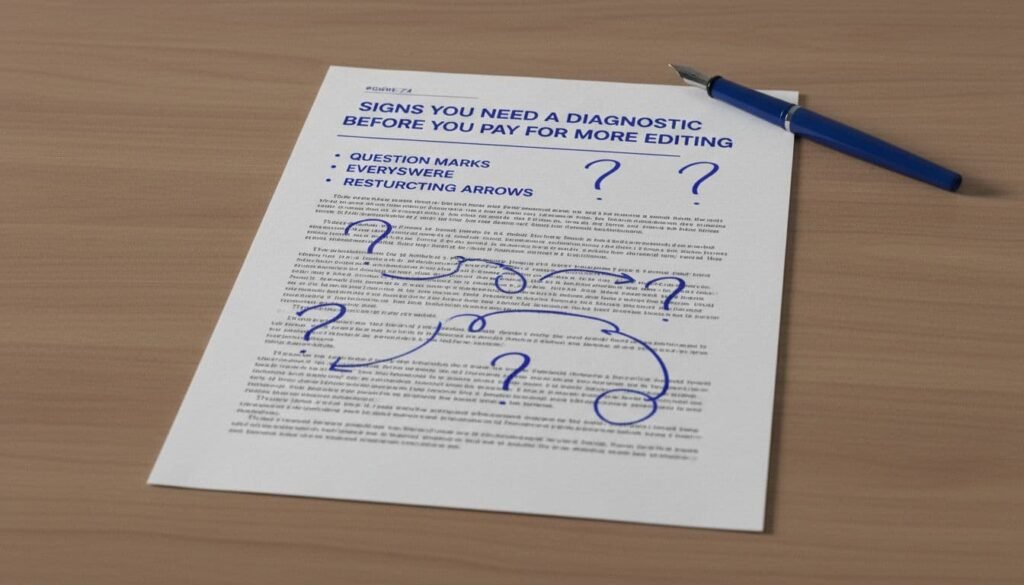
The signal isn’t one frustrating draft. It’s a pattern. You’ve revised the same piece multiple times and still can’t say what’s wrong. You’ve hired an editor or asked a colleague and the feedback didn’t fix it. You keep adjusting surface details because you can’t point to the real failure.
When that’s your pattern, stop revising, and don’t pay a copyeditor for help. Get a clear read on what’s actually broken. That’s what a diagnostic does: it names the problem before you spend more time or money treating the wrong one.
You keep asking for polish, but what you really need is direction
If you need help deciding what belongs, what leads, what can go, and what the piece is trying to do, you’re not asking to simply edit your writing. You’re asking for informed judgment.
That kind of help looks different. It means someone reads for the draft’s core decisions, not only its wording. They tell you where the point goes soft, where the order breaks down, and where the reader’s needs get missed. That saves time because you stop spending money polishing sections that may not survive the rewrite. And this is not a service you typically find.
You need a Strategic Diagnostic.
If the pattern sounds familiar, the next step isn’t another round of revision. It’s a clear read on what’s actually broken.
The Strategic Diagnostic is a focused review of your document’s core decisions: what the piece is trying to do, whether the structure supports it, and what needs to change before editing can help. You get a written assessment and a conversation to work through it.
Pricing is by document length, starting at $175, and it replaces the expensive cycle of editing too early. Start with the Strategic Diagnostic
Your Most Important Business Documents Never Had an Editor
The proposal you write from scratch every time, still not sure why some land and some don’t. The services page you’ve rewritten twice and still doesn’t quite say what you mean. The client-facing report that takes longer than it should because you can never tell if it’s clear until after it’s already out.
These are your highest-stakes documents. They almost never see an editor before they go out. Not because you don’t care about them. Because sending a business document to an editor before it goes out isn’t something most independent professionals think to do. You did your best. You trusted your education, your instincts, and your knowledge of your own work.
That gets you further than most people realize. And not quite as far as you need.
The professionals who offer this kind of pre-editing diagnostic work typically serve large organizations with communications departments. It has never been priced or built for the person doing this work alone.
This kind of help exists. And it doesn’t have to cost a fortune.
Frequently Asked Questions About Editing vs. Writing Diagnosis
Editing works on the writing. A diagnostic works on the decisions behind the writing: whether the argument is clear, whether the structure holds, whether the piece is aimed at the right reader. You do the diagnostic first so the editing, if you need it, is working on the right problem.
If you can describe what’s wrong, you probably need an edit. If you’ve revised the same piece multiple times and still can’t say why it isn’t working, start with a diagnostic.
No. A two-page proposal with the wrong argument is a bigger problem than a ten-page report with clear structure. Length isn’t the deciding factor. Stakes and clarity are.
You get a written assessment of what’s broken and what kind of help comes next. Sometimes that’s a structural revision you handle yourself. Sometimes it leads to a line edit. Either way you’re not guessing anymore.
Yes, specifically. The professionals who have historically offered this kind of pre-editing judgment work serve large organizations with communications departments. The Strategic Diagnostic is priced and scoped for the person doing this work alone.
When Good Enough Isn’t Getting You There
The problem with most writing advice is that it assumes you already know what kind of problem you have. Fix your sentences. Tighten your structure. Know your audience.
Good advice, if you can see clearly enough to apply it. Most writers can’t, not because they’re not good at their work, but because they’re too close to it. The same knowledge that makes you an expert in your field is exactly what makes your own writing hard to read with a stranger’s eyes.
That’s not a flaw. That’s how the human mind works with material it already knows.
The documents that suffer most from this gap aren’t manuscripts. They’re the proposals, the service pages, the client reports. The things you write alone and send out hoping they’ll bring in business for you. The ones where you did your best, trusted your instincts, and still don’t seem to quite be working.
If that’s where you are, the next step isn’t more editing. It’s knowing what’s actually broken first.
A Tool for Your Next Draft
f this post named something you’ve been feeling about a document you’re working on, this one-page reference gives you a structured way to look at it before you revise again or hire anyone.
Where Did Your Reader Get Lost? A Three-Level Editing Diagnosis
A one-page guide to naming surface, structure, and message problems in your own writing before they cost you time or money.
While you’re at the Freebie Library, grab the April 2026 calendar. It’s free, and it has a few things on it worth knowing about.
👉 Download the Reference (in the Freebie Library)
Ready for a Clear Read?
If you’ve revised the same document more than twice and still can’t say why it isn’t working, the next step isn’t another round of editing.
Start with the Strategic Diagnostic
Pricing is by document length, starting at $175, with no future commitment required. You’ll get a written assessment plus a conversation to work through it.

Thanks for reading — here’s to clearer writing and stronger ideas.
~~ Susan