This week I’ve been pondering the well-structured paragraph. When I am revising AI-generated text into a human way of writing, there’s more to the work than just pushing sentences together into larger groups. Good paragraphs have a silence to them that mark their proper ending place.
The proper ending is not marked by white space. Nor is it visual breathing room. A good-feeling paragraph is more functional than that. It’s a reader arriving at the end of a paragraph and feeling, without quite knowing why, that something has been completed. A unit of thought has closed. The next one is about to open.
That’s not aesthetics. That’s thought architecture. John Warriner and Frances Griffith put it plainly in English Grammar and Composition, first published in 1951 and still on my shelf: “A paragraph is a series of sentences developing one topic.” That’s it. One topic, developed, in sequence, until it closes.
Warriner and Griffith were describing expository writing specifically. The rules don’t apply to narrative prose, personal essays, or news writing, each of which operates by different structural logic. But for the kind of writing most professionals produce, specifically reports, proposals, white papers, analysis, business communication, that definition is still the operating standard.
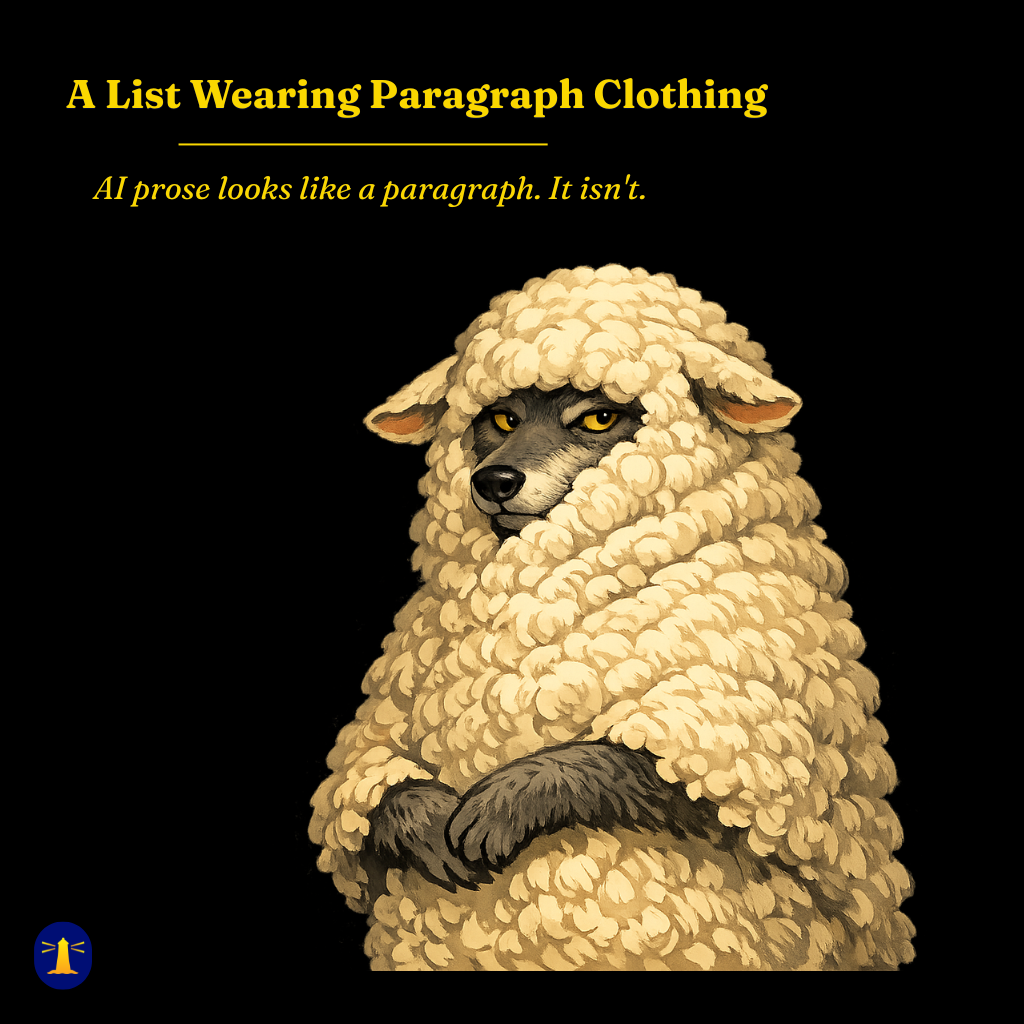
Notice what that rules out. One sentence is not a paragraph. It’s a sentence. Calling it a paragraph is a category error, not a stylistic choice. And a group of sentences that don’t develop a shared topic aren’t a paragraph either. They’re a list wearing paragraph clothing.
As I think back to my training, I am reminded that the paragraph is a meaning system. It has always been. Paragraphs can be diagrammed the same way that sentences can be diagrammed, but with different jargon. The way sentences accumulate, turn, and close inside a paragraph signals the shape of an idea. Readers learn this system through exposure, not instruction. Exposure to writing that creates thought architectures correctly. And readers rely on the system, without consciously knowing they do, every time they read.
AI writing has broken that system. And it took me quite a bit of rewriting AI-influenced text to see it. AI broke this unwritten contract between writer and reader in the way of a slow, quiet flood: so gradually that most people haven’t named the damage. They’ve only felt it. This post is an attempt to name it precisely, for writers and editors who already sense something has gone wrong but haven’t had the vocabulary to say what.
Key Takeaways
- AI-generated prose often breaks paragraph structure by grouping sentences near each other without building a full unit of thought.
- Strong paragraphs do more than create white space. They develop, turn, and close an idea so readers feel a sense of completion.
- The main weakness in AI-assisted writing is often structural, not factual, because sentences may sound clear while the paragraph carries little weight.
- Short paragraphs are not the problem by themselves, because effective brief prose still carries meaning, pressure, and internal movement.
- Writers and editors should review AI-assisted drafts at the paragraph level first, checking whether each paragraph completes its job before moving on.
Estimated reading time: 15 minutes
What AI Prose Actually Does
You’ve probably read something recently that felt oddly unsatisfying, and you couldn’t quite say why. The sentences were fine. The information was there. But something wasn’t landing. There’s a good chance the problem was the paragraph.
The signature of AI-generated writing isn’t the hallucinations or the occasional wrong fact. Those are easy to catch. What persists even in well-prompted, carefully reviewed AI output is structural: the paragraph that isn’t really one.
AI style defaults to brevity by proximity. Two or three sentences, then a line break. Two more sentences, then another. It reads quickly. It looks clean on the screen. It doesn’t feel thin … until you try to consolidate it.
Take a set of AI-generated paragraphs and push them together the way a traditional editor would. What you get isn’t a richer paragraph. What you get is the exposure of the architecture underneath: there isn’t one. The sentences were adjacent, not related. They didn’t accumulate toward anything. They listed. That’s the tell for me.
Warriner and Griffith gave this demonstration a name. Here it is applied to the kind of writing most professionals produce today.
Paragraph Lacking Sufficient Development
Clear communication is the difference between a prospect who understands your offer and one who clicks away. Clear communication matters for every business. When you communicate clearly, customers understand you better. Good communication helps build trust. Businesses that communicate well are more successful than businesses that don’t communicate well.
Adequately Developed Paragraph
Clear communication is the difference between a prospect who understands your offer and one who clicks away. A service description that leads with what the client gets, rather than what you do, answers the question every reader brings to the page: is this for me? When the answer is visible in the first two sentences, the reader stays. When it’s buried under background, credentials, or process detail, most readers are already gone before they find it.
The first paragraph announces the same idea five times. The second one develops a single claim through a specific reader scenario and closes with a consequence. Same opening sentence. Completely different paragraph. That’s not a trick of wording. That’s architecture.
Human prose, at its best, doesn’t list. It turns. A paragraph begins somewhere and moves. It introduces a complexity, complicates it, and resolves it, even if that resolution is only provisional. You sense this movement as a reader even when you can’t describe it. There’s a forward pressure to good prose, something that pulls you through a paragraph not because the sentences are punchy but because the idea isn’t finished yet.
AI prose doesn’t create that pressure. It creates the appearance of forward motion through sheer accumulation, one announcement after the next, until the piece ends.
This is how clarity lives differently in different prose. AI fragmentation mimics simplicity without delivering it. The white space looks like breathing room. What it actually conceals is the absence of a paragraph doing its job.
The Exceptions That Sharpen the Distinction
This is the part where someone always reaches for Hemingway.
Fair. He’s relevant. (See what I did there?)
Hemingway’s sentences are short. His paragraphs are often brief. And yet no one reads Hemingway and thinks “thin.” Because Hemingway’s brevity is not absence. It is compression. Every short sentence is carrying load. Every spare word is the product of decisions about what to take out. The brevity is the result of more work, not less. Hemingway’s visual style doesn’t equate to thin meaning.
The same holds for other styles that resemble AI prose at a glance. Military and intelligence writing is concise by design. Executive briefings are direct because high-stakes decision-makers need signal before they get context. Good business writing strips the hedge and gets to the claim. In each case, the compression is the result of having more to say than space allows, not less. Even the paragraphs are blocks instead of indented novel-style shapes.
Neither military nor business writing are AI style even when they look like it on a page. The difference is load. In Hemingway, in a well-written executive brief, in strong military prose, every sentence is weight-bearing. Pull one out and the structure shows the gap. In AI prose, you can remove a paragraph and the surrounding text closes over it like water. Nothing changes. Nothing was there.
That’s not compression. Rather, that is the absence of architecture. And readers feel it, even the ones who can’t say why.
Why Readers Feel It Before They Can Name It
What readers actually notice
Two weeks ago, JoAnne Dyer wrote a LinkedIn post on missing having paragraphs to read. A quick search on “I miss paragraphs” gave me 13 hits in a little over a year. JoAnne got significant engagement, and the replies pretty much said the same thing: yes, me too, I don’t know why, but yes. I didn’t see very much on the argument being missing, or distorted, when paragraphs are chopped up into dramatic haiku. Or when these mini-paragraphs start with a non-specific pronoun (pet peeve).
JoAnne was responding to something real. Paragraphing is a learned signal. Readers who have read widely absorb the paragraph as a unit of thought. When the unit breaks down, when the white space arrives before the idea has been completed, those readers register a disruption. Not always consciously. Often just as a vague sense that the writing is not quite doing what it should. They keep reading. They finish the piece. But they close the tab with a faint, unexamined dissatisfaction they may attribute to the topic, or the argument, or the writer’s credibility, when what actually happened is that the structure never landed.
What the research inverts
Here’s the part that inverts the assumption underlying most AI-style writing. Research on text cohesion suggests skilled readers actually learn more from less cohesive text. The less cohesive text forces them to do cognitive work, to make connections, to build the architecture the writer left implicit. Less skilled readers, by contrast, need more cohesion. They need the structure to be visible.
What AI prose offers neither group is the actual thing. Not true concision. Not true cohesion. A simulation of both, with the cost hidden in plain sight. The skilled reader gets structure that looks familiar but has no depth to explore. The less skilled reader gets white space that resembles clarity but doesn’t deliver it. Nobody wins. Fragmentation tricks everyone, including the writer. Especially the writer, who often feels, watching the paragraphs stack up cleanly on the screen, that the thinking is further along than it is.

What active editing reveals
I learned to paragraph in a high school English class that probably no longer exists in its original form. Diagramming sentences. Tracking the main clause. Understanding that a paragraph has a job, and that the job ends before you start another one.
That training is still bearing fruit, very directly, in a manuscript I’m editing right now: a memoir where the prose was partially drafted with AI assistance, and where the paragraphing is the primary structural problem. Not the word choice. Not the sentence rhythm. The paragraphs. Ideas begin, gesture at themselves, and stop before they’ve resolved anything. The white space arrives like punctuation, but what it’s punctuating is sometimes unclear. My editing work is less correction than it is reconstruction, finding the thought that was trying to form and helping it finish within the same written space. And some chapters are glorious in their paragraph cohesion. I suspect an artifact of AI use varying from the first written chapters to the latest ones.
Nobody maps sentences anymore. Nobody enjoys mapping paragraphs and arguments, much. But readers still respond to the architecture, even when they’ve never been taught to name it. The paragraph is an x-ray of meaning. If there’s no structure inside the paragraph, the x-ray shows it. The reader feels the blank, even if they call it something else.
What This Means for Writers and Editors
Paragraphing is a strong feature of writing style. Not a stylistic preference, the way font choice is a preference. A structural choice with real consequences for how your ideas land on a reader.
If you’re writing for audiences who read widely and think carefully, your paragraph structure is part of your argument. Thin paragraphs, AI-style fragmentation, the default pattern of two sentences and a line break: these signal, accurately, that the thinking beneath the surface may not have gone much deeper. Your reader may not be able to name that signal. But they feel it.
If you’re editing AI-assisted work, the paragraph is the first place to look. Not for em dashes. Not for word choice. For whether the unit of thought was completed before the writer moved on. In AI writing, usually the paragraphs end before the thought does. The sentences are serviceable, but the paragraphs are placeholders. That’s the edit.
Writers, bloggers, editors: stop at the paragraph level. Read not just what the sentences say but what the paragraph does. Does it move? Does it accumulate? Does it close?
If the answer is no, then the post, the memo, the report is doing less work than it looks like it’s doing. And in a landscape where AI-assisted prose is becoming the baseline, that gap is widening. The writers and editors who can name it have an advantage. The ones who can fix it have even more.
Revisiting My Deskside Assistant Editor 🐾

My silver tabby, Finnegan, has an opinion about AI-generated prose. It is consistent, deeply felt, and as impatient as a one-year old cat can be. I share the opinion. He gets to nap while I deal with the scatter, reshaping it patiently back into meaning. Finnegan is all focus, these days, but real short on patience.
Finnegan is now bigger than Winnie, our oldest cat, a tawny tabby. When they are in motion we often confuse one for the other. Time has passed so quickly. He’s a big cat now!
Frequently Asked Questions About AI Writing and Paragraph Structure
Push the paragraphs together. Take two or three adjacent AI-generated paragraphs and consolidate them the way you would in a traditional edit. If what you get is a richer, more developed paragraph, the structure was sound. If what you get is a list of announcements with no internal movement, the architecture was missing from the start. That consolidation test is faster and more revealing than reading for grammar or word choice.
Yes, and often in ways that are hard to predict. A draft that moves between heavy AI assistance and more independent writing can shift noticeably between sections, with some paragraphs doing real structural work and others gesturing at ideas without finishing them. The inconsistency itself is a diagnostic signal. If a manuscript feels uneven in ways you can’t quite locate at the sentence level, the paragraph architecture is usually where the variation lives.
When the writer can no longer see where the thought was trying to go. Self-revision at the paragraph level works well when the structure is mostly intact and needs tightening. When ideas start but don’t finish across multiple sections, or when the white space has been doing the work of actual transitions, reconstruction is the job. That’s harder to do on your own work, because you already know what you meant to say. That gap between what you intended and what the paragraph actually does is exactly what an outside editorial eye is for.
The pattern is consistent enough across tools that the specific platform matters less than the prompting and review process behind it. The paragraph architecture problem isn’t a bug in one tool. It’s a structural feature of how most large language models generate text: producing coherent sentences in sequence rather than building a paragraph as a unit of thought. Better prompting can reduce the problem. Longer, more thorough and thoughtful review can catch it. But the tendency toward adjacency over accumulation shows up broadly, which is why editing AI-assisted drafts at the paragraph level is worth doing regardless of which tool produced them.
Partially. A well-constructed prompt can reduce fragmentation and encourage longer, more developed paragraphs. A style guide that specifies paragraph minimums or requires a topic-and-close structure will help a careful writer catch the problem before it reaches an editor. But prompting works at the sentence level more reliably than at the paragraph architecture level, and style guides require the writer to already understand what a complete paragraph does. For drafts where the structural problems run deep, upstream fixes reduce the volume of work. They don’t replace the judgment call about whether each paragraph has actually finished its job.
The Forecast
AI-assisted writing is not going away. The volume of prose produced with AI assistance will increase, the tools will improve, and the sentence-level output will get cleaner. That’s the easy prediction.
The harder one is this: as AI prose becomes the baseline, the paragraph problem gets worse, not better. Cleaner sentences make the structural thinness harder to see. A document that reads smoothly at the line level but carries no real architecture will pass more reviews, reach more readers, and do less work than it appears to. The gap between what the prose looks like and what it actually does will widen quietly, and most writers won’t have the vocabulary to name it.
Readers will feel it before anyone names it. Some already do. Writers are grasping towards this insight as well. The writers who understand paragraph architecture at this level will write prose that stands out without anyone being able to say exactly why. The editors who can diagnose it will be worth considerably more than the ones who can’t. And the documents that get this right, that actually move, accumulate, and close, will earn a reader’s comprehension (both strong and weak readers) in ways that smoothly generated prose won’t.
I’ve seen the pattern, analyzed, and named it because I’ve been doing this kind of reconstruction work directly, in manuscripts where AI assistance created exactly the pattern this post describes. It’s solvable. It takes judgment, not just rules, and it takes an editor who can see the thought that was trying to form and help it finish.
If that’s the problem your draft has, that’s the work I do.
See Where Your Draft Stands
If this post named something you’ve been sensing in your own writing or your clients’ work, the next useful step is scoping the problem before anyone touches a sentence.
The Editing Cost Calculator
This tool provides a free and independent estimate that helps you understand a reasonable cost for your draft and its actual needs, based on document type, condition, and scope. No commitment, no contact form. Just a clearer starting point.
👉 Access the Editing Cost Calculator
When You Need Help Fast
Most editing relationships start with two weeks of setup. Scope conversations. Contracts. File transfers. By the time you’re cleared to go, the deadline has moved.
That’s the part nobody talks about when they recommend “just hire an editor.” The editing itself isn’t the bottleneck. The onboarding is.
Premium Access solves that.
One setup conversation now means you can send the file when the deadline is real, skip the lengthy setup, and get the kind of reconstruction work this post describes, without starting from scratch under pressure.
Only a few clients are active at any given time. If you’re thinking about it, now is a good time to reach out.

Thanks for reading — here’s to clearer writing and stronger ideas.
~~ Susan