I’ve watched this scene play out more times than I can count. The first draft looks “good enough.” The owner hits publish, posts the service description, sends the proposal, or queues the email sequence. The words make sense to them, so they assume the words will make sense to everyone else.
Then the quiet damage starts. Fewer replies. More “just checking in” follow-ups. A prospect asks a basic question that the page already “answered,” except it didn’t, not clearly. Sometimes the tone lands wrong, and the reader feels pushed. Other times the pricing language leaves room for doubt, so the buyer waits.
That pattern is why editing is not a luxury in business communication. It’s risk control and revenue protection. Editing reduces confusion, closes credibility gaps, fixes tone drift, and removes the kind of ambiguity that creates disputes later. It turns “I think this is clear” into “this is hard to misread.”
Editing, in the context of business writing, means improving clarity, tightening structure, calibrating tone, and reducing the kind of ambiguity that causes problems later. It is not primarily about grammar. It’s about making sure the writing does what the writer needs it to do.
Key Takeaways
- Editing is risk control for small business writing because it prevents confusion, tone drift, and costly misunderstandings.
- Clear writing protects credibility because readers assess your judgment by how your words feel on the page.
- Better clarity removes buying friction, which reduces delays, follow-up questions, and stalled decisions.
- Editing reduces rework and scope creep by tightening deliverables, revision terms, and next steps.
Estimated reading time: 15 minutes
Credibility Is The Product. Editing Protects It
 Photo by cottonbro studio
When a business owner publishes anything, they’re not only delivering information. They’re projecting judgment, taste, and follow-through. Even if the client can’t measure those things at first, they can measure what it feels like to read the words.
Target audiences scan fast. They don’t announce it, but they punish friction. If a sentence forces extra effort, readers feel a small spike of doubt. If the structure is muddy, they assume the process will be muddy, too. If a case study rambles, they wonder if the work does, too.
There’s another layer to this that most writing advice skips. When you’re deep inside your own expertise, you really lose the ability to see what a reader won’t understand. The context lives in your head, not on the page. You’ve already answered the question internally, so the sentence feels complete. To the reader, it’s a gap.
This is the stovepipe problem. Subject matter experts are the last people who can see it in their own writing. Not because they’re careless, but because expertise is the blind spot.
Editing is the step that turns raw ideas into clear authority using active voice and authoritative language. It doesn’t “polish” for vanity. It removes the little signals that say, “This might be sloppy.” For small business owners and independent pros, those signals are expensive. Trust is often the only thing separating them from a cheaper competitor. If you’re in that position, the small business editing services page walks through what’s available.
I see this most in business writing that carries real stakes:
- Service pages that need to explain outcomes without hype.
- Proposals that must lock scope without sounding rigid.
- Onboarding docs that should calm clients, not overwhelm them.
- Case studies that need to show impact without sounding like a diary.
- Thought-leadership posts that should sound like a person, not a brochure.
Business owners & independent pros don’t need perfect writing to earn trust. They need credible writing, which usually means clear, consistent, and easy to follow.
If their words feel organized, their work will feel organized. Readers connect those dots in seconds.
Clarity removes the reasons people hesitate.
Clarity isn’t only a style choice. It’s a buying-path choice. When offers read like a clean hallway, people keep walking. When they read like a storage closet, potential customers back out.
Editing improves conversion because it fixes the hidden blockers: weak order, missing context, fuzzy logic, and jargon and buzzwords. It also forces business writers to answer the questions the reader is already asking.
Here are a few common “before and after” outcomes I’ve seen in my own work and in client drafts:
- A service page leads with tasks instead of outcomes. After editing, the outcome moves to the top. The reader immediately knows what changes after they pay.
- In a proposal, the next step is buried or feels optional. After editing, it’s singular and obvious. (“Reply to approve, and I’ll send the invoice.”) Clients stop wondering what to do.
- An onboarding sequence tries to answer every question at once. After editing, it splits into a welcome, a timeline, and one request. Fewer follow-up questions. Clients arrive prepared.
| Document | Before editing | After editing | Result |
|---|---|---|---|
| Service page | Leads with task list | Outcome moved to top | Reader knows what changes after they pay |
| Proposal | Next step buried or optional | Single, obvious CTA | Fewer delays, faster approvals |
| Onboarding email | Everything in one message | Split into welcome, timeline, one request | Fewer follow-up questions |
Clarity doesn’t make people buy. It removes the reasons they hesitate.
Tone is the part readers feel before they can explain why.

Tone is the part of writing that readers feel in their chest. It’s also the part writers misjudge most, especially when tired, rushed, annoyed, or expert in their topic.
Editing helps business writers match tone to context. A sales page can be warm and direct. A client email should be calm and precise. A policy page needs firm language without sounding like a threat.
What are the tone problems that cost the most? Sometimes the tone of a piece sounds too casual, so business owners seem less serious than the price suggests. Sometimes a piece’s tone sounds too corporate, so business owners seem distant or fake. When owners try to be “safe,” they get vague language, and vagueness kills trust. When they try to be decisive, they can come off aggressive.
Tone also affects how people read boundaries. If a contract summary sounds apologetic, clients push. If it sounds cold, they resist. Editing helps business owners & independent pros land in the middle: clear, fair, and self-assured.
I like to think of tone as posture. Good editing stands writing up straight by adjusting sentence length without puffing its chest.
Skipping Editing Doesn’t Save Time. It Moves the Cost

I understand why editing feels optional. It’s quiet work, and it happens before anything “real” ships. Yet the cost of skipping it shows up later, as rework, delays, and lost momentum.
Small errors don’t stay small when money is attached. A single unclear line in a proposal can trigger a week of hesitation. A sloppy FAQ can create support tickets that never should’ve existed. A vague deliverable can open the door to scope creep, which is a polite name for working for free.
Even when the client stays happy, unedited writing steals attention. It forces business owners and independent pros to revisit decisions they already made. It makes them re-explain things they already said. It turns their calendars into a patchwork of “quick calls” that aren’t quick.
Editing is cheaper when it happens early. If logic is fixed before a page is designed, a small business avoids redesign costs later. If the offer is tightened before ads run, businesses avoid paying to promote confusion.
This is another reason why editing is not a luxury. It’s an operational choice, not an aesthetic one.
Back-and-forth is where profit goes to die.
Back-and-forth looks harmless, because it arrives in small pieces: one clarifying email, one extra meeting, one revised timeline, one “can you also” request.
Most of that churn starts with unclear roles, deliverables, and decision points, which track changes can help clarify. Collaborative documents like proposals, scopes of work, and onboarding docs carry the most risk because they set expectations.
Here’s a simple scenario. A business owner writes, ‘I’ll provide two rounds of revisions.’ The client reads it as two rounds per section, not two rounds total. The owner meant “two revision cycles,” but the client heard “as many as it takes, twice.” Now the owner is in an awkward spot. If they push back, they look stingy. If they comply, they eat the cost.
Editing helps because it forces precise language: what counts as a revision, what “round” means, what’s excluded, and when approvals happen. It also helps information be organized so clients don’t miss the important lines.
Clear writing doesn’t remove every question. It prevents the expensive ones.
Public writing is a receipt. Choose what it proves.
Private confusion is bad. Public confusion is worse.
When marketing communications are published (think service pages, posts, or LinkedIn articles), permanent samples of a business owner’s thinking are created. People screenshot things. They forward emails. They quote lines out of context. Even if the mistakes are fixed later, the first version can keep circulating.
Brand damage doesn’t require a scandal. Sometimes it’s just a pattern: inconsistent claims, sloppy grammar, and mixed messages. Readers don’t always complain. They just quietly decide a business is not their choice.
Then there are the higher-stakes risks. A policy page with unclear refund terms can trigger disputes. A health, finance, or legal-adjacent service can attract trouble if copy overpromises results. A pricing page can create legal or tax confusion if the terms are vague. Editing improves the clarity and precision of that language. It does not replace legal or compliance review, and it does not constitute professional legal advice.
Editing isn’t fear of your customers. It’s prevention, like checking the locks before leaving the house. It won’t stop every problem, but it reduces the ones that can be controlled, helping them appear as professional communicators.
Public writing is a receipt. Editing helps choose what it proves.
What Editing Actually Is, and How Much You Need

When people hear “editing,” they often picture typos and commas. That’s part of it, but it’s not the main event, especially in business writing where the goal is action. The editing process goes far beyond surface fixes to ensure the message drives results.
I’ve also noticed a new wrinkle in 2026. Many strong writers now start with AI drafts. That can help speed, but it also increases the need for human editing. AI text often sounds confident while missing key details. It can drift in voice, repeat itself, or slip in claims that don’t match the offer. This makes the editing process even more critical to refine the output effectively.
So the real question becomes practical: what level of editing fits the risk and the goal?
If you’re writing a private note to yourself, you don’t need much. If you’re writing a sales page that will represent your business for months, you need more than spellcheck. If that sounds like where you are, Premium Access is worth a look.
This is where the “luxury” label falls apart. Editing is a tool that should scale up when the stakes rise.
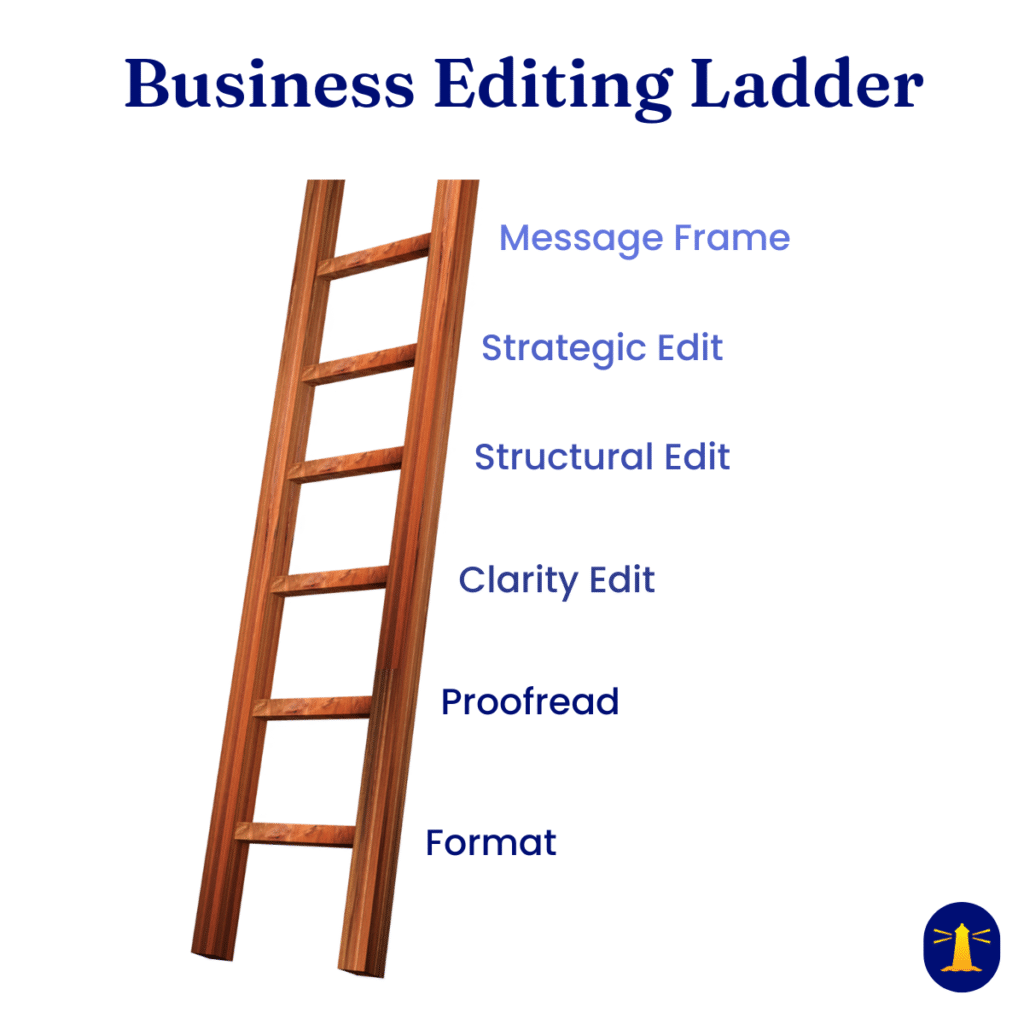
The four kinds of editing, and what each one does.
| Level | Best for | What you get |
|---|---|---|
| Message Frame | Any document before drafting begins | Clear purpose, audience, and goal |
| Strategic Edit | Proposals, thought leadership, sales pages | Stronger argument, better positioning |
| Structural Edit | Long documents, academic work, complex reports | Logical flow, no missing sections |
| Clarity Edit | Any client-facing writing | Consistent voice, precise language |
| Proofread | Final pass before publication | Clean, error-free copy |
| Formatting | Designed or published documents | Visually consistent final file |
Good editing should preserve the author’s voice. In other words, it shouldn’t turn your personality into beige paste. It should make your meaning easier to hear.
Scale the editing to the stakes, not the word count.
Editing costs vary because projects vary. Length matters, but so does complexity. A short investor deck can take more care than a long blog post, because every line carries weight.
Draft condition also changes price. A clean draft needs refinement. A messy draft may need re-ordering, re-writing, and fact-check prompts back to the author. Turnaround time matters too, because fast work forces an editor to reshuffle their schedule.
Stakes are the last factor. Public-facing pages, proposals, and thought leadership usually need more scrutiny than internal notes.
I recommend you practice a simple rule: you self-edit your low-stakes writing, and you pay for help when the writing has to earn money or protect you to reach a final draft. That includes sales pages, proposals, onboarding sequences, investor materials, published articles, and book manuscripts that represent your expertise.
Is professional editing worth it? Run this check.
These are a few green lights that tells you when professional editing is worth it:
- The piece will be public and tied to your name for months or years.
- Money depends on it, such as a proposal, pitch, or sales page.
- You’re explaining scope, pricing, or policies, where ambiguity causes disputes.
- You used an AI draft, and your voice or claims feel slightly “off.”
- You keep re-reading without improving it, which means you’ve lost perspective.
- The audience is skeptical, like enterprise buyers, agencies, or investors.
When you price editing against the cost of one lost client, one delayed signature, or one week of revision churn, the math gets simple.
Frequently Asked Questions About Editing for Small Business Writing
Editing costs vary by document type, draft condition, and turnaround time. A short proposal or service page runs differently than a long onboarding sequence. The most reliable way to get an accurate number is a scoped estimate, not a per-word rate chart. My Editing Cost Calculator gives you a starting framework before you request a quote.
That’s the most common signal that your writing isn’t clear. When you’re deep inside your own expertise, the context lives in your head, not on the page. You’ve already answered the question internally, so the sentence feels complete. To a reader who doesn’t share that context, it’s a gap. The writers who most need editing are often the least able to see it themselves. A Clarity Session is a low-cost way to get an outside set of eyes on exactly that problem.
Yes, but not in the same pass. Strong editing works in layers, starting with structure and argument before moving to voice and precision. An editor who tries to fix everything at once usually fixes the wrong things first. At Future Perfect Services, the scope is defined before any editing begins.
That’s exactly what a Clarity Session is for. It’s a 45-minute advisory conversation about your writing project. You leave with a clear diagnosis of what the document needs and a recommended next step. No full edit required. If you decide you want more after that, the relationship is already in place.
Send it when you’ve said everything you meant to say, even if it feels rough. Editors work better with a complete messy draft than an incomplete polished one. If you’re stuck mid-draft, a Clarity Session can help you find the problem before the editing begins.
AI tools generate and smooth. Editors evaluate and protect. An AI draft can sound confident while missing the argument, drifting in voice, or making claims that don’t match your offer. Human editing catches what AI can’t see: whether the piece actually does what you need it to do for the reader you’re writing for.
Premium Access is designed for exactly that. It’s a one-time setup that builds the relationship before you need it. You get on-call editorial access without onboarding every project, and without a monthly retainer. If your writing carries real stakes and you want a partner who’s already in context, that’s the place to start.
Effective Messaging Pays You Back. Unclear Writing Sends a Bill.
Editing isn’t about impressing anyone. It’s about making your message work, on purpose, every time. When you treat it as part of the job rather than an optional finish, you protect credibility, reduce costly misunderstandings, and give buyers a faster path to yes. That’s not a luxury. That’s how professional writing earns its keep.
Before You Write the Next Draft, Run This Check
Business writing that looks fine to you can still lose readers before they reach your point. The Editing Cost Calculator helps you scope your next editing project before you send it out or request a quote. It’s free, and takes about five minutes.
Editing Cost Calculator
The calculator is an independent, practical tool for estimating scope, time, and what the work is worth getting right.
👉 Get access to the Editing Cost Calculator
The Editor Who’s Already in Context
When the writing carries real stakes, such as a proposal, a service page, a thought leadership piece, rework is expensive. Not just in time. In the impression it leaves. Premium Access is a one-time setup that builds the editorial relationship before you need it. On-call support, no onboarding lag, no monthly retainer. Spots are limited.
Premium Access
Pre-cleared editorial access, good for 12 months.
Only a few Premium Access clients are active at any given time. If you’re thinking about it, reach out before your next project lands.

Thanks for reading — here’s to clearer writing and stronger ideas.
~~ Susan