
That last 10 percent of a draft can feel brutal. The proposal is basically done; the service page has all the parts; the LinkedIn article has the right story; but the writing still sounds rough. You don’t have time for a full rewrite, yet you also can’t ship something that feels slightly off. This is when you read your work out loud for a quick check.
Here’s my point: Reading out loud is a fast clarity test, but it’s not a full editing solution.
When I’m under deadline, I still read your draft out loud (or I read my own work out loud) to run a simple diagnostic: what I hear, what it usually means, and the smallest next revision move. The read-it-out-loud test, a proofreading technique, helps me hear the clunk, catch hidden typos, and spot credibility leaks before they hit a client or a public audience.
Key Takeaways
- A 10-minute read-out-loud pass works best when you mark clunks first, tag the issue, then make the smallest revision move.
- Reading your draft out loud is a fast clarity test that spots clunky sentences, tone slips, and “invisible” typos your eyes miss.
- Stumbling while reading usually means the sentence is overloaded, split it, put the actor first, and use one strong verb.
- If the copy sounds defensive or salesy, fix structure first, state the outcome, add proof, then give the next step.
- Reading out loud won’t catch bad facts or weak logic, follow with a quick consistency sweep for numbers, terms, and claims.
What Reading Out Loud Catches Fast

When I use reading-out-loud editing, I’m listening for clunky phrasing and friction. I’m not listening for “nice.” A good draft should feel like a door that opens on the first try with good flow and rhythm, not one you have to shoulder.
Here’s the pattern I follow as I read your work out loud: what I hear, what it signals, the smallest revision move. That’s how I improve flow without getting sucked into perfectionism, and how I revise for clarity naturally without rewriting the entire piece in my writing and revising process.
I also catch “invisible” typos that my eyes skip, including doubled words and missing words. A wrong-but-real word (form instead of from). Hearing the sentence forces my brain to process what’s actually there, not what it expects, catching typos and misspellings that visual proofreading misses. If you’re not sure which level of edit you actually need and you’re trying to hire help, this is where the terms matter; here’s a plain-language breakdown of copyediting vs. line editing vs. proofreading. Read-Out-Loud Editing even flags unrealistic dialogue for those writing scenarios or conversational business copy.
When I stumble, it usually means the sentence is doing too much
Mini-scenario: I’m reading a client deliverable and I hit awkward sentences that make me run out of breath. Halfway through, I lose my place and have to reread.
What I hear: my voice speeds up, then trips. What it signals: bad sentence structure, stacked clauses, a buried subject, pacing issues, or three ideas competing for one slot. Smallest move: split it into two sentences, put the actor first, use one strong verb, and cut one qualifier (often “very,” “really,” or “highly”) with precise word choice.
When it sounds defensive or salesy, it is a tone problem, not a grammar problem
Mini-scenario: I read a proposal paragraph and it feels like it’s arguing with an imaginary objection. The sentences keep saying “we just,” “we actually,” “we basically,” and the promises get louder instead of clearer.
What I hear: hedging, overpromising, and a faint wince in my own voice. What it signals: the structure isn’t doing its job, so tone is trying to compensate. Smallest move: state the outcome, then the proof, then the next step. Replace hedges with specifics (scope, timeline, definition of done).
When the offer gets lost, the structure is hiding the point
Mini-scenario: I read a service page and I can’t tell what’s being sold until the third paragraph. The opener is full of values and big words, but no concrete promise.
What I hear: a long warm-up with no landing. What it signals: the top line offer is delayed, headings are vague, and the CTA arrives late. Smallest move: move the offer sentence to the top, add one concrete example (a before-and-after result helps), and tighten the first heading so it says who it’s for and what it does.
Here’s an example:
Scenario: A small business owner writing a blog post to promote a new service package.
Before (sounds fine in your head, but the offer gets blurry):
“If you’ve been feeling stuck, you’re not alone. A lot of small business owners hit a point where they’re doing everything and still not seeing consistent results. That’s why I created a new support option that helps you get clarity, build a plan, and move forward with more confidence and less overwhelm.”
After (same warmth, but the offer is graspable and actionable):
“If you’re running a small business and your marketing feels scattered, this package gives you a clear 30-day plan. We start with a 60-minute diagnostic call, then I deliver a one-page action plan with your top 3 priorities, what to do first, and what to stop doing. If you want this, click ‘Apply’ and I’ll reply with next steps within two business days.”
If you’re using this read-out-loud pass on business writing and you keep finding deeper clarity issues, you may be at the point where you need editorial help, not more self-editing. Here’s my page for editing support for independent professionals and small business authors.
What Reading Out Loud Will Not Catch
 Photo by Karolina Grabowska www.kaboompics.com
Reading your work out loud helps me diagnose clunky writing quickly, but it won’t guarantee business-grade accuracy or logic when catching errors. Smooth sentences can still carry bad facts, weak reasoning, or a risky promise.
Mini-scenario: I read a scientific manuscript that sounds clean and confident. Nothing feels awkward, and the pacing is fine. Then I notice the same metric appears with two different numbers across sections.
What I hear: nothing sounds off. What it signals: the issue isn’t rhythm, it’s verification and consistency. Smallest move: do a fast sweep for repeated terms, numbers, and claims. Then add one proof line (source, method, or constraint) where the claim is made. This is the kind of miss that reading out loud won’t surface, because the ear can’t fact-check.
Other gaps that slip through even when the prose sounds polished: missing evidence, flaws in paragraph construction, a weak argument chain, inconsistent terminology (“client” vs. “customer”), formatting problems (tables, bullets, headings), and audience mismatch (what feels clear to you may feel thin to a buyer or reviewer).
A smooth read can still be wrong, incomplete, or risky
If the writing “sounds fine,” I treat that as permission to move to the next layer: logic, support, and precision. This is the piece most people miss when they say they’re “polishing” a draft. Here’s what I mean by that, in practical terms. Reading out loud is a filter, not a finish line.
A 10-Minute Read-Out-Loud Test You Can Run Today
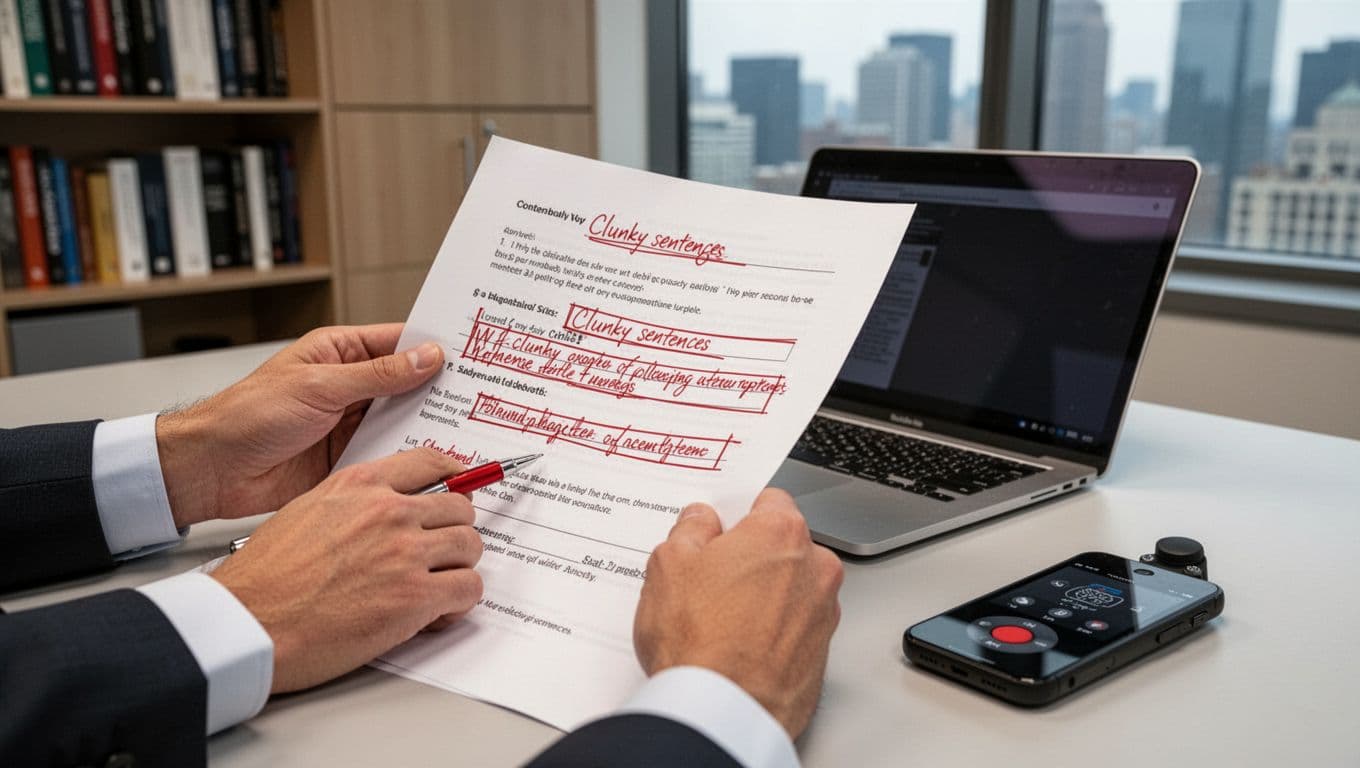
When I need results fast, I keep the read it out loud test tight. Ten minutes is enough to surface the worst problems, and it fits into a workday.
- Pick one slice (about 250 to 400 words): your opener, the main recommendation, or the section a client will quote.
- Read exactly what is on the page out loud at a steady pace. Don’t perform it. Just speak it.
- Mark every clunk in real time using a printed copy (highlight, underline, or drop a quick comment). No fixing yet.
- Label the clunk with one of four tags: too long, unclear subject, tone wobble, missing point.
- Make the smallest revision move (split, reorder, swap one verb, cut one hedge, move the offer line up).
- Reread only the changed lines out loud. Stop when the friction is gone.
If speaking is awkward in your setting, record yourself with a quick voice memo on your phone, use Microsoft Word Read Aloud, or try text-to-speech software. The key is hearing the words, not staring at them.
A quick scoring check so I know what to fix first
I triage lines that trigger (1) a stumble, (2) a tone wince, or (3) a meaning question. Stumbles usually mean the sentence is overloaded. Tone wincing points to hedges or overclaiming. Meaning questions mean the subject, offer, or action step is buried. I fix those first because they pay off immediately. If you want another fast “pre-submit” screen that pairs well with this approach, I keep a short set of clarity checks here.
What Smart People Get Wrong About Reading Out Loud (3 misconceptions)
Listening to your writing uncovers hidden issues, yet here are three common misconceptions:
- “If I read out loud, I’ve edited.” To read your work out loud finds friction, but it doesn’t verify facts, logic, or compliance language. I treat it as a diagnostic pass.
- “Faster reading is better.” Speed hides problems. I read at a calm pace so I can fully engage my ear and hear where the line stops making sense.
- “If it sounds fine to me, it’s clear.” You wrote it, so your brain supplies missing meaning. I aim for writing that makes sense to someone who didn’t live inside the project.
When Speed Matters, Use the Right Kind of Editorial Help
Sometimes the read-out-loud pass tells me the draft isn’t just clunky. It’s structurally uncertain. The offer is fuzzy. The logic skips steps. Voice inconsistencies appear, the tone doesn’t match the audience, or the piece makes promises the business can’t back up.
That’s when I stop trying to self-rescue in tiny edits and bring in responsive editorial help. Premium Access fits into the revision process for momentum, not a weeks-long bottleneck. A lot of my approach to clarity comes from writing environments where the stakes are real and the standard is credibility, not vibes. If you’re curious where that lens comes from, here’s the background: What My Years In Government Taught Me Abut Writing. It’s for the moments when you need a clean, credible finish because the document affects revenue, client trust, or public visibility.
If the read-out-loud pass shows the draft is not just clunky, but structurally uncertain, this is where Premium Access helps. It’s responsive editorial support for the moment you need a clean, credible finish.
I also see writers get better results when the working relationship is clear: what you want, what I’m changing, and what stays in your voice.
If you want a working relationship that stays clear and respectful, this matters. Here’s what I mean by “trust your editor,” including what you can expect me to change, and what stays yours.
FAQ
That usually means the issue is not sentence-level clunk. It’s one of these:
* Missing shared context: you are assuming the reader knows the background, the terms, or the stakes.
* Logic gaps: you jump from A to D because you already know B and C.
* Unstated decision criteria: you recommend something but do not tell the reader how to choose between options.
Fix: ask one outside-brain question per section: “What would a smart stranger need to know to agree with this?”
Then add one line that supplies either the missing premise, the bridge step, or the decision criteria.
Read-out-loud is not a “make it chatty” tool. It’s a cognitive load tool. For formal writing, you listen for:
* Whether the subject arrives late
* Whether the verbs are doing real work
* Whether key nouns are consistent
* Whether the sentence forces rereading
A formal sentence can be long and still be easy. The goal is not simplicity. The goal is trackability.
You can keep the benefit without speaking:
* Use text-to-speech and listen at 1.1x speed
* Have your phone read it as a voice memo
* Read silently but with a pencil and tap the desk lightly at punctuation to slow your eyes down
* Read only the first sentence of every paragraph out loud, not the whole piece
This is an accessibility issue, not a discipline issue. The method should adapt to the writer.
It’s the wrong tool when the main risk is not clarity, but accuracy or consequences. Examples:
* Contract language
* Medical, legal, compliance, financial claims
* Promises that create scope risk
* Statistics, dates, names, technical specs
Reading out loud can make those sentences sound confident. It cannot make them true. For those, you need a verification pass or a second set of eyes.
Use a “trust-first” sales test:
* Can the reader tell what you do without hype words?
* Do you name who it is for and who it is not for?
* Do you make the next step clear without pressure language?
If your call-to-action feels pushy when spoken, it usually means the copy is trying to create urgency instead of making a clean offer. Replace urgency with specifics: scope, timeline, outcome, and what happens after they click.
The 10-Minute Clarity Finish
Go back to the featured image and read it out loud. And that’s why reading out loud is still my quickest clarity filter.
When I read your draft out loud, I can hear the verbal fumbling, catch sneaky typos, and smooth the flow in minutes, not hours. If you want the longer explanation of why this works, and what it reliably reveals, I break it down here. If you want the full ten-minute method written as a repeatable pass, here it is. More importantly, it tells me when the issue isn’t wording at all. It’s structure: transitions that don’t carry the reader, evidence that doesn’t land, or a mismatch between what you’re saying and who you’re saying it to.
Here’s the simplest way to use it. Take your most important section and do a ten-minute read-out-loud test. Listen for the exact moment you stumble, flatten, or start “performing” the sentence instead of speaking it. Then make one small revision move that removes friction, and read that line again.
I still use this technique after 50 years because it works. It helps you move fast and still ship something with a clean, confident narrative flow you’re proud to put your name on.
Make The Read-Out-Loud Pass Easier
Reading out loud works, but only if you can do it without overthinking it. This guide gives you a simple way to run the pass, mark what you hear, and make the smallest useful revision.
“Read-Aloud Buddy” Guide – A fast self-editing support tool
Use it when you’re revising proposals, service pages, emails, or blog posts and you want your writing to sound clear, credible, and easy to follow.
👉 Download the “Read-Aloud Buddy” Guide (in the Freebie Library)
Need A Clean Finish, Not A Weeks-Long Bottleneck??
If reading out loud exposes bigger issues, an unclear offer, a logic gap, a tone mismatch, or promises your business cannot back up, stop trying to self-rescue in tiny edits. Premium Access is built for exactly that moment. You get responsive editorial help that protects clarity, credibility, and client trust.
Only a few Premium Access clients can be active at any given time. If it’s on your mind, it’s worth reaching out.

Thanks for reading — here’s to clearer writing and stronger ideas.
~~ Susan