
You hit send on a document that’s clean, spelled right, and formatted, yet the reader still comes back confused. Now you’re stuck in email loops, meetings, and rewrites, and you can feel trust thinning with every round. Managers, technology specialists, subject matter experts are all expected to write well (clear, concise, to the point). Plenty of people don’t have those skills and progress more slowly than they might like. If you’re a solo entrepreneur, or have a small business, you might be caught between not having the skills you need or being able to afford expensive help on retainer. So keep reading.
Proofreading fixes surface errors. Strategic editing improves message clarity.
That’s why your business writing needs more than proofreading for high content quality. When the stakes are high (clients, regulators, boards, executives), strategic editing is the difference between a polished page versus a message that lands the first time.
Key Takeaways
- Proofreading fixes surface errors (spelling, grammar, punctuation). It does not fix unclear meaning, weak logic, or vague scope.
- Strategic editing focuses on reader comprehension. It clarifies purpose, sequence, key terms, and “the ask” so a document holds up under review.
- Clean copy can still fail when claims are broad, terms are undefined, or the recommendation is buried, even if the writing is “correct.”
- In high-stakes writing (legal, compliance, boards, clients), strategic editing reduces follow-up questions, rewrites, and approval delays.
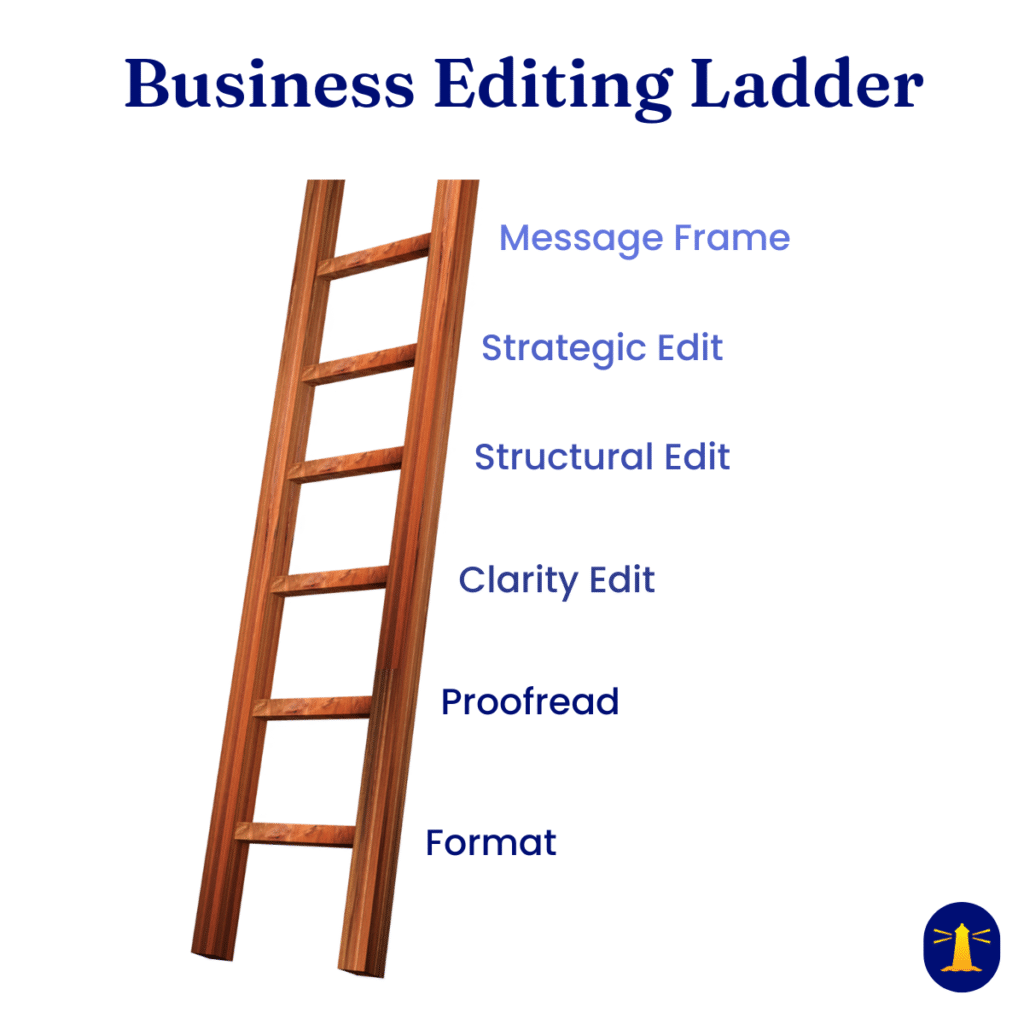
- Strategic editing sits along a different axis than the typical book publishing process, and both are needed in professional writing because a polished sentence can still carry the wrong meaning.
In this post, I’ll show what I mean by strategic editing in plain terms: working from the reader’s point of view to shape structure, sequence, clarity and readability so your document earns confidence. Let me show you what that looks like in practice, and why it matters more than you might think.
What Is Strategic Editing?
Most business drafts don’t fail because the writer lacks expertise. They fail because the reader has to work too hard to find the point, and busy readers don’t do extra work.
Strategic editing focuses on the argument structure to benefit the reader’s path. To learn more, look at the post “Strategic Editing for Clear Business Communication.” Where do readers enter the idea, where do they get their bearings, and where do they see the decision or next step? If the “why” and the “ask” arrive late, the document feels vague, even when every sentence is grammatically fine.
Common structural fixes:
- Cut repeats that show up in the first draft when it was built in stages (and never fully re-shaped).
- Lead with purpose, not warm-up. The first paragraph should tell the reader why they’re here.
- Surface the ask early (approve, decide, review, fund, sign, reply). If there’s a decision, I don’t bury it.
- Group related ideas so context, recommendation, and constraints don’t get tangled together.
In professional settings, the questions a reader asks are blunt:
- What are you asking me to do?
- What’s the basis for that ask?
- What changes if I say yes (or no)?
- What risk am I taking by agreeing?
A proofread pass won’t get those questions answered. A proofread can make the sentences correct, but it can’t make the intent unmistakable.
Strategic editing lies along a different axis than proofreading
Proofreading is a quality check. Strategic editing is a comprehension check.
I see it all the time: a document with correct grammar and punctuation and consistent formatting that still triggers follow-up questions, legal discomfort, or a stalled approval. Nothing is technically wrong, but the meaning isn’t stable. The message shifts. The scope is fuzzy. The ask is vague. Or the logic depends on the reader “getting it” without being led there.
Strategic editing is where I step in and ask, sentence by sentence, “What will a reasonable reader think this means?” Then I help you shape the document so the reader reaches the right conclusion without extra effort.
That often means work like:
- Re-ordering the opening so the point comes first.
- Tightening scope so you don’t promise more than you can deliver.
- Defining terms so departments don’t interpret them differently.
- Making the ask concrete (time, cost, owner, next step).
Notice what’s missing: I’m not correcting commas. I’m not hunting for typos. Those matter, and I want them fixed, but they are not the reason a clean document fails. If you are curious, you can see more about my editing services for small businesses and independent professionals.
I fix logic gaps and unclear claims before they become problems
A clean sentence can still contain a broken idea. In high-stakes writing, that’s what triggers painful follow-up questions, slow approvals, and “can you clarify” emails that should never have been needed.
The most common logic gaps I see are simple:
- Missing “because”: You recommend an action, but the reason is implied. The reader shouldn’t have to infer the bridge.
- Unexplained assumptions: “This will reduce risk,” “users will adopt it,” “the vendor can meet the timeline.” Based on what, and under what conditions?
- Unclear responsibility: The draft says “we will,” “the team will,” or “it will be handled,” but no owner is named. That’s how work falls through the cracks.
- Undefined thresholds: Words like “significant,” “timely,” and “secure” sound safe, but they are empty unless you define them. Significant to whom, timely by when, secure under which standard?
I don’t treat those as style issues. I treat them as credibility issues.
Here’s what happens when a claim isn’t nailed down: a skeptical reader spots the gap, and now your document becomes a debate. You end up defending your competence instead of your proposal. Strategic editing prevents that by forcing each key claim to stand on its own, with clear limits and a clear chain of reasoning.
If you want a neutral reference point on the difference between editing and proofreading in business contexts, this overview of editing vs. proofreading in business writing covers the basic split. My focus is the part that protects you in the room, where people read literally and remember what you wrote.
When I’m doing strategic editing, I’m asking practical questions such as:
- What’s the decision here? If the reader can’t name it in 10 seconds, the opening isn’t doing its job.
- Who owns the next step? If “we” and “you” blur, accountability blurs too.
- What could a reasonable reader misread? Ambiguity is expensive in professional settings.
- Is the tone fit for the risk level? Friendly is good, casual can sound careless, and stiff can sound evasive.
Strategic editing is about function, not format or genre
In business writing, I don’t start by asking, “What kind of document is this?” I start with, “What must this document do?”
Function comes first, prioritizing clarity and readability over superficial polish.
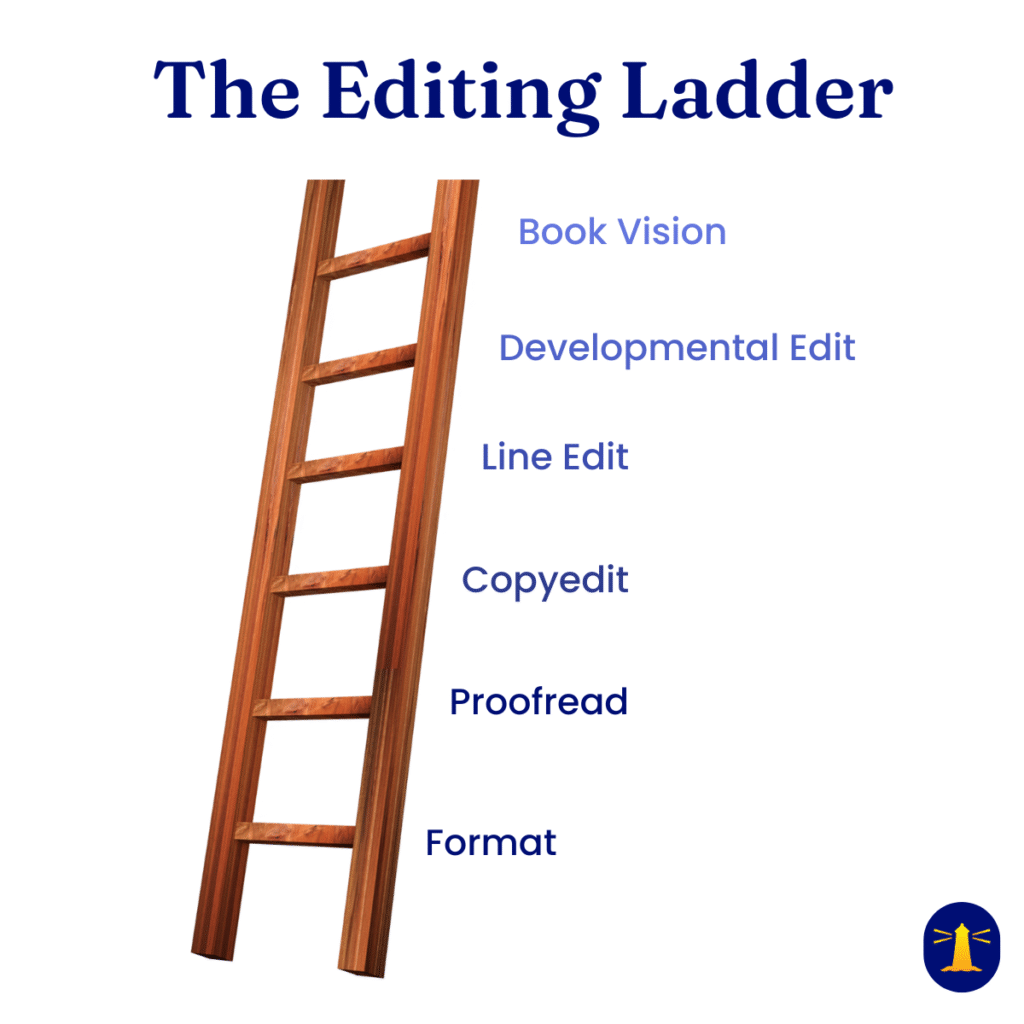
A lot of confusion comes from borrowing a publishing model and forcing it onto professional documents. In book publishing, people talk about a neat ladder: developmental editing, line edit, copyedit, then proofreading. That sequence can be useful for developmental editing on a manuscript with chapters, scenes, and a long runway to publication.
Business and government-adjacent writing doesn’t work that way. Your draft is usually tied to a decision, a deadline, and a mixed audience, unlike a book manuscript. A clean document can still fail because the reader can’t track the point, the request, or the logic. That’s the gap I mean when I talk about strategic editing vs. proofreading.
Why the Book Editing Ladder Doesn’t Fit Professional Documents
The book ladder for both fiction and nonfiction assumes the writer has time to build the work in layers, and the reader will follow a long arc. Most business writing is shorter, higher stakes, and less forgiving.
🧾 A Quick Guide to Common Editing Terms
- Manuscript assessment
A front-end review of a full draft to evaluate structure, clarity, tone, and what kind of editing would serve the work best. - Developmental editing
Focuses on structure, logic, and flow; shaping the argument so ideas land clearly and the overall piece holds together. - Line editing
Refines voice, tone, and sentence rhythm; helping the writing sound intentional, human, and aligned with your goals. - Copyediting
Checks for grammar, punctuation, word usage, and clarity; improving precision without altering the meaning or structure. - Proofreading
Catches typos, formatting glitches, and final polish issues; typically the last pass before publication or submission.
That’s why I treat strategic editing as its own lane. In business writing, the labels matter less than the outcome: the document needs to be understood the first time.
Strategic editing: the high leverage step that makes your message work
When I talk about strategic editing, I’m talking about the high-leverage step in the revision process that decides whether your document does its job. Not whether it’s “nice,” not whether it’s “error-free,” but whether a real reader can track your point, trust your claims, and act without a follow-up call. If this sounds familiar, you might be facing clarity trouble, and you can find out more about clarity trouble in this post.
That’s the practical difference in strategic editing vs. proofreading. Proofreading is a cleanup pass. Strategic editing is where I shape structure, logic, and decision clarity from the reader’s point of view, so the message lands the first time, delivering strong ROI through clear communication.
The “missing rung” that causes expensive rewrites
When teams skip strategic editing, they usually pay for it later in the form of meetings and revisions that damage content quality. The draft “looks done,” so it gets circulated. Then people respond with different interpretations, each one reasonable based on the wording. Now the team has to patch the document while it’s already in motion.
I think of it like sending a package with perfect wrapping and the wrong address. The box looks great. The tape is straight. None of that helps if it goes to the wrong place.
Here are a few red flags that tell me strategic editing is needed, even when the copy is clean:
- The purpose is implied, not stated, until page 2 or 3.
- The recommendation is buried under background.
- Your key reader isn’t named (who owns the decision?).
- Your “we” and “you” drift, so responsibilities blur.
- Risk language is vague, which makes legal or compliance readers nervous.
If any of those are true, proofreading is the wrong tool. It’s like tightening screws on a chair that has the legs on backward.
This Isn’t Marketing Copyediting
A lot of people hear “strategic editing” and picture marketing. They assume I’m here to edit their marketing materials, sprinkle in persuasion tricks, punch up the adjectives, and make the copy “pop.” That’s not what I do.
When I talk about strategic editing, I’m talking about something more practical. Proofreading makes a document clean. Copy editing delivers professional polish. Strategic editing makes a document hold together. It tests whether your meaning survives real readers, real constraints, and real consequences.
If your writing is tied to a decision (approval, funding, purchase, compliance), clean copy can still fail. Not because you needed better slogans, but because your claims were fuzzy, your terms were undefined, or your logic didn’t track from one paragraph to the next.
I’m not rewriting to sell; I’m helping you say what matters more clearly
My job is not to make you sound clever or persuasive. My job is to make your meaning hold up under pressure.
Pressure is where writing tells the truth about itself. A draft can feel smooth to the writer and still fall apart for the reader. In my work, I look for the spots where a reasonable person would pause and think, “Wait, what are they actually saying?”
Here are a few kinds of pressure your document should survive:
- A skeptical reader: They don’t dislike you, they just need your claim to be specific and supportable. If the wording lets you wiggle out of meaning, they’ll assume you are.
- Legal review: A lawyer reads for risk, ambiguity, and unintended promises. Vague terms that feel “friendly” to the writer can read like liability to counsel.
- A busy decision maker: They scan fast. If the point is buried, the ask is unclear, or the sequence is off, you don’t get a second chance.
If you’re writing in government or regulated environments, this post reflects on lessons I learned from those years.
So no, I’m not rewriting you to “sound salesy.” I’m making sure the key idea is stated plainly, in the right order, with enough context to stand on its own. This kind of directness can feel risky at first, and there’s a reason for that. I explain why in this post about clear writing. Think of it like checking the load-bearing beams of a house, not repainting the walls.
Marketing editing sells the offer; I make the message trustworthy and intelligible
If a sales message collapses under close reading, it was never strategic editing; it was style polish.
Marketing editing often focuses on appeal: voice, energy, and emotional pull. Copy editing and line editing have their place for refining flow and word choice. Those are real skills, and they have their place. My lane is different. I make sure the message is solid enough that a careful reader can’t poke holes in it with basic questions.
Trust gets built in writing the same way it gets built in person: through consistency and clarity. Specifically,
- Clear claims: You say what you mean, and you mean what you say. No inflated promises, no “we do everything” language.
- Clean logic: Each point follows the one before it. You don’t skip steps and hope the reader fills them in.
- Defined terms: If you use words like “support,” “compliance,” “integration,” or “results,” you define what those mean in this document.
- No hidden leaps: You don’t jump from “we offer X” to “therefore you should trust us with Y” without showing the bridge.
Here’s a quick example of a claim that sounds fine but fails under close reading: “We provide end-to-end support.” End-to-end of what, exactly? Onboarding to renewal? Strategy to implementation? Business hours or 24/7? If two departments read that line and imagine two different scopes, you’ve just planted a future conflict.
This is why “clean” can still be costly. A typo is embarrassing. A vague scope statement is expensive.
If you want a general explainer on where proofreading ends and editing begins, this breakdown of proofreading vs. editing differences is a decent starting point. What I’m describing here is the part many business teams skip, the part where the message becomes dependable.
This work is about clarity, not persuasion tactics
I’m not a ghostwriter, a brand stylist, or a messaging coach. I’m the person who tells you when your meaning gets lost, and helps you fix it.
That “meaning gets lost” problem shows up in predictable places: the opening paragraphs that never state the point, the middle sections that drift into background, the key terms that shift halfway through, the conclusions that ask for something different than what the body supports. Proofreading won’t catch that, because nothing is “wrong” on the surface.
Strategic editing is where I step in and ask, bluntly, what will the reader think at each turn. I talk more about how this plays out in high-stakes editing. Then I help you make targeted fixes that preserve your voice and intent while removing the confusion. Often that means tightening the sequence, clarifying a claim, adding one sentence of context, or replacing a soft generality with a concrete statement you can stand behind.
The outcome you should expect is simple: fewer misunderstandings, fewer revisions, more confident yeses.

High Stakes Documents Is Where Clarity Pays For Itself Fast
If your draft is “clean” but people still misread it, you don’t have a proofreading problem. If you’re not sure where clarity breaks down, try these three ways to spot clarity problems before you hit submit. You have a reader-path problem. This is the moment where strategic editing vs. proofreading becomes more than a definition. It’s the difference between a document that looks finished and a document that gets the right decision without extra meetings.
When I do strategic editing, I’m not chasing commas first. I’m checking whether your structure, sequence, and wording guide a busy reader to the same meaning you intended. If the meaning can drift, the document can fail, even when every sentence is grammatically correct (Purdue’s checklist is a good reminder of what proofreading covers and what it doesn’t, see Purdue OWL editing and proofreading guidance).
Some documents punish ambiguity, in contrast to an academic paper. They don’t just create confusion, they create delays, rework, scope fights, and legal discomfort. These are the places where strategic editing earns its keep quickly because it prevents expensive back-and-forth while ensuring factual accuracy.
- Proposals: Common failure is a polished pitch with a fuzzy scope, so the client can’t tell what they’re buying; strategic editing tightens the offer, the boundaries, and the decision path.
- Statements of work (SOWs): Common failure is unclear roles and “included vs. not included,” which leads to disputes; strategic editing makes responsibilities, deliverables, and assumptions hard to misread.
- Policies: Common failure is vague rules that different teams interpret differently; strategic editing makes the policy usable, consistent with the style guide, and defensible under review.
- Standard operating procedures (SOPs): Common failure is steps that make sense to insiders but not to new staff; strategic editing fixes order, missing steps, and unclear triggers so the process runs the same way each time.
- Executive summaries: Common failure is an overview that never reaches a clear recommendation; strategic editing puts the decision, rationale, and impact where a leader will actually see them.
- Board memos: Common failure is too much background and not enough decision framing; strategic editing clarifies what’s being decided, what changes, and what risk the board is accepting.
- Grant narratives: Common failure is a strong mission with weak logic and unclear outcomes; strategic editing tightens claims, evidence, citations, and alignment so reviewers can follow the story without guessing.
- Compliance responses: Common failure is careful wording that still leaves loopholes or unanswered questions; strategic editing makes your answers direct, complete, consistent, and ensures factual accuracy across the full response.
- RFP answers: Common failure is responding “in general” instead of to the exact ask; strategic editing maps each answer to the evaluator’s criteria and removes vague promises.
- Client onboarding documents: Common failure is friendly guidance that skips the hard details (timelines, inputs, responsibilities); strategic editing makes expectations clear so service delivery starts clean.
- Sensitive emails: Common failure is a “simple update” that accidentally reads like blame, a promise, or an escalation; strategic editing controls tone, clarity, and implied commitments.
If you’re writing in one of these categories, I treat “clear enough” as a risk decision, not a style choice. Proofreading can help you look professional. Strategic editing helps you stay professional when someone rereads your words under pressure.
Strategy is the engine.
Frequently Asked Questions About Strategic Editing
If the wording is technically clean but you’re still not getting the results you want — such as slow approvals, confusion, pushback, or endless revisions — the issue likely isn’t punctuation. It’s structure, clarity, or decision friction. Strategic editing addresses those deeper challenges.g.
Line editing focuses on sentence polish. Strategic editing focuses on message clarity, logical flow, and whether the document actually works for its intended purpose. It’s the step that ensures your ideas land the way you intend.
Not always. Internal reviews usually check for accuracy or tone, not for structure or strategic purpose. Strategic editing looks at whether your message is clear, credible, and persuasive to someone outside your team. first.
They help reframe your message so it earns trust and moves decisions forward. This might include clarifying the purpose, reordering content, tightening transitions, or removing distractions that get in the way of your reader’s understanding.
Yes. Strategic Editing is the official name of the service I offer for complex business documents. It includes structural revision, message framing, and clarity work. If you’re looking for help making your writing more effective, this is the level of editing that does the heavy lifting.
Bottom Line
Proofreading makes a draft grammatically correct, but proofreading can’t make the logic hold, the scope stay stable, or the ask feel unmistakable. In the revision process, strategic editing is where I work from the reader’s point of view, shaping structure, sequence, tone, and meaning so your writing earns trust, moves decisions forward, and achieves professional polish that boosts content quality.
If the stakes are high and you want your message to land the first time, choose Strategic Editing. If you might need the service on short notice, set up Premium Access. I provide professional writing services for professionals, not just proofreading and error correction.
Not Sure What Kind of Editing You Need?
Start with the Writing Clarity Checklist. Available now in the Freebie Library, free with no signup.
It’s a one-page self-review that helps you spot the real barriers in your business writing and figure out whether you need proofreading, line editing, or something deeper.
No opt-in. Just clarity.
Want Your Writing Reviewed By a Strategic Editor?
If you’ve worked through the checklist and still have questions, I offer deep-dive editorial consults through Premium Access.
This isn’t a coaching call or a sales pitch. It’s a professional assessment of your project’s clarity and effectiveness … and whether editing will actually move the needle.
Only a few Premium Access clients are active at a time. If you’re thinking about it, now is a good time to reach out.
👉 Learn more about Premium Access

Thanks for reading — here’s to clearer writing and stronger ideas.
~~ Susan