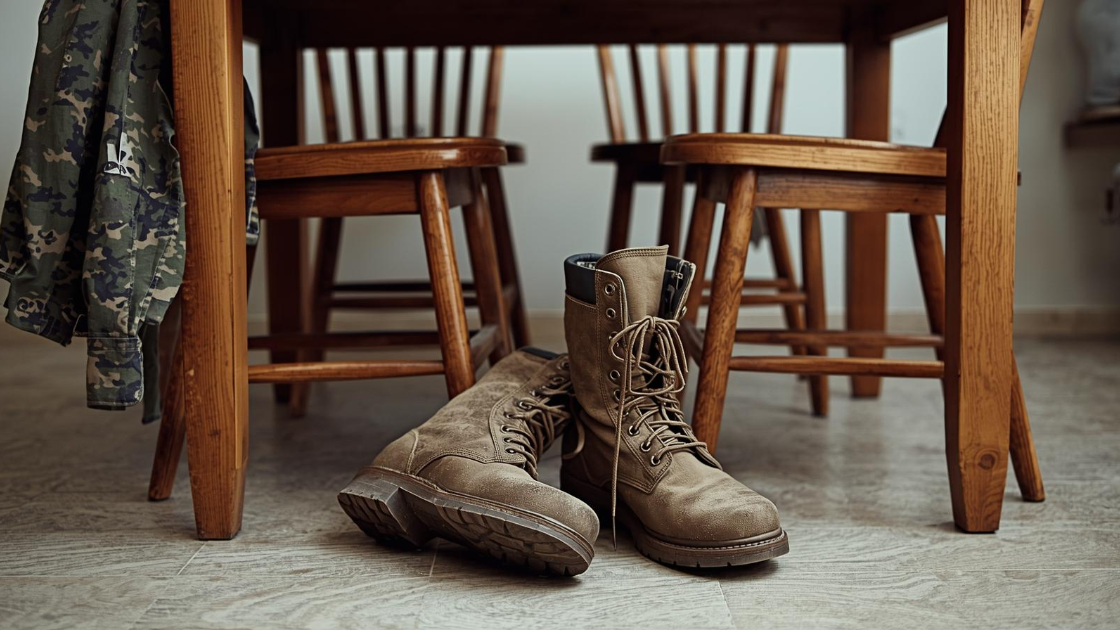
Not every war story comes in uniform.
This Veterans Day, I’m thinking about veterans in terms of their caretakers. My mind lingers, once again, on the people who carry the weight with those who served, usually in silence.
I almost let Veterans Day slip past me this year. I had tuned-out hard after my government retirement in April. Heck, I was so far from monitoring the news that I didn’t realize the end of Daylight Saving Time had happened until late afternoon of the next day.
I can’t let Veterans’ Day go unremarked, although it’s a real departure from my topic space. The military has been the background hum of my adult life since 1996 when I met my husband, a disabled Army veteran. It’s the soundtrack of my marriage, the texture of my family, the reason our family’s stories never even remotely fit neatly into any category.
I’m a civilian who’s worked in defense spaces. I even had a deployment once, tucked behind layers of protection in Afghanistan. But the people I love carried the weight of real deployments, the kind that leave marks you really cannot show in public. The kind you don’t talk about because “normal people” recoil in horror if you do.
My husband has too many deployments under his belt, mostly unacknowledged and super-secret. He’ll always be recovering from the memories. And in our marriage, I learned the safe way to wake him up and never to sleep in his arms. Fortunately, the loud nightmares faded some years ago. I’m incredibly proud that our marriage has lasted 27 years when multiple divorces are the norm for his type of soldier.
My brother served twenty years in the Navy and is still trying to find a shore that holds steady. I got my one and only combat story from him, listening in as he and my husband got to know each other. Turns out Mogadishu involved too many of my relatives and friends on that horrible day.
My second sister served, too, and her son, and both her husbands wore uniforms. Her second husband, a Vietnam vet, taught me that you can’t run from those emotions forever. Live long enough, and they creep out at the dinner table.
Service doesn’t stop when you exit the service. It ripples outward, across families, decades, and dinner tables.
I can edit almost anything. But I can’t edit this.
In the midst of all this hurt and suppressed emotion, storytelling matters. It displays the true awful horror of war. As if the physical destruction isn’t enough, the devastated lives are uncountable. Will the experienced people ever manage to convince the young and the chickenhawks about the real cost of war? Many, many writers have tried.
Beyond those profound costs, I’ve realized the wars never, ever seem to end. I feel like we’re still fighting the beliefs that drove WWII, and even those of the U.S. Civil War. Heck, I was wondering today if the Hundred Years’ War is really, truly over? Are France and England really supportive allies with every bit of the combativeness behind them?
We all fought to keep Americans safe, so they have to deal with real war on our territory. Together, we’ve done a good job. A great job. See how safe they all feel? You can tell by their obliviousness peaceful innocence. In retrospect, I liked mine, too, and I wish I could go back.
At this point in my well-worn thought track, I give up and swing my mind back to the micro level. I’ve left the macro behind me after working all 20 years of Global War On Terror. The stories are what matters, and the people who are brave enough to tell their stories, who translate the experience for the rest of the world to understand. Telling those stories in the face of disbelief and rejection—that’s bravery.
I have a private theory about these stories. I believe every vet needs to tell their worst stories three times and be accepted afterwards. The first time the war story is told, it’s funny or a bit sarcastic. The second telling is marked by soberness, quiet, the beginning of confession. The third telling opens the emotional vent and relieves the pressure of silence. If the tale is accepted in the sober spirit in which it is told, it seems that healing begins. Finding a person who does not impose their own feelings on a warrior’s story is remarkably hard, yet desperately needed.
So sometimes the clearest writing we can do is the kind that doesn’t change or fix anything. It’s writing just to bear witness to the weight, the cost, the loyalty that never ends. A telling that shares the horrible truths and the deepest feelings.
To those who served, and to the ones who love them, fight beside them, and keep translating their stories, thank you.
The caretakers are too often unseen. The public gaze stops at uniforms and medals. But we caretakers know the shadow‑service that happens in kitchens, waiting rooms, and sleepless nights. You might be unseen but you are never alone. I know you are there.
To the veterans who carry burdens—your words absolutely matter. May God give you peace.
The VA offers support to caregivers: contact https://www.caregiver.va.gov/

Thanks for reading — here’s to clearer writing and stronger ideas.
~~ Susan