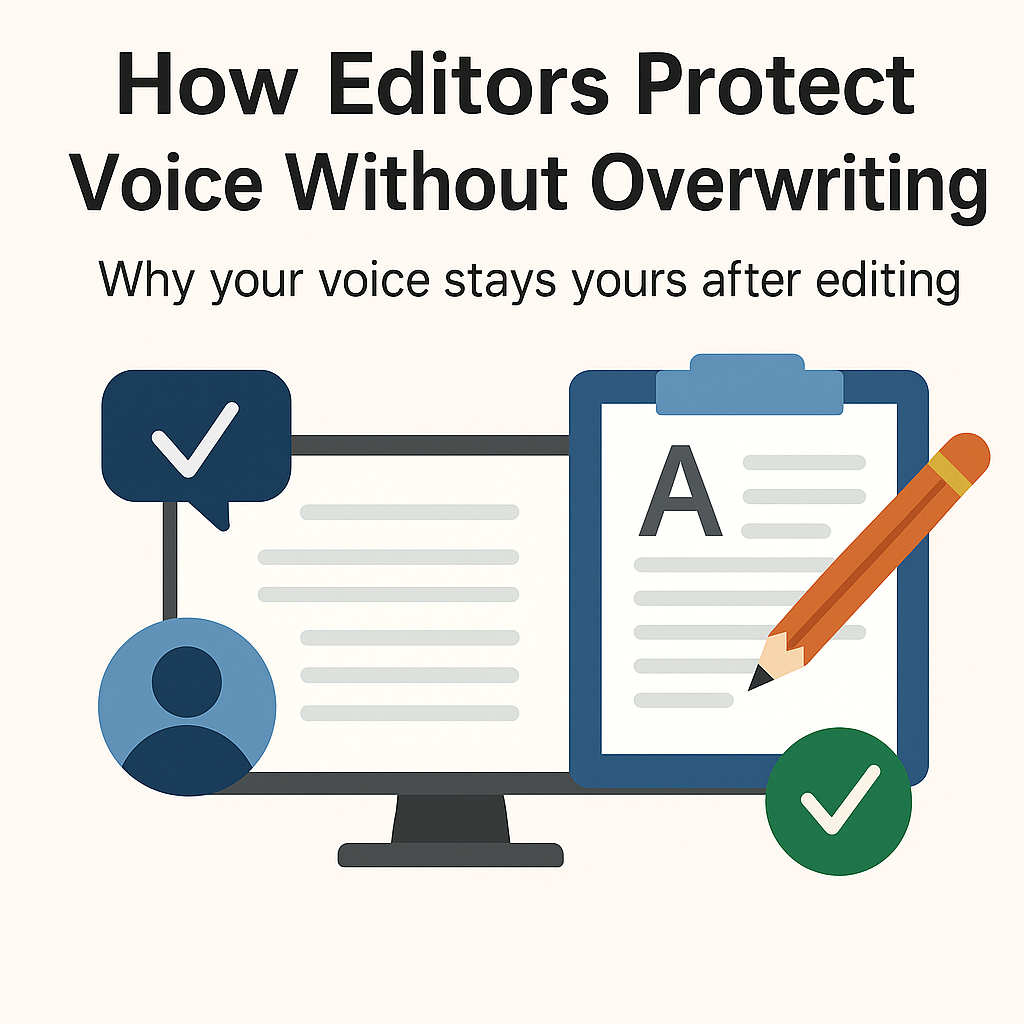
If you’ve ever hesitated before sending a draft for editing, you’re not alone.
Independent professionals, small-business owners, and thoughtful writers often share the same quiet fear: What if the edit flattens everything that sounds like me? What if your lively, direct voice comes back sounding like a corporate memo, or worse, like the impersonal output of AI technology?
That fear sits at the heart of protecting your voice.
Key Takeaways
- Professional editors protect an author’s voice by respecting their tone, rhythm, and intent, while focusing changes on clarity, structure, and consistency.
- Good editing targets problems in logic, pacing, grammar, and reader experience, not the author’s personality or stylistic fingerprint.
- Editors avoid overwriting by making the smallest effective change, explaining major revisions, and matching the edit depth to the author’s goals.
- A strong editor–author relationship is built on clear expectations, sample edits, and open conversation about what “voice” means for that specific project.
- Thoughtful editing often makes an author’s voice more vivid and confident on the page, rather than more generic or “editor-sounding.”
In this piece, I want to show you what good editors actually do to protect voice, how to recognize overwriting, and how to tell when an edit is drifting into ghostwriting or tonal mismatch. I’ll walk through concrete signs to look for, simple “green flags” that your voice is safe, and a clear before-and-after example where the words are sharper but the person on the page is still unmistakably you.
Let’s start with what “voice” really means.
What “Protecting Voice in Editing” Really Means
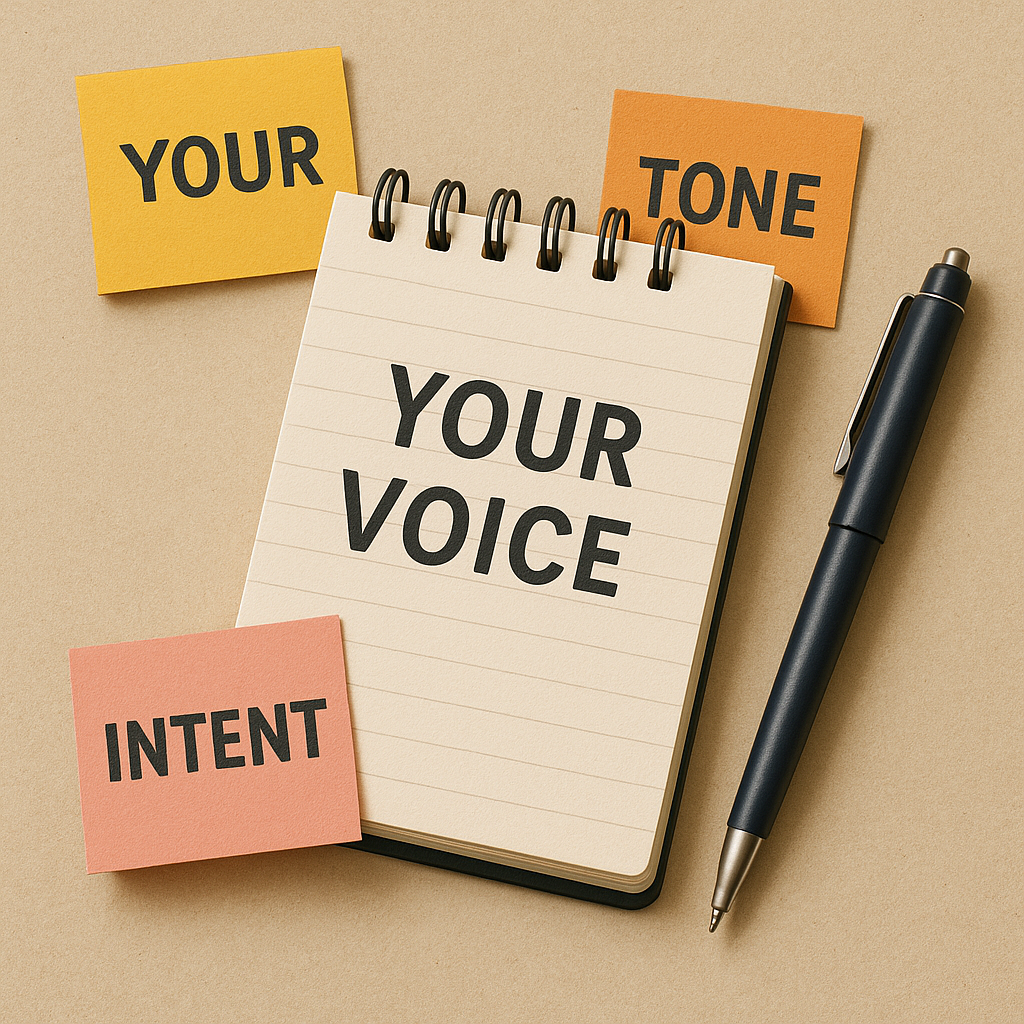
When I talk about voice in editing, I’m not being mystical. Voice shows up in very practical ways:
- The words you naturally reach for
- The rhythm of your sentences
- How formal or casual you tend to be
- The kinds of phrases and images you repeat
- The values that leak through your examples and stories
Preserving your voice means I improve clarity, structure, and correctness as part of the writing process, but I do not replace your personality or intent with my own. Your ideas stay central. Your sound stays recognizable. The polish is in service of you, not a generic template.
It also helps to draw a clear line between editing and ghostwriting. Editing supports the ideas, stories, and phrasing you already brought to the page. Ghostwriting supplies new ideas, new arguments, and large stretches of new phrasing. Ghostwriting is a valid, useful service when that’s what you ask for. This article is about something different: how to keep your own voice intact when what you want is editing, not a new author.
How I Tell Style From Voice
I think of style within voice style and tone as the “rules and rails”: clean sentences, logical flow, no distracting errors. Style is where I might draw on resources like The Chicago Manual of Style to keep things consistent and readable, much as that manual describes codifying practical best practices in editing and publishing (Chicago Manual acknowledgments).
Voice, on the other hand, is how you sound when those rules are in place.
You might have a naturally playful voice: short sentences, quick jokes, a lot of “you” and “we.” Someone else might be naturally formal with an academic voice: longer sentences, more cautious phrasing, very few contractions. I can edit both for clarity without turning the playful writer into the formal one or the formal writer into a stand-up comic. My job is to work inside your natural range, not to swap it out for mine.
Editing Goals That Support Voice Instead of Erasing It
When I’m protecting voice in editing, my goals are simple:
- Remove confusion so readers don’t have to guess what you mean.
- Cut clutter to aid argument development so your key ideas stand out.
- Fix errors so nothing undercuts your credibility.
- Support your purpose: to persuade, explain, reassure, invite, or instruct.
If I’m doing that well, you should read the edited version and think, “This is me on a very clear day.” Not “Who wrote this?” and not “Wow, that sounds polished but I’d never talk like that.” Like good vocal health, the final output enhances your natural expression without strain.
You should feel like the best version of yourself, not like a stranger.
The Line Between Helpful Editing and Overwriting
So where does helpful editing tip into overwriting?
In plain language, overwriting happens when the editor starts rewriting in their own voice instead of refining yours. It often shows up as a draft that comes back sounding more formal, more generic, or more “brand-speak” than anything you’d naturally say out loud.
That’s why so many writers get uneasy when they see a sea of tracked changes, leading to a kind of vocal fatigue. It’s not the amount of red that matters; it’s what those changes do to your tone.
What Respectful, Voice-Safe Editing Looks Like
Respectful editing has a few consistent markers:
- Your basic sentence shapes are still there. Long, short, punchy, measured, they’re just clearer.
- The level of formality matches what you wanted. If you write “you,” the edit doesn’t suddenly favor “one.”
- Familiar phrases stay in place unless they’re genuinely confusing or repeated too often.

You’ll often see questions or comments in the margins: “Is this the tone you want here?” or “Do you mean X or Y?” That kind of checking-in shows that your editor is protecting voice by confirming intent, not guessing and imposing.
What Overwriting Looks Like in Real Life
Overwriting is easier to feel than to define, but there are common signs:
- Long new sentences that sound nothing like what you wrote
- A shift into corporate or “academic voice” language you would never use with your actual clients
- Jokes, asides, or small human touches stripped out with no clear explanation
- Whole paragraphs replaced rather than revised
- New ideas or promises added that you never mentioned
Compare these two sentences:
- “I love helping my clients sort out messy ideas.”
- “I am committed to providing world-class client service.”
The second isn’t wrong, but it’s generic and corporate in a way the first is not. If your draft sounds like the first and your edit comes back full of the second, that’s tone drift. If it happens across the whole piece, the work has slid toward ghostwriting, which should always be named and agreed to in advance.
Want a real-world example? This very post is one.
The first draft of my posts come from my AI writing assistant, a tool I’ve been steadily retraining to sound more like me. It finally clicked when I insisted on contractions. That one tweak changed everything.
For the first time, I didn’t feel the need to rebuild the rhythm or fix the tone. I read the draft and thought, “Oh. That’s me.” Then I thought how this will speed me up, because my time tracker is very unhappy with the hours I spend revising each post.
When contractions go missing, I hear it in my bones. My brain starts making these tiny, pained noises—eee-eee, eee-ee—because something about the flow is just off. It’s not wrong, it’s just … not me.
So I fix it. I always fix it.
That’s what voice-protective editing feels like in practice: you still recognize yourself on the page. You don’t disappear. You just come through more clearly.
Subtle Tone Drift: When Edits Quietly Change Who You Sound Like
Edits don’t have to be dramatic to change your voice.
Small shifts add up, such as:
- Swapping “you” for “one”
- Cutting every contraction so “I’m” becomes “I am”
- Replacing direct phrases like “Let’s fix this” with “This may warrant further consideration”
One or two of these changes can be fine, especially for a very formal document. A pattern, though, can move your writing from warm and direct to distant and stiff.
If you read an edited piece and feel, “This no longer sounds like me,” that feeling matters. That moment of doubt is worth paying attention to, especially if you’re already second-guessing your draft. This post on writer self-doubt might help you notice the early signs and re-ground your confidence.
Signs Your Editor Is Protecting Your Voice, Not Replacing It
Let’s turn to the positive side. What does it look like when protecting your voice in editing actually happens?
You can treat this section as a quiet checklist while you review any edited draft.
Your Draft Still Sounds Like You, Just Clearer
The simplest green flag is this: when you read the edited document out loud, you still hear yourself.
Your favorite phrasing is often still there, only cleaned up around the edges. Awkward sentences are smoother, but your voice style and tone remains intact. If you hand the piece to a colleague or friend, and they say, “Yes, this sounds like you,” that’s a strong sign your editor stayed inside your voice.
Edits Fix Problems Without Adding New Ideas
In voice-safe line editing, the content of your argument doesn’t change.
An editor might sharpen a point, suggest where an example would help, or flag a gap with a comment like, “Do you want to add a brief story here?” What they shouldn’t do is drop in their own example, claim, or case study without your say-so.
This matters for voice, but it also matters for integrity. You’re responsible for the promises and ideas in your writing. Edits should help you say those ideas more clearly, not smuggle in new ones.
Comments Ask About Your Intent Instead of Assuming It
Good editors stay curious.
You’ll see questions such as:
- “Is this as direct as you want to be?”
- “Do you want to keep this playful, or should it be more neutral?”
- “Is this the main promise you’re comfortable making?”
These questions signal respect and clear guidelines. Your editor is trying to understand your goals, not steer you toward their taste level or their risk tolerance.
Informal Touches Are Trimmed, Not Scrubbed Away
Many of my clients do their best work with a bit of informality: contractions, a light joke, a human aside.
A voice-protective edit might remove extra exclamation points, tidy repeated filler like “kind of” or “basically,” and cut a few emojis in a formal report. But it will keep natural spoken rhythms where they serve your brand and audience.
A red flag pattern looks different: every hint of informality disappears and the result could pass for dry academic writing. If you feel all the personality has been washed out, that isn’t necessary professionalism, it’s a mismatch.
Wondering how this plays out in business writing? This earlier post shows how clarity and personality can coexist, even in formal documents.
Red Flags: When Editing Crosses the Line Into Overwriting
Not every concern is a crisis. Sometimes a single odd edit is just that, and a quick conversation clears it up.
But if you see several of these red flags together, it may mean the fit isn’t right or the work has shifted into rewriting without everyone naming it.
Excessive Rewriting and Brand-New Phrasing Everywhere
Some drafts need heavy help; that’s normal. Even then, though, the revised version should feel rooted in how you think and speak.
If almost every sentence has been rewritten, including lines that were already clear, and the finished piece reads like generic output from AI writing tools or the editor’s samples rather than anything you’d ever write, something’s off. Frequent overwriting like this indicates a failure in setting guardrails for the project. The point isn’t to erase your fingerprints.
New Ideas or Claims You Never Approved
Another serious warning sign: the editor inserts new promises, strong claims, or stories you didn’t supply.
For independent professionals and small businesses, this can create real trust and legal issues, as it violates voice ownership. You don’t want an editor promising “guaranteed results” or citing data you haven’t seen, all under your name. A responsible edit sharpens what you already stand behind; it doesn’t commit you to new positions.
Tone Flips From Casual to Corporate (or the Other Way Around)
Tone shifts are often the first thing you’ll notice.
Maybe you wrote, “If your report feels messy, we can fix that.” It comes back as, “Our team is committed to delivering high-quality documentation solutions.” Same basic idea, very different feel, with a shift from your natural tone toward an formal business voice. Or your careful, formal report is suddenly full of chatty asides you’d never use in a board meeting.
When tone flips like that, trust erodes. Your readers know how you usually sound. So do you.
All Traces of Personality Vanish
Finally, there’s the “could be anyone” test.
If every story, aside, or tiny bit of humor is gone, and all that’s left is generic, flattened language like a synthetic voice, the editor probably overcorrected. Some trimming is helpful; not every tangent needs to stay. But frictionless, personality-free pages are forgettable.
The goal is not to sand off every rough edge. The goal is to protect your human vocal identity, keeping the edges that make you memorable and real.
A Simple Before-and-After Example of Voice-Protective Editing
To make this concrete, here’s a short fictional example from a small-business owner who did voice-to-text to capture initial thoughts about working with clients but specifically wanted to keep her informal tone.
Before
I kinda jump into projects with my clients because I get excited, and then halfway through they’re sometimes like “wait, what’s the plan again?” which is fair, because it’s mostly in my head. I do have a process, but I don’t always slow down enough to walk people through it, so it can feel messy even when it’s not. That’s something I’m trying to fix this year.
After
I tend to jump into projects with my clients because I get excited. Halfway through, they’re sometimes asking, “Wait, what’s the plan again?” That’s fair, because a lot of the plan is still in my head. I do have a process, but I don’t always slow down enough to walk people through it, so it can feel messy even when it’s not. That’s something I’m working to fix this year.
Same person, clearer page.
What Changed: Clarity and Flow
In the edited version, I broke one long sentence into two, so readers don’t have to hold the whole thought in their heads at once.
I trimmed “kinda,” which didn’t add much, and changed “they’re sometimes like” to “they’re sometimes asking,” which sounds more like spoken English than a transcript of speech. I also shifted “trying to fix” to “working to fix,” which feels a bit more grounded without changing the meaning.
All of these are small clarity and flow improvements. They enable more effective persuasive analysis by helping the reader move cleanly through the ideas.
What Stayed the Same: Voice, Tone, and Point of View
Notice what didn’t change.
The “I” and “my clients” structure stayed. The admission of excitement and messiness stayed. The self-aware, conversational tone stayed. Even the line “it can feel messy even when it’s not” remained word for word, because it’s a sharp, honest phrase that sounds like something this person would actually say.
That’s the heart of protecting voice in editing: the writer’s sound and point of view are intact. The text is just easier to follow.
How to Work With an Editor Who Shares Your Tone
Finding a voice-safe editor who respects your voice gives you control over vocal identity; it’s part skill match, part communication.
You don’t have to turn this into a big project plan. A few thoughtful steps at the start can make the whole relationship smoother.
Share Real Samples So Your Editor Can Hear You
Before the first project, send a couple of pieces that feel “most like me,” even if they’re rough.
You might point out, “This blog post is the tone I want for client emails,” or “This report intro felt exactly right.” That gives your editor a living baseline to protect. You can even note what matters most: “The humor here,” “The directness here,” or “The calm, measured feel here.”
Talk Openly About Boundaries and Comfort Zones
It helps to name your preferences out loud.
You might say:
- “I want this to feel professional but still like a human is speaking.”
- “I’m comfortable with some jargon with peers, but not with clients.”
- “I don’t want promises I can’t keep added into the copy without explicit consent.”
You can also ask simple questions like, “How do you think about voice when you edit?” or “What’s your policy on using AI writing tools?” When it comes to transparency and control, it’s also fine to ask how AI‑generated content is disclosed and who owns the output. If you’re unsure, request a short test edit and see if it still sounds like you.
Review Edits As a Conversation, Not a Verdict
Finally, treat the first few rounds of editing as a conversation, not as a decision by the editor you hire.
It’s completely healthy to say, “This sentence doesn’t sound like me; can we try another option?” or “I see why you cut this, but I’d like to keep a lighter version of it.” Try reading your draft out loud, even if no one else is around. This is sometimes called the rubber-duck method: the act of explaining your idea to a silent listener (yes, even a plastic duck) to catch fuzzy spots or unclear logic.
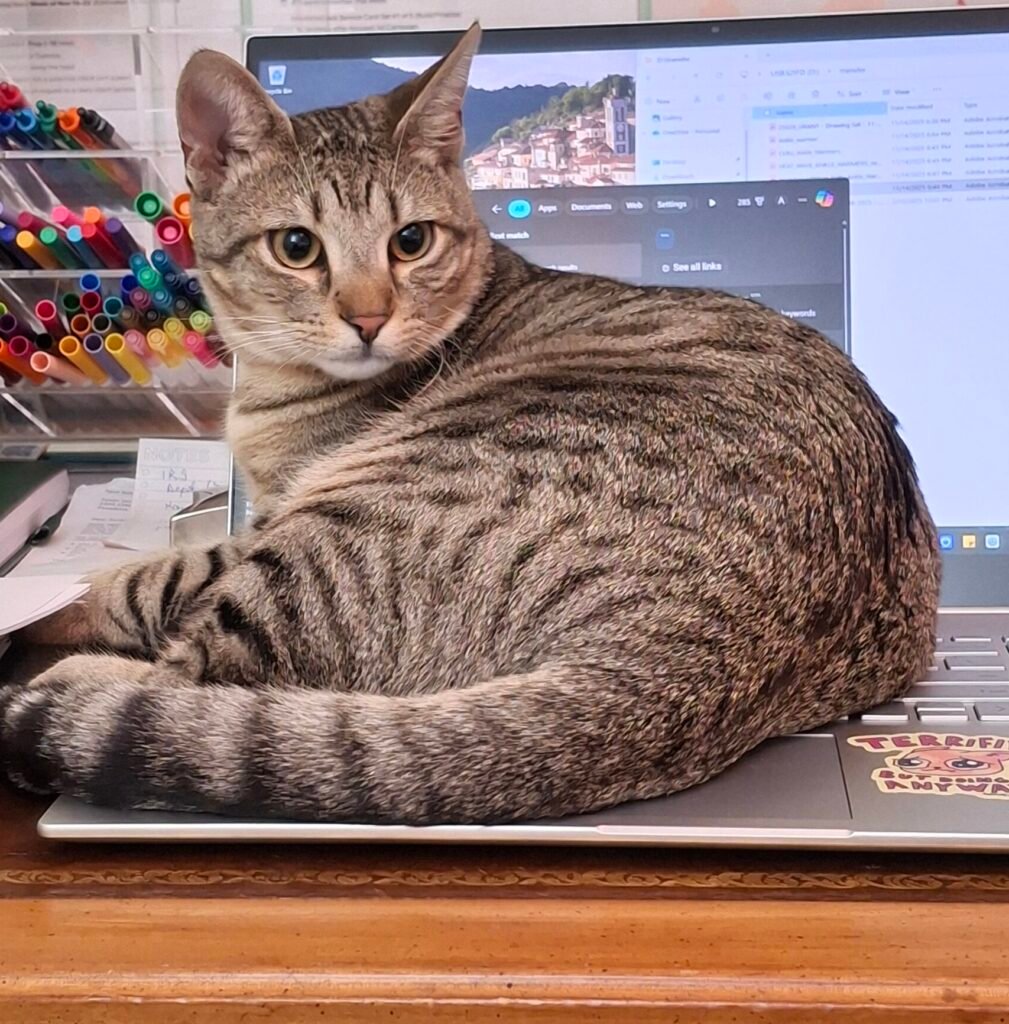
Personally, I recommend a tabby cat. Finnegan, my silver assistant, has helped me catch many a muddled paragraph just by sitting nearby while I talk things out. Here’s a picture of my patient buddy, helping me.
If you’re curious, ask why a change was suggested. Accept some edits, reject others, and invite alternatives.
That back-and-forth isn’t conflict. It’s like AI model training; it’s how your editor learns the vocal folds of your voice more deeply, so future edits protect it even better.
A really professional editor will give you back a Tone Style sheet that you can use in the future. Not sure what kind of editing you need? This quick explainer breaks down the difference between copyediting, line editing, and proofreading, so you can choose the level that fits your project (and your voice).
Frequently Asked Questions About Protecting Author Voice
Editors protect voice by distinguishing between the writer’s stylistic fingerprint and fixable issues in clarity or correctness. They keep sentence rhythm, word choice patterns, and tone intact, while tightening structure, correcting errors, and smoothing confusing passages. When an edit risks changing the feel of a line, a careful editor flags it as a suggestion, explains the reasoning, and invites the author to confirm or adjust. The goal is always, “Your voice, just sharper,” not “My voice instead of yours.”
Overwriting happens when an editor replaces an author’s natural expression with their own preferred style, even when the original is clear and correct. This can show up as unnecessary rephrasing, flattening distinctive turns of phrase, or imposing a uniform tone across an entire manuscript. In practice, overwriting makes different authors start to sound the same. A thoughtful editor avoids this by asking, “Is this change necessary for clarity, consistency, or correctness?” before rewriting anything that already works.
Authors can often tell from a sample edit, a short trial section, or even a focused conversation about goals. A good-fit editor will ask about audience, genre, and tone, then show how they’d refine the work without stripping out personality. Their changes should feel like a clearer, more confident version of the same voice, not a wholesale rewrite. If the edited pages feel foreign or “not mine,” that is a sign the collaboration or edit depth may need adjustment.
Edits that clarify meaning, correct grammar, tighten repetition, and improve structure usually support voice instead of muting it. For example, breaking up an overly long paragraph, fixing ambiguous pronouns, or aligning terminology across a document all help readers follow the writer’s thinking. These changes don’t alter the author’s tone or perspective; they make it easier for that voice to reach the reader without friction or confusion.
Strong editors recognize that some rule-breaking is part of a deliberate voice, especially in fiction, personal essays, and creative nonfiction. Instead of automatically correcting every unconventional choice, they look at whether it serves the piece and the audience. When a quirk might distract or confuse readers, the editor can explain the potential impact, propose an alternative, and let the author decide. This collaborative approach respects both craft and individuality.
In Summary
At its best, protecting voice in editing means you end up with writing that is cleaner, clearer, and easier to trust, while still sounding like you on the page, contributing to your professional digital vocal health.
The line between healthy editing and overwriting sits in a few key places: your voice still feels familiar, no surprise ideas or promises appear, and the tone stays within the range you chose, whether that’s relaxed, formal, or somewhere in between, especially for voice actors safeguarding their professional tone. Conversations help set clear boundaries and maintain integrity, and it’s wise to confirm the editor adheres to ethical AI practices if AI tools are involved. When those green flags are present, you can accept changes with a lot more ease.
It’s completely reasonable to ask for edits that protect your voice and to look for an editor who understands your tone. The right partner won’t make voice actors sound like someone else or a generic synthetic voice. They’ll help you sound more like yourself, with every sentence enhancing your verbal performance.
Keep the Key Points Close
If this post helped you see how editing can protect your voice instead of sanding it down, you might like having the key points close by next time you revise your copy or hire help.
How Editors Protect Your Voice – A Quick Reference Guide
This one page summary distills the blog into practical checkpoints so you can stay recognizably yourself in website copy, service pages, newsletters, and thought leadership pieces.
👉 Download the Quick Reference Guide (in the Freebie Library)
Curious About Working Together?
If you are a small business or independent professional who wants editorial support without losing your voice in the process, I’m here for that.
You can start with a simple estimate and we will decide together what level of editing supports your goals. Ongoing editing or monthly retainer support is also available if you prefer steady partnership across multiple projects.
🧭 Request a Thoughtful Estimate

Thanks for reading — here’s to clearer writing and stronger ideas.
~~ Susan