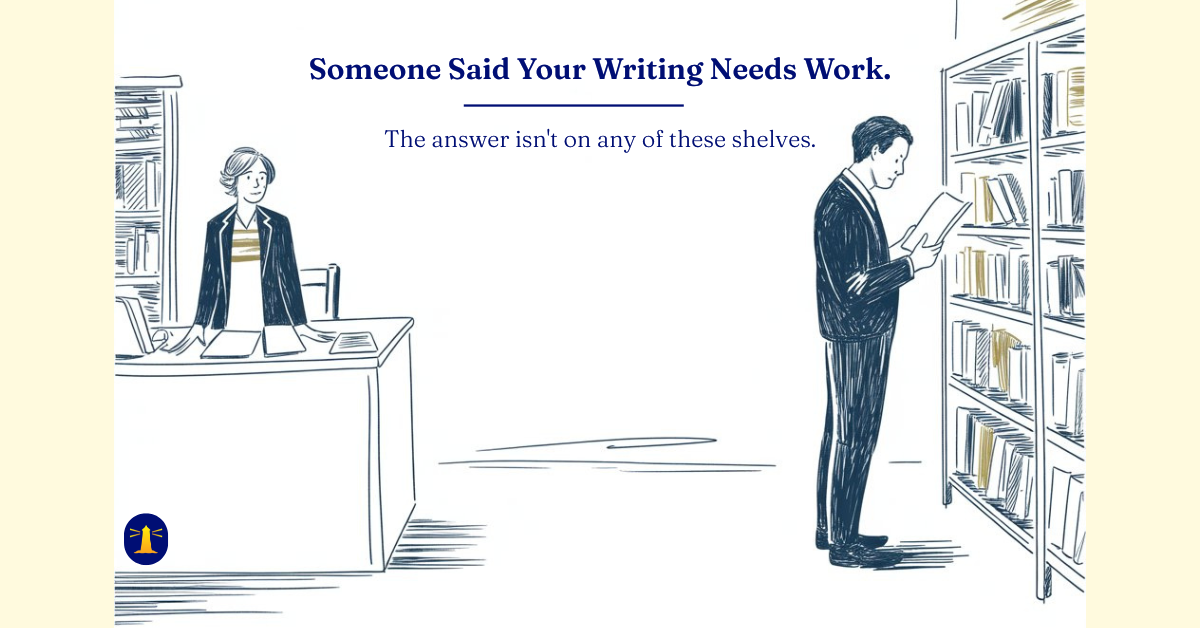
There’s a moment that research librarians know well. A patron comes in, not lost exactly, but circling. Someone they respect, either a boss, a mentor, or a peer whose opinion carries weight, looked at their writing and said, “This needs work. Clean this up before it goes out.” Or “This isn’t quite working. Go re-write.”
The librarian can see what’s happening. The patron isn’t in denial. They’re not here to complain. They’re here searching, moving through writing guides, style resources, grammar references, self-editing checklists, anything that might make them better so the next draft doesn’t earn the same response. The librarian sees this regularly. She recognizes the pattern. And she wishes she had somewhere specific to send them, because what they’re looking for isn’t on any of her shelves.
You Need a Second Reader.
The Gap Nobody Can See From the Inside
Skill isn’t the issue. And grammar or style aren’t the issue, either. The writers who stand across from research librarians in this moment are capable professionals who know their subject and care about how they communicate it. What they can’t see, because no writer can see it from inside their own work, is the distance between what they meant and what landed. That gap doesn’t close with more self-study. It closes with a second reader and some collaboration.
This is not a new insight. In professional writing environments where the stakes are measurable and the readers are powerful and the consequences of unclear writing are real, outside review is never optional. Intelligence analysts don’t send reports to decision-makers without a second reader. Executive briefs go through review before they reach the general’s desk. Not because the writers are weak. Because no writer, regardless of skill or seniority, can fully stand where their reader stands after being inside a problem for weeks. The reviewer’s job isn’t primarily to fix errors. It’s to represent the reader the writer can no longer see.
That’s the standard. It has always been the standard in environments where serious writing gets done. It’s also the argument I made in a recent post about why perspective, not skill, is usually what’s missing. Most people just never see it from the inside; this work is hardly the stuff of film drama.
What My Cousin Vinny Actually Got Right
Except, perhaps, in one case. There’s a scene near the end of My Cousin Vinny where Vinny and Lisa are finally driving out of Alabama, case won, cousin free, future intact. It looks like a simple exit. What it actually is, though, is the payoff for every moment Vinny finally stopped trying to do it all alone.
The case turned on Lisa. She got on the stand and dismantled the prosecution’s tire track evidence with her encyclopedic knowledge of automotive mechanics, the single move that collapsed the case against Bill and Stan. That was visible. What Vinny didn’t know until they were in the car driving away was that Lisa had also quietly reached out to Judge Malloy, Vinny’s own mentor back in New York, the man who had originally persuaded him to pursue law, and persuaded him to vouch for Vinny’s credentials when Judge Haller was threatening to exclude him from the case entirely.
Lisa fixed two problems. He hadn’t asked her to fix either one. And the sheriff tracked down the real killers in Georgia and handed Vinny his closing argument. Even the grits helped. And Lisa had been waiting through all of it. Years of engagement, a wedding that kept not happening, a man whose pride kept costing him the very help he needed. She was close to done.
Every structural piece that held the case together came from Vinny accepting the help around him instead of winning his first case all on his own. His instincts and his questioning style were real. But without the people who carried what he couldn’t carry alone, his cousin goes to prison and Lisa walks. So that highway scene isn’t a victory lap. It’s what’s left when the pride finally gets out of the way.

Letting the Right Person In
Your reader’s version of that highway scene is the moment their document lands. The proposal that gets a response. The report that earns trust. The pitch that moves forward. The work being received the way it deserved to be all along.
That moment doesn’t come from one more round of self-editing. It comes from letting the right person in. In this case, the right person is an editor – which is not the same thing as a proofreader. Proofreading catches what’s already wrong on the surface. Editing for professional business writing addresses what the reader needs that isn’t there yet in a collaborative fashion.
An editor is a second reader who stands where your audience stands and tells you what that audience really needs to hear, where the argument holds, where it slips, where an assumption you stopped seeing is doing quiet damage. Not there to find your weakness but to help you articulate what you know deeply but can’t see as a new reader. The distance between writer and reader is a structural problem, not a personal one and not a skill problem. That distance exists in almost every piece of professional writing that hasn’t had a second reader. Not sometimes. Almost always.
If someone you respect looked at your writing and told you it needs work, that signal is worth taking seriously. Not by studying harder but by getting the kind of help that actually closes the gap.
Where This Starts
Vinny didn’t win by getting better at being a lawyer alone. He won by finally letting the right people carry what he couldn’t carry. That’s not a concession. That’s how things actually get done.
Keep the Key Points Close
If this post resonated, you might want to download:
Where Did Your Reader Get Lost? A Two-Part Writing Diagnostic
This guide helps you identify where your writing stops working for your reader, before it goes out. If you’ve revised the same document more than twice and still can’t say why it isn’t landing, the next step isn’t another round of editing.
👉 Where Did Your Reader Get Lost? (in the Freebie Library)
Curious About Working Together?
If someone you respect has already told you your writing needs work, that’s enough of a starting point.
Start with the Strategic Editorial Diagnostic
Pricing is by document length, starting at $175, with no future commitment required. You’ll get one focused conversation about your document, your reader, and what’s standing between them.
👉 Strategic Editorial Diagnostic

Thanks for reading — here’s to clearer writing and stronger ideas.
~~ Susan
Frequently Asked Questions About the Strategic Editorial Diagnostic
Proofreading catches surface errors: spelling, punctuation, grammar, formatting. It assumes the document is structurally sound and just needs a final pass. Editing addresses something deeper: whether the argument is clear, whether the reader’s questions are being answered, whether the writing is aimed at the right target. If someone you respect told you your writing needs work, they almost certainly weren’t talking about typos.
If the feedback came from someone who knows your field or your audience, and they couldn’t point to specific sentences but said something felt off, unclear, or not quite landing, that’s the gap the Diagnostic is designed to find. You don’t need to know what’s wrong, because finding that and solving is the point of the Diagnostic.
No. The Diagnostic works on drafts at any stage. What it requires is a document that exists and a reader you’re trying to reach. You don’t need to have it ready.
Usually not. Colleagues who know your field share the same assumptions you do. But there’s a deeper issue: reading as a naive reader, someone who doesn’t yet know what you know, is a skill that takes years to develop. An experienced editor has trained to stand where your reader stands. A well-meaning colleague, however smart, almost certainly hasn’t.
That’s exactly the situation the Diagnostic is designed for. You don’t need to diagnose the problem yourself before asking for help. Knowing something isn’t landing is enough of a starting point.