The Standard Nobody Tells You About
Most people have never seen professional writing get made. Not the kind where the stakes are real and the readers are powerful and the argument has to land. That world has its own standards. And one of them, at every level, is that consequential writing doesn’t go out alone.
Not because Jane didn’t know the answer.
Because she didn’t know that was the question.
Jane’s Line Sheet
Jane spent eight months on her collection. She sourced fabrics deliberately, some of them rare, all of them chosen for weight and drape and the way they moved. She studied historical garments for reference. She added trims because she believes fabric should be enhanced, not left to speak alone. Every detail on every piece had a reason for existing.
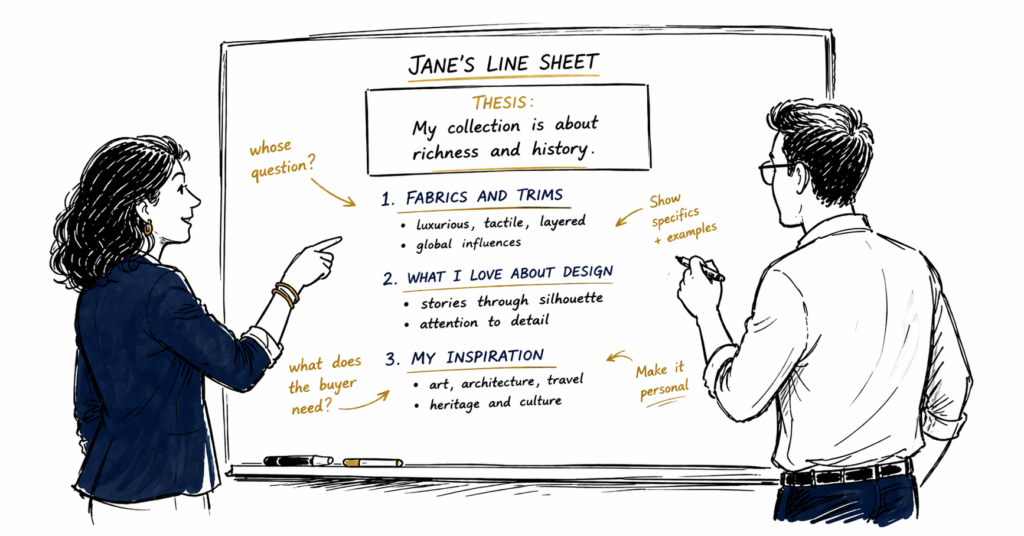
She wrote her line sheet in one afternoon. It listed everything a buyer would need: item numbers, wholesale prices, available sizes, color options. Photos that showed the work at its best. And she wrote a brand paragraph that said, “My collection is about richness, rich fabrics inspired by clothing history over the past thousand years. I love trims because fabrics should be enhanced.”
She sent it to fourteen boutique buyers. She only heard back from two. And neither moved forward.
Jane figured the buyers just weren’t looking for her aesthetic right now. Or maybe the timing was off. Maybe the market was saturated. Those boutique buyers just didn’t appreciate what she was doing. She went back to designing.
The line sheet is still sitting in her sent folder, unchanged.
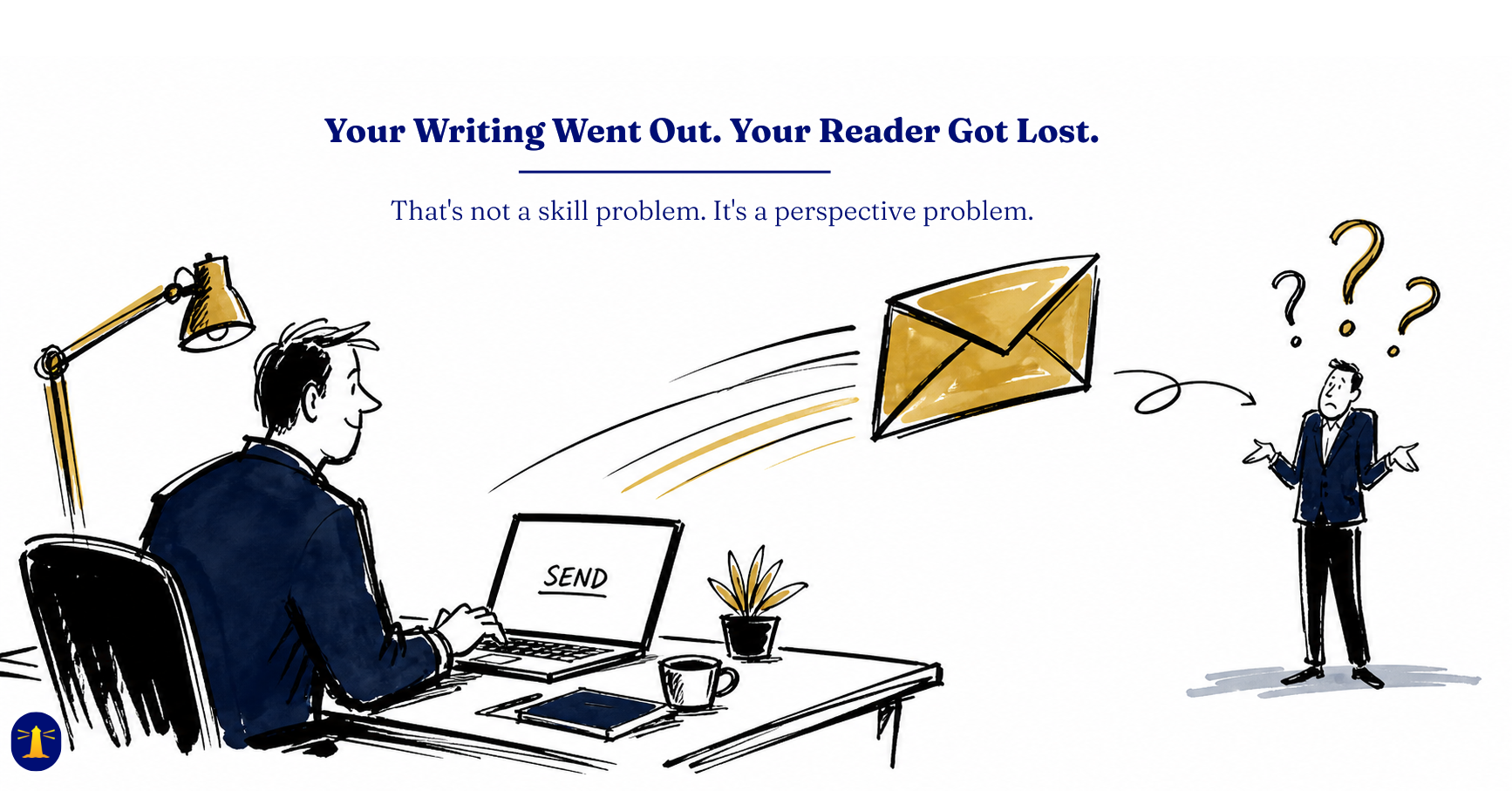
What Jane couldn’t see, because she never asked anyone to review her writing, was that her brand paragraph described the collection the way she experienced making it. It told buyers what Jane loves. What Jane values, and what inspires Jane.
However, a boutique buyer has one question when she opens a line sheet: will my customers buy this? The buyer’s thinking about the woman who comes into her store on a Saturday afternoon, pulls something off the rack, and feels something. The buyer needs to know who that woman is and why this collection is for her.
Jane actually knew the answer. Her customers are people who see clothing as wearable art. Who recoil from fast fashion. Who will pay for fabric that was chosen with intention and finished with care. And that person is a real customer as well as a customer a boutique buyer can picture.
But Jane’s line sheet never said that. It said what Jane felt. Not what her boutique buyer customer needed.
The buyer’s question never got answered. Not because Jane didn’t know the answer. Because she didn’t know that was the question.

Why Nobody Can See This From the Inside
Jane isn’t unusual. What happened to her line sheet happens to most professional writing that goes out without outside judgment. Writers doing their own professional writing are not careless or unskilled in the mechanics of writing. But they cannot both be close to their content and see it with new eyes. Writers cannot manufacture distance from within their own expertise.
When you know something deeply, you write from inside it. You answer the questions you believe are important. You emphasize what matters, in your own judgment. There are always assumptions you’ve stopped noticing because they’re so familiar, and those stop being visible entirely. The reader, standing somewhere completely different, asking a completely different question, becomes invisible.
Think about the last time you read something in your own field written for a general audience and winced. The author used jargon without defining it. They skipped a step that felt obvious to them and left you lost. They spent three paragraphs on something you didn’t need and one sentence on the thing you actually came to understand. They weren’t careless. They were inside their expertise, writing to a version of the reader that lived in their head rather than the one holding the page.
That’s what Jane did. That’s what most capable, knowledgeable writers do when they write without a reader who isn’t them.
This isn’t a flaw in the writer. It’s a feature of expertise itself. The closer you are to what you know, the harder it is to see the distance between what you understand and what your reader needs in order to follow you there. Researchers have a name for it, the curse of knowledge, and it is a well-established cognitive bias. Once you know something, it becomes nearly impossible to remember what it felt like not to know it.
Outside judgment doesn’t fix bad writing. It fixes the gap between what you meant and what landed. That gap exists in almost every piece of professional writing that hasn’t had a second reader. Not sometimes. Almost always.
Standard Process for Serious Writing
Here’s what most people never see. In professional writing environments, the ones where the stakes are real and the consequences of unclear writing are measurable, outside judgment is never skipped. Not because first drafts have errors, but because cognitive biases are inevitable. So a second pair of eyes reviewing any writing is built into the process from the beginning, because the people in those environments learned a long time ago that a single perspective is never enough.
Intelligence reports don’t reach decision-makers without a review by a second pair of eyes. And our intelligence analysts are not weak writers and are very well-trained. But because the analyst who spent three weeks inside a problem cannot see it the way a reader who needs a clear answer in four minutes sees it. The reviewer isn’t correcting mistakes as much as calibrating aim.
Executive briefs get a second reader before they land on a general’s desk. Policy documents, white papers, consequential proposals, none of them go out without review. The writer’s job is to know the material. The outside reader’s job is to represent the audience the writer can no longer see clearly because they’ve been too close to the problem for too long.
I spent years inside those environments. Writing for senior government officials. Synthesizing complex material under pressure for four-star generals who had no patience for writing that buried its point. Learning intelligence community writing standards from people who had refined them over decades of consequential work. And the one thing that was never optional, at any level, for any writer, regardless of experience or seniority, was outside review.
And that includes my own writing, thank goodness. I didn’t want to be exempt from review; I wanted that assistance. I’ve been edited hundreds of times and at the highest levels of consequential writing, on material where clarity wasn’t a nicety but a professional requirement. And there was always something. Always. An assumption I stopped seeing, an argument I thought I’d made that lived only in my head. Sometimes a reader’s question I forgot to answer because I already knew the answer.
I never saw my editors as shoring up any weakness in my skills. Editing is simply the standard. That’s what serious writing looks like from the inside. But that scene is never sexy enough to be in movies or the turning point of a spy novel. Reviews are simply just done. But almost nobody outside those environments realizes how normal that is. Honestly, now that I have no one to check my writing, I am both a lot slower (reading, resting on it, re-reading) and my production is of lower quality.
The Variable Nobody Examines
Jane doesn’t need to work inside the intelligence community to write like someone who does. She needs one thing: a reader who isn’t her. Not a red pen. Not a grammar check. Not a colleague who says “looks good” because they don’t want to hurt her feelings or because they’re too close themselves to see the work clearly. A reader with enough distance from her expertise to see what her boutique buyer actually needs to know.
Jeff needs the same thing. Jeff runs a bookkeeping business. He’s good at what he does, his clients stay, his numbers are accurate, his process is clean. He built a website because that’s what you do when you want new clients. He wrote the service pages himself because he knows his business better than anyone.
His website lists everything he does. Monthly reconciliations. Payroll processing. Tax preparation. Catch-up bookkeeping for businesses that have fallen behind. It’s accurate. It’s complete. It’s organized.
It’s also aimed at the wrong question. A small business owner looking for a bookkeeper isn’t scanning for a list of services. She already knows what bookkeeping is. What she’s actually asking, the question underneath the search, is this: can I trust this person with something I’m already anxious about? Will they judge me for the mess I’m in? Do they understand businesses like mine?
Jeff’s website doesn’t answer any of those questions. Not because Jeff can’t answer them. He answers them every time he gets on a call with a prospect and the prospect relaxes within five minutes because Jeff is calm and nonjudgmental and clearly knows what he’s doing. But that Jeff, the one who earns trust in a conversation, never made it onto the website. The website has the other Jeff. The one writing from inside his own expertise, listing what he knows how to do, to a reader he’s stopped being able to see.
Jane blamed the buyers. Jeff wonders why his website isn’t converting. Neither of them has examined the one variable that would change everything.
It’s not their skill, or their product. Or the market, the timing, or the competition. It’s that the writing went out without a review. Without a professional editor with the judgment and experience to stand where their audience stands and say: here’s what your audience actually needs to hear, and here’s where you stopped saying it.
Adopting that practice isn’t admitting weakness. It’s working the way serious writers work.
What It Feels Like When It Works
Jane’s collection is beautiful. Jeff’s bookkeeping is solid. Neither of them has a skill problem.
What they don’t have yet is the confidence of sending something out that they know will catch their customer. Jane and Jeff want the feeling that their work is being received the way it deserves to be.
That feeling has a name. It’s called being understood by the people you’re trying to reach. It’s the moment a boutique buyer reads a line sheet and thinks: my customers will love this. It’s the moment a small business owner reads a service page and thinks: this person gets what I’m dealing with and will give me the help I need.
That moment doesn’t happen by accident. It doesn’t happen by writing harder or knowing your subject better or revising one more time alone at midnight. The good news is that the gap is fixable, but not by revising alone. That solution has a name: an editor. Not the red-pen kind from school but the kind who stands where your reader stands and tells you what they actually need to hear.
Every month I put together a free calendar, just for fun. May’s calendar is in honor of the Maryland Sheep & Wool Festival, and it features the cutest sheep on the planet.
👉 May 2026 Calendar (in the Freebie Library)
Keep the Key Points Close
If this post resonated, you might want to download
Where Did Your Reader Get Lost? A Two-Part Writing Diagnostic
This guide helps you identify where your writing stops working for your reader, before it goes out. If you’ve revised the same document more than twice and still can’t say why it isn’t working, the next step isn’t another round of editing.
👉 Where Did Your Reader Get Lost? (in the Freebie Library)
Curious About Working Together?
If you’re wondering whether your writing is aimed at the right questions, that’s exactly what the Strategic Editorial Diagnostic is for.
Start with the Strategic Diagnostic
Pricing is by document length, starting at $175, with no future commitment required. You can start with a simple conversation to explore what kind of help would serve you best.
👉 Strategic Editorial Diagnostic

Thanks for reading — here’s to clearer writing and stronger ideas.
~~ Susan
Frequently Asked Questions About Outside Editorial Judgment
Any writing where the reader’s question is different from the writer’s expertise. That includes service pages, proposals, white papers, grant applications, executive summaries, and business communications of any kind. The format matters less than the gap: if you know the subject well and wrote it yourself, outside judgment is warranted.
A skilled copy editor will often catch aim problems, not just mechanical ones. But if they do, you’re looking at reworking the content and then paying for a full editing pass afterward. The Diagnostic front-loads the aim question before any line-level work begins. Starting at $175, it’s often less expensive than discovering a structural problem mid-edit and cycling back through.
No. The Diagnostic works on drafts at any stage. What it requires is a document that exists and a reader you’re trying to reach. You don’t need to have it “ready.”
Usually not. Colleagues who know your field share the same assumptions you do. They often can’t see the gap for the same reason you can’t: they’re too close to the expertise. Outside judgment means someone who stands where your reader stands, not where you do.
That’s exactly the situation the Diagnostic is designed for. You don’t need to diagnose the problem yourself before asking for help. Knowing something isn’t landing is enough of a starting point.