
I’ve worked with a professional editor, opened the returned draft, and felt a jolt of panic. My tone sounded flatter. A few strong lines got softened. Even the order of my points shifted. On paper, the writing looked “cleaner,” yet it didn’t feel like my author’s voice and it really wasn’t my original structured argument.
For a small business owner or solo writer, that moment is expensive to your writing career. It can mean lost authority in your storytelling, brand voice drift, a wasted budget, a delayed launch, and then a quiet decision to publish less often.
Trust in editing means you can predict what will change, why it will change, and where your final say lives.
Key Takeaways
- A healthy workflow includes decision rights and a calm way to disagree. Typically, the editor explains risk, and the author decides.
- Trust in an editor comes from a clear process, not personality. You should be able to predict what your editor will change and why.
- Before you hand over a draft, share a short brief (tone, audience, non-negotiables, success criteria, risk areas) to protect your voice.
- Trust builds when an editor confirms the goal, sets scope boundaries, explains comments in terms of reader impact, and flags meaning-changing edits.
- Ethical editing requires transparency and consent. Editors should not silently change your intent, positioning, or promises.
Estimated reading time: 12 minutes
Trust in editing is the difference between shipping work you stand behind and second-guessing every sentence. Such trust is built at specific moments where an editor proves they can protect both your voice and your goals. If you’re wondering how long that trust takes to form, see How Long Does It Take to Trust an Editor? This post names those specific moments, how I test fit, and what ethical editing looks like when the stakes are real.
A Quick Self-Check Before You Hand Over A Draft
Before I hand over the first draft, I do a short reset. It takes five minutes, and it saves hours of rework. More importantly, it keeps my voice from getting “improved” into something generic. If you want a fuller version of that reset, see How to Sharpen Your Vision Before You Hire an Editor.
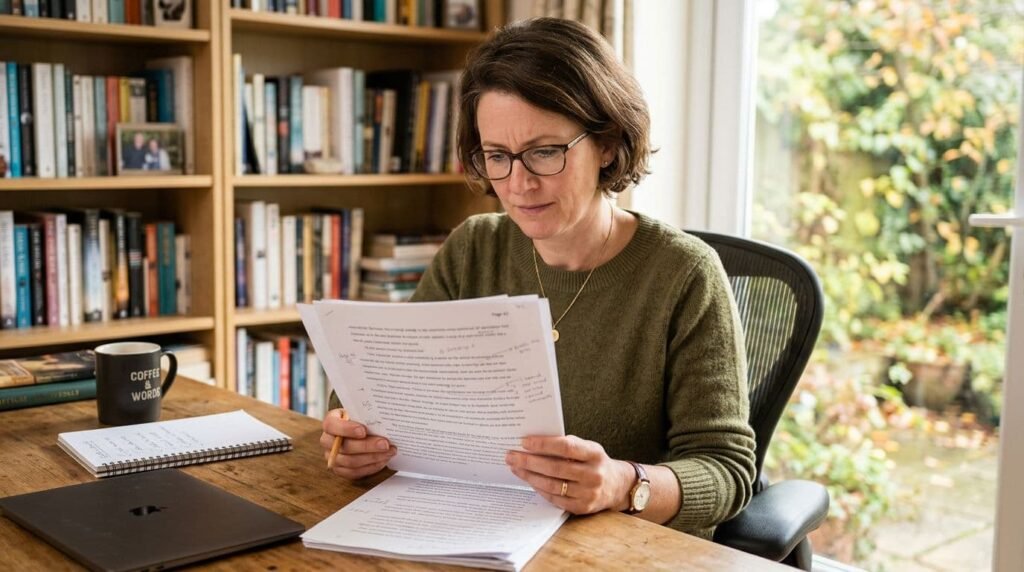
Here are the prompts I answer, in plain language:
- Tone that must stay: What can’t change (calm authority, warmth, blunt clarity with succinct phrasing)?
- Audience in one sentence: Who am I trying to help or persuade, and what do they care about?
- Non-negotiables: What claims, examples, or phrases must remain because they define my stance?
- What success looks like: What should a reader think, feel, or do after reading?
- Risk areas: What sections are high-stakes (positioning, pricing, bio, legal-ish wording)?
When I share these up front, it promotes open communication, so I don’t need to “fight for my voice” later. I’ve already defined it. If you want to see the kinds of business writing I support and how I scope it, start here: Editing for small businesses and independent professionals.
The Real Reason Trust Breaks
It’s usually a process problem, not a personality problem
Most editing conflicts in the writer-editor relationship don’t start with ego. They start with missing agreements in the editorial process. If the scope is fuzzy, the editor has to guess what “better” means. If decision rights aren’t clear, meaning-changing edits can sneak in as “cleanup.”
Here’s a common misalignment I’ve lived through: I expected light line edits. The editor delivered a heavy rewrite. They weren’t trying to take over; they were trying to help. Still, the result was a draft I had to re-author under deadline.
When I say I want trust in editing, I mean something simple: I can predict what the editor will change, why they’ll change it, and where my final say lives. That predictability fosters mutual trust. It is calming. It also protects my authority, because my audience hears my stance, not a blended version of it, to hold the reader’s attention.
If you’ve ever thought, “My editor doesn’t get me,” it may be truer to say, “Our process didn’t define the target of clear and impactful content.”
Where Trust Is Actually Built in the Editing Process
There are key moments that make or break it.

I don’t decide to trust an editor because they seem nice. I trust them because they handle a few key moments well, demonstrating judgment that goes beyond technical ability. Each moment gives me evidence that they can improve the work without moving my goalposts. If you want a concrete picture of what this looks like in practice, read Curious What It’s Like to Work With an Editor?
Onboarding clarity
What I look for: the editor asks questions that sound like developmental editing strategy, not just grammar.
What I ask: “Can you restate my goal for this piece in one sentence?”
Good looks like: “This needs to read as publish-ready thought leadership for potential clients, so we’ll prioritize clarity over cleverness and credibility over hype.”
Risky looks like: “I’ll fix it up and make it flow,” with no shared definition of “flow.”
That restated goal prevents the later feeling of being “corrected.” It turns editing into alignment.
Scope boundaries
What I look for: clear boundaries around depth and deliverables.
What I ask: “What will you change silently, and what will you always flag?”
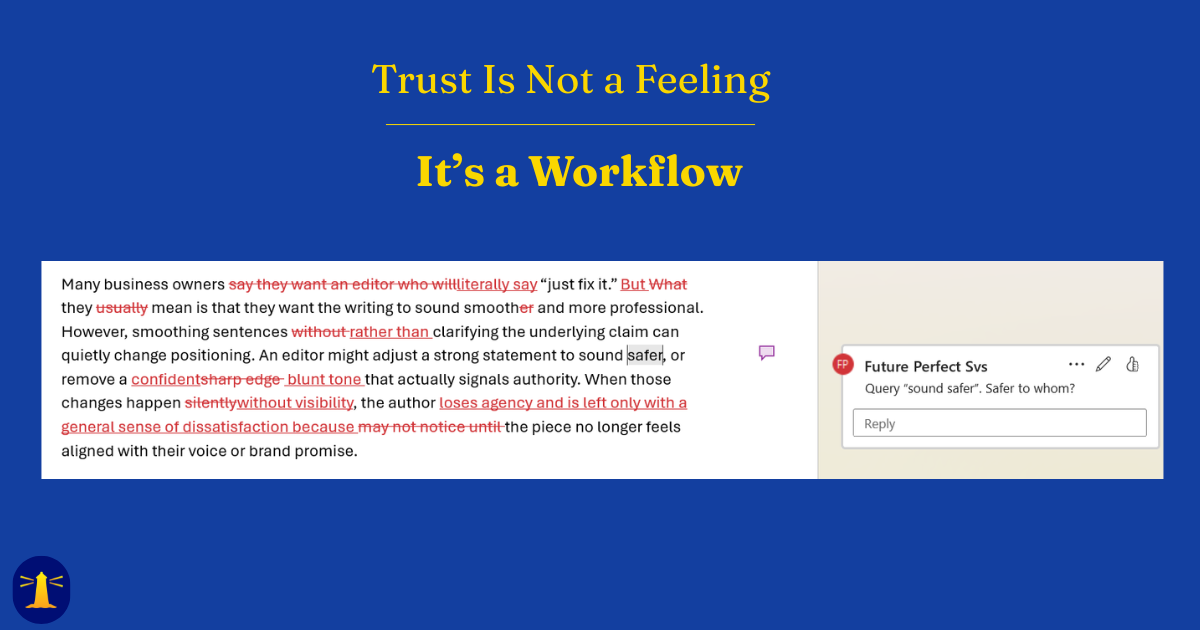
Good looks like: the editor says they’ll fix low-risk mechanics quietly (typos, basic grammar, copy editing), but they’ll query anything that shifts meaning, tone, or positioning, especially line editing changes. They’ll flag claims needing evidence, but they won’t invent sources. They’ll suggest structure changes, but they won’t rewrite my point of view without asking, always preserving the author’s voice.
Risky looks like: heavy rewrites with no explanation, then a note that says, “I improved this section.”
Decision rights are the backbone of trust in editing. Without them, every clean sentence has a question mark.
Comment tone and intent
What I look for: comments tied to reader impact, not personal taste.
What I ask: “Why this change, and who does it help?”
A strong comment sounds like this (and I’ve saved ones like it): “I kept your voice, but tightened this line because it reads as defensive to a new client. Do you want confident or conversational here?”
A risky comment sounds like: “This is wrong,” “You can’t say that,” or “No one will care.” Vague editorial criticism or unhelpful remarks push me into arguing, because the editor didn’t show the note behind the note, their reasoning for constructive feedback.
A creative collaborator can challenge my first draft while still treating me like the decision-maker.
Revision boundaries
This is especially important for high-stakes sections, and important in a different way for AI-assisted drafts. What I look for: extra care around the parts that define me.
What I ask: “Can you use a light touch on my bio and positioning lines, and query instead of rewriting?”
Good looks like: the editor marks a paragraph “rewrite suggested” and explains why, instead of rewriting it invisibly. For AI-assisted drafts, they watch for logic gaps, overconfident claims, and voice shifts. They also flag anything that sounds certain without support, especially in the revision process.
Risky looks like: a polished paragraph that reads well but quietly changes what I’m promising. That’s how brand drift happens: one “better” sentence at a time.
Disagreements and final decisions
What I look for: a simple way to disagree without drama.
What I ask: “What’s the risk if we keep my version?”
Good looks like this workflow: I ask for the reason, the editor ties it to audience and goal, then I decide. For example, an editor suggests cutting a metaphor because it slows the paragraph. I keep the metaphor, but I trim one sentence so the point lands faster.
Risky looks like: the editor taking disagreement as a threat, or me treating every suggestion as an insult. In a healthy process, firm craft and diplomatic flexibility can coexist.
Five key moments determine trust in an editor.
Common Misconceptions About Working With an Editor
Even careful professionals carry a few myths into the editing relationship. I’ve believed all three at different times.
Misconception: “A good editor should just fix everything.”
“Fix everything” sounds efficient, but it hides decisions. I once approved a draft quickly, then noticed my key claim had shifted. The writing was smoother, yet my audience would’ve heard a different stance.
A good editor improves the writing, yes, but they also make meaning-changing choices visible. That’s part of trust in editing.
Misconception: “If I feel discomfort, the editor is overstepping.”
Some discomfort is useful; it fosters psychological flexibility and contributes to professional development. Clearer structure can expose weak logic. A tightened sentence can reveal I was hedging.
Still, true overreach feels different. It’s when the edit changes my intent, my moral stance, or my brand promise.
My simple rule: If the edit changes what I mean or what I’m willing to claim, it needs my explicit yes. If it changes how cleanly the reader understands me, it can be a suggestion.
Misconception: “Trust means stepping back completely.”
When I disappear during an edit, I tend to feel blindsided by the final draft. Then I waste time reacting instead of deciding.
Real trust stays active. I want checkpoints, queries on high-stakes lines, and clear “why” notes. Blind faith isn’t the goal, clarity is.
The Ethical Stance Behind Strong Editing
An ethical editor guards both your voice and your goals.
That line is simple, and it’s demanding. In practice, it means transparency, consent around meaning-changing edits, respect for author intent, and reader-first clarity.
Here’s what ethical behavior looks like in real life: an editor flags a claim that could mislead readers, upholding principles seen in journalism, but they don’t moralize. They might write, “This reads as a guarantee. Do you want to soften it, or add a condition?” My tone stays intact, and the reader gets honesty. My own standards for that kind of clarity were shaped long before I worked as an editor. If you’re curious where they came from, read What My Years in Government Taught Me About Writing.
Why Future Perfect Services does this differently
When I want trust in editing, I want a process I can understand. FPS’s editing service runs editing with clear stages: a diagnostic read that names the biggest risks first, silent fixes for low-risk items, focused edits tied to the goal, then targeted sweeps for consistency. If you want editing support but you feel stuck on the onboarding step, I wrote a separate piece for that moment: Want Editing Help … But the Setup Is Too Much?
In a mini-scenario that feels familiar, I send a draft and get a sample edit back: “Your argument is strong, but two sections bury the lead. I’ll fix mechanics silently. I’ll query any line that changes positioning or claims.” Now I can relax, because I know where the editor will act and where they’ll ask.
That structure builds trust, as echoed in client testimonials, because it makes decisions visible.
Frequently Asked Questions
You’ll know in the first review cycle. A trustworthy editor can restate your goal clearly, explain why they suggest changes, and flag anything that shifts meaning or positioning. If meaning changes, you decide.
You should give your editor authority over low-risk mechanics, not over your intent. They can improve clarity and structure, but meaning-changing edits require your approval. Trust does not mean surrendering authorship.
Useful discomfort strengthens your argument and tightens weak logic. Overreach changes your intent, stance, or brand promise without consent. If the meaning shifts, it needs your explicit yes.
AI drafts often contain logic gaps, overconfident claims, or voice drift. Editors should correct mechanics and flag unsupported certainty, but they should not invent evidence or rewrite your positioning without approval.
Choose based on your goal. Developmental editing addresses structure and argument, line editing improves clarity and flow, and copy editing corrects mechanics. A diagnostic review can clarify the appropriate level.
Trust Is Not a Feeling. It’s a Workflow
Trust in editing grows when an editor proves, moment by moment, that they can protect my voice and my goal. I watch for onboarding clarity, clear scope boundaries, respectful comments, careful handling of high-stakes sections, and a clean way to disagree. I don’t need blind trust; I need a process that keeps choices transparent and keeps my authority intact. When that’s in place, publishing feels steady again, because the edits preserve the author’s voice, align with my storytelling, and rebuild trust in editing.
Writing Clarity Starts With Cost Clarity
If you want to trust the editing process, you need cost clarity, too. The tool below helps you estimate a realistic range before you commit.
Editing Cost Calculator
This guided calculator helps you identify the cost drivers behind your project, so you can plan with fewer surprises and choose the right level of editing.
👉 Get access to the Editing Cost Calculator
Build the workflow before you hand over trust
If you are carrying the writing load yourself, it is easy to lose perspective. Premium Access gives you an editorial partner, with clear boundaries and a predictable workflow.
Premium Access
Only a few Premium Access clients are active at any given time. If you’re thinking about it, now is a good time to reach out.
Premium Access is structured, on-call editing for the work that matters most, without re-scoping every project. You get clarity on what will be changed, why it will be changed, and where your final say lives. Not sure if this is a retainer? It isn’t. Premium Access Isn’t A Retainer explains how it works.

Thanks for reading — here’s to clearer writing and stronger ideas.
~~ Susan

🕒 Comments are open for 30 days to support timely conversation. Thanks for being here while the post is fresh.