Sometimes you’re writing and feel completely alone.
You waited until everyone else left the office so you could think. But now, staring at a messy draft, it’s clear: you need an editor. Or maybe you’ve been working for days and you know the piece needs outside help. But you also know it’ll take a week to find someone, never mind getting through the paperwork to pay them.
The logistics are blocking you from the help you want.
After years of being that writer working after hours, I wanted to design a better way, especially for solo entrepreneurs and independent professionals. They don’t need full-service editorial retainers. They just need a smooth, fast, trustworthy way to get editing help, maybe even overnight.
But editing often gets left out of project planning.
When a busy professional is in the middle of a time-sensitive project, there’s rarely time or energy to line up editing support in advance. And for solo professionals, the real bottleneck isn’t resistance. It’s setup friction. what can that cost?
- Grant deadlines → A late submission often means automatic disqualification.
- Board reports → One unclear sentence can raise unnecessary questions from executives.
- Policy memos → Legal or regulatory consequences if language isn’t precise.
- Website rewrites → Tone or phrasing issues can damage brand trust or raise compliance flags.
- Book launches → A missed upload window means no pre-orders, no launch.
These professionals aren’t avoiding the red ink of editing. They’re hard-charging, busy professionals with too much on their plates. They’re trying to protect outcomes, approvals, and reputations. And when they’re searching for how to hire an editor quickly, it’s not a casual search. It’s a risk decision under pressure.
In this post, I’ll show you how to avoid that late-night “I can’t send this yet” moment … by setting up access before the panic window.
Key Takeaways
- Many professionals skip editing not because they fear critique, but because the setup feels too slow, too expensive, or too vague.
- The biggest obstacles are lack of process knowledge, unclear expectations, and the effort to build a trusted relationship in a rush.
- Most panic moments are really logistical ones caused by delays, surprises, or confusion during the editing setup.
- A pre-established editorial relationship solves most of this, and it doesn’t have to cost much.
- My Premium Access model handles the logistics ahead of time, so you can start fast when it matters most.
Why These Clients Don’t Know the Editing Process
More people would absolutely use editing help if the setup didn’t quietly shut them out.
How are these professionals shut out?
1. Because they’re smart, capable professionals who don’t normally need help. They’ve never had to learn how editing works, and the industry doesn’t make it easy to find out.
2. They’re not serial authors. Editing is a support task to them, not a craft they study. And they are taken aback to learn that editing is mostly collaborative and will take their time. They can’t get the best results by shipping it off and getting one shipment back with no other engagement.
3. Unintentionally, the typical quote process hides the customer’s participation from new customers. Editors ask for a sample or a call before explaining anything. (If you’re not sure what kind of edit you need or how to prepare for help, this post on sharpening your editorial vision might help clarify your next step.) There’s no visible roadmap. There’s no clarity on the differences between developmental editing or copy editing or proofreading or formatting. (If you’re wondering what those terms actually mean, this post breaks down the differences so you can understand what kind of editing you really need.) Meanwhile, I can just see the customers think, “All that goes into editing? Is it really needed? Do I have to pay for all that?”
4. They’re used to just-in-time support. Professional designers, accountants, and coaches can usually jump in with a short brief. These clients expect editors to work the same way, and are taken aback when that’s not the process.
5. They don’t realize editing involves mutual calibration. They think “editing” means fixing typos and cleaning up language. They don’t expect it to be relationship-based, iterative, or staged.
The Barrier Isn’t Critique. It’s Bad Setup
It’s easy to assume that people avoid editors because they’re afraid of critique. But most professionals can handle feedback. In fact, many welcome it.
The real hesitation comes from something more logistical: not knowing how the process of getting editing actually works.
Hiring an editor often happens right when the pressure spikes: before a grant deadline, a policy review, a launch, or a board meeting. These clients aren’t afraid of red ink. They’re busy. And they can’t afford confusion about what comes next.
But confusion is what they get:
- When does the edit begin?
- What kind of edit is this: line, copy, developmental?
- What will the editor need from me, and when?
- What’s the actual path from now to done?
- How long is it going to take to figure this out before the editing work even begins?
Most professionals outside publishing don’t know the answers. And the industry doesn’t help. There’s no explanatory playbook or manual. Many editors expect a discovery call before revealing scope, timelines, or workflow. That’s fine for novelists. But it’s a barrier for deadline-driven clients who are just trying to get the job done. Business simply runs at a different tempo than book publishing.
These professionals expect editing to work like other support roles: brief, quote, go. But editing usually involves calibration, mutual understanding, and a defined handoff process. When that’s invisible, professionals opt out.
Why Retainers Don’t Work for Small Businesses
Retainers sound smart: guaranteed access, fixed monthly rates, no scramble. But for most small businesses, consultants, and solo professionals, they don’t work. Not because editing isn’t valuable, but because the rhythm is wrong.
Retainers are built for regular usage. Weekly blog posts. Daily content updates. Recurring campaigns. If you have that kind of volume, a retainer makes sense.
But most of the people I know don’t need constant editing. They need trusted editing, at the right moments, with a quick launch into a smallish task. They need help with a launch, a proposal, a keynote, a important deliverable. Not every week. But when it matters, it matters deeply.
Retainers make you commit before you know what you’ll need, and they punish you for not needing it often enough.
They force you to decide early how much editing you’ll need later and lock you into using it fast, or wasting the money. That’s backwards for professionals who run lean.
The people I support aren’t trying to publish more. They’re trying to publish wisely. They want strategic feedback, judgment, and voice protection, not just a clean-up pass. (If “judgment” in editing feels vague, this post shows how it works in practice. And why it makes the biggest difference in high-stakes writing.) But the industry isn’t set up to deliver that. Most editors advertise copyediting and proofreading. Not thinking partnership.
That’s where the gap lives.
Most of my clients don’t want to “hire an editor.” They want to “have an editor.” Ready, briefed, and already onboarded into the client’s world. So when something big hits their desk, they don’t have to start from scratch.
That’s what I offer. Not a retainer. Not a panic button. A calm, pre-established partnership you can count on with clearly defined contract parameters and no monthly bill.
What really pushes clients away: Mismatched tempo and invisible labor
Most of my clients can handle feedback. They’ve been through performance reviews, stakeholder edits, and public comments. They’re not afraid of Track Changes.
They’re caught off guard by the setup.
Because they’re used to high-speed support in other areas (designers, accountants, IT) and expect editors to work the same way: a quick brief, a scoped quote, a delivery date. Instead, they get asked for samples, goals, audience definitions, contract reviews, and pre-work. And suddenly the help they needed feels like one more full-time job.
The mismatch is jarring. Right when they need speed, they’re asked for reflection. When they want clarity, they’re asked to define the scope. And when they expect a quick yes/no, they’re asked to join a process they don’t understand.
It’s not resistance to critique. It’s shock at how much front-loading is required.
And many don’t realize this is normal. They think they’ve made a mistake, or chosen the wrong editor, or that they’re not “ready” for editing at all.
So they drop the project, or they muscle through without editing, and not because they don’t need help, but because the setup feels like one more thing they can’t afford to get wrong. And next time? They won’t even consider hiring an editor.
The real panic moment, when the next step is unclear
There’s a moment when a client thinks, “Wait, what happens now?” That’s the moment their nervous system takes over.
What Clients Start Wondering When the Clock Is Ticking
In the early hours of deadline stress, most clients don’t ask about voice, revision cycles, or editing theory. They ask three simpler, sharper questions:
1) Is this editor even available?
They don’t know if the inbox reply will be a yes, a no, or a waitlist. Uncertainty here causes immediate stall.
2) How fast can I get help?
Even if they don’t need a rush job, they want to know the timeline now. Not after a discovery call, quote, and contract review.
3) How hard will this be to set up?
If there’s no visible path, or if the early questions feel heavy, they may decide it’s easier to just keep struggling through alone.
These are project management questions, not creative ones. That’s why your early communication on timeline, process, and scope matters more than your editing credentials or even skills.
When communication is vague, the brain reads it as danger. A slow reply, a fuzzy estimate, or shifting expectations can make even a calm client send an urgent email. Not because they’re difficult, but because they’re trying to regain footing.
What clients are actually afraid of: losing time, control, or clarity
When a client sounds panicked, I translate it into practical fears. The message under the message is often one of these:
- Losing time: missing a deadline, missing a launch window, missing an approval cycle.
- Losing control: edits that change meaning, tone, or intent, or edits that trigger internal disagreement.
- Losing clarity: the final document feels “off,” even if it’s grammatically correct.
For executives and government-sector teams, there are extra layers. There may be approvals across offices. There may be compliance language that can’t shift. There may be reputational risk if a public-facing piece is unclear. In that setting, panic often shows up as:
- Rapid-fire questions
- Extra attachments and “one more thing” notes
- A sudden change in scope
- Requests for reassurance that are really requests for a plan
That’s why I don’t treat client panic as drama. I treat it as a signal that something in the setup is unclear. Let’s look at what really causes the panic window, and how the editor’s onboarding process for the client feeds it.
The True Trigger: Slow Onboarding Process for Clients
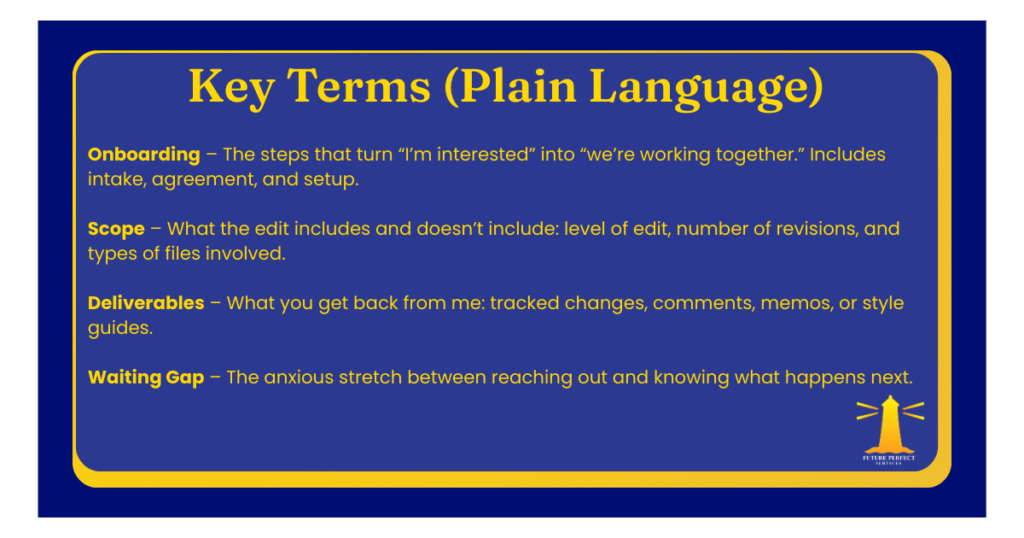
The editor’s onboarding process for clients is the set of steps that turns “I might need an editor” into “we’re working together, and here’s what will happen.” It’s the bridge between interest and delivery.
When onboarding doesn’t match the client’s environmental reality, clients feel disoriented exactly as they are depending on the editor for direction. If the editor defaults to a book publishing model, the clients might not even be clear on what questions to ask in this unfamiliar environment. They don’t know what they’ve agreed to, what the editor needs, or how to move forward. That confusion creates stress, especially when deadlines are tight.
Common friction points are simple:
- Unclear contract or no written terms
- Unclear scope (what’s included, what isn’t)
- Unclear timeline (start date, delivery date, revisions)
- Unclear files (format, version control, where comments will live)
- Unclear communication rules (email, calls, response times)
- Unclear style guide or deliverables
None of this requires perfection. It requires visibility.
Where onboarding breaks down, contract, scope, timeline, and communication
When I hear “We thought this was a quick edit,” I usually don’t hear a bad client. I hear a weak definition.
In the editor contract process, clients need a few basics spelled out in plain language, including editor rates:
- What level of edit they’re getting (whether it’s a developmental editor, substantive editor, line editing, copy editor, or proofreader, and what that means in practice)
- What deliverables they’ll receive (tracked changes, comments, a memo, a style sheet)
- What files I need (Word, Google Docs, PDF for reference, manuscript)
- How many rounds of revisions are included
- How questions work during the edit
- What “done” means (final file, final pass, or final plus post-review)
- The timeline of the whole effort – or what can be changed to meet the timeline the client has
Vague terms like “light edit” or “quick turnaround” can backfire. They sound friendly, but they don’t protect the schedule. If you’re trying to understand how to hire an editor for a high-stakes document, clarity matters more than charm.
For authors, the same issue shows up when self-publishing authors are trying to hire a nonfiction editor for their manuscript and aren’t sure what book editing services they need, like developmental feedback or copyediting. Many hiring guides focus on finding the “right” editor, but the calmer win is agreeing on the actual work. I like the straightforward checklists in How to Hire a Book Editor: What Writers Should Know because it pushes clients to name what they need, not just what they feel.
If you want a solid set of interview prompts, resources from the Editorial Freelancers Association and Hire an Editor With These 10 Questions are also helpful references. The best questions don’t test the editor’s ego, they test whether the process is clear.
The waiting gap is the panic window
The biggest spike in anxiety often happens in the gap between first contact and a clear plan. This is the “waiting gap,” and it’s where people start searching phrases like hire an editor fast and how to hire an editor quickly at 11:30 p.m.
A few things can create that gap:
- “I’ll get back to you soon” with no next date
- A quote with no timeline and no intake steps
- No clear way to reserve a slot
- A request for files without saying what happens after files arrive
For deadline-driven work, the waiting gap collides with real calendar pressure. Internal review cycles don’t pause because an editor is busy. Print deadlines don’t move because the scope was unclear. Book upload windows don’t care about good intentions.
If I can reduce that gap, I can reduce panic. That’s true even when the schedule is tight.
Potential Clients Really Want Readiness, Not Kindliness
Clients don’t need pep talks. The people I work with are highly capable. They’re managing teams, projects, and approvals. They don’t want hand-holding.
They want readiness.
Readiness looks like this:
- A clear series of next steps that don’t require guesswork
- Simple choices instead of open-ended options
- Evidence that I understand the document and its constraints
This is why I treat clarity as the foundation of the service, not a bonus. The edit begins before the first sentence changes.
The three questions I answer early to build trust
When a client is tense, I don’t try to talk them out of it. I answer the questions that tension is asking.
Do you understand my project?
I reflect back the goal, audience, and constraints. For example: “This report needs to read well for the board, but it also has to survive legal review.” When a client hears their reality named, they relax.
Will I lose control?
Unlike just finding an editor who might overhaul everything, I explain how I protect voice and intent. I provide professional feedback and suggest changes, but I don’t hijack. I’m clear about decision points, like “I’ll flag the places where meaning could shift, and you’ll choose the final wording during revisions.”
What is the path from here to done?
I outline the path in dates and deliverables. For a blog post, that timeline might include my time plus just one review by a key decision maker. For a policy memo, that might include a first pass, client review, then a final polish with revisions.
Clients don’t calm down because I say “Don’t worry.” They calm down because they can see the path.
A simple, visible roadmap calms everything down
A roadmap is not fancy. It’s a visible plan that both of us can refer to when the week gets busy. Most editors don’t offer this kind of pre-established relationship. I do, because I’ve seen what happens when people have to scramble at the worst time. I’m trained to work at the highest and most visible levels, while also having a true sympathy for small businesses and solopreneurs.
Here’s the Premium Access roadmap: the quiet setup that makes fast edits possible.
- Intake Form Submitted
You send a brief overview of your goals, deadlines, audience, and preferred outcomes. This helps me understand the context before we talk. - Exploratory Review Together (required)
We meet to look at past writing, clarify the level of editing you’re likely to need, and preview how I work. This isn’t a sales pitch; it’s a test-drive for both of us. - Agreement Sent (no date needed yet)
You receive a clear, ready-to-sign agreement covering scope, ceiling, and communication terms. You can sign now and delay your start or hold the agreement until you’re ready. We define terms that meet your needs and your budget. - Access Secured
Once you’ve signed and paid the small fee for the setup, your access is guaranteed. You’ll have an open lane when the time comes: no need to search again. - Project Activated When You Are
You send the real file when you’re ready to begin. You can request a quick-start quote, or use your pre-defined fixed window, depending on your needs. - Editing Begins
Once you declare your start, I confirm the timeline and begin the work. All deliverables and milestones flow from this mutual go-ahead. - Review & Feedback Loop
You receive comments, changes, or a memo depending on your package, and we build in time for clarification or revisions. - Final Delivery
All files are returned, cleaned up, and ready for use. If Premium Access was unused after 6 months, we check in. At 1 year, we reconnect in full.
I also treat editing turnaround time as a planning tool, not a promise pulled from thin air. Turnaround depends on scope, document condition, and how many stakeholders are involved. When I explain that in plain terms, clients stop trying to squeeze the work through a fantasy calendar.
The strange thing is, once the setup is stable, the actual edit feels easier. Unless the document is really large, setting up the relationship can take more time than the actual edit. With this planning, clients can receive feedback without spiraling because they aren’t also trying to manage uncertainty. That’s exactly why I created this calmer way to prepare: Premium Access.
I Prevent Late-Night Panic With Premium Access
A calm, pre-established editing setup that lets you start fast, without having to re-explain your needs every time.
- Deadline-driven professionals who work in cycles (quarterly reports, annual reviews, recurring proposals)
- Teams with approvals and multiple reviewers
- Nonprofits and soloists with recurring writing cycles
- Owners of or part-time writers for small businesses
- Leaders who want clarity, not scramble
- Solopreneurs
- One-off jobs with zero flexibility
- People seeking “rush edits” with no prep
- Clients who can’t clarify audience or goals
Premium Access is for people who know they have high-stakes work coming and don’t want to fight for calendar space at the worst time. This approach helps with finding an editor early, nailing down the relationship, streamlining revisions and avoiding last-minute chaos.
What Premium Access changes: calm setup, clear scope, and earlier scheduling
When I set access early, a few things change right away:
- A soft start before the panic window: We confirm the editor relationship, contract terms, likely timelines for likely projects, and other predictable variables before the deadline feels close, so clients can focus on other work.
- Clear scope and contract with no surprises: The editor contract process is handled early, with clear definitions for your manuscript. The contract is well understood, the details needed for a fixed price are understood, and a contract can be turned around in an hour & signed at the speed of email, launching a project.
- Less back-and-forth during high-stakes weeks: We don’t waste time re-deciding the basics when the clock is loud.
I keep this low-pressure. The goal is calm, not pressure. I set the conditions so a fast start is possible, whenever my client needs my time, with revisions handled smoothly. If my client doesn’t need to use my service for a few months, I don’t care. What matters is the mutual understanding has been developed. That’s the condition that makes a fast start possible.
If you like seeing what a formal agreement can look like, Editors Canada’s Agreement Template for Editing Services is a solid example of the kind of detail that prevents misunderstandings later.
A client-facing checklist for the process of working with an editor
What I’ll need from you:
- Final deadline (and any review windows before it)
- Audience and project goal (who it’s for, what it must do)
- Must-keep terms or compliance language
- File format (usually Word or Google Docs)
- One primary point of contact
- Your internal approval plan (if applicable)
When a client can see the editing process, and have crystal clear expectations, they stop chasing reassurance. They start managing the project again.
Why I Built This: From Crisis to Clarity
Most of my clients don’t want to “hire an editor.” They want to have an editor who is ready, briefed, and already oriented.
They don’t want to waste time explaining the same goals again and again. They don’t want to scramble for quotes or contracts the same week they’re supposed to deliver a final. They want a relationship they can trust when the clock gets loud.
I built Premium Access because the old way — waiting until the pressure peaks, then rushing to find help — wasn’t working.
For 20 years, I worked in national security. My job was clarity under pressure. I know what it’s like to write for high-stakes audiences, where deadlines, review chains, and reputations are all in play. And I know the difference between crisis response and calm planning. (If you’re curious how my background shaped this approach, this post explains the high-stakes environments I came from, and how they taught me to plan for clarity under pressure.)
I didn’t learn my writing chops with an English degree. I got my Ph.D. and spent 15 years in college learning cross-disciplinary fields; I’ve been a college professor; I’ve been an intelligence author and editor. I’ve written for senior executives for years. All that shaped my approach. I don’t do crisis anymore. I overcome obstacles by planning. And I understand fast turn needs.
Premium Access is how I bring that mindset to editing. It gives thoughtful professionals a quiet way to prepare, before the deadline, before the scramble, before the pressure makes everything harder. It’s editing that starts from calm, not chaos.
If that sounds like what you’ve been looking for, this offer was built for you.
Client Vignettes

What This Looks Like In Real Life
When Editing Felt Out of Reach
Dana runs a solo consultancy. She’s sharp, experienced, and used to juggling proposals, deliverables, and client meetings.
Ten days before a major industry event, she finally carved out time to finish a high-stakes article. She knew it needed editing; she’d bookmarked three editors. But every site asked for a quote request, a discovery call, a manuscript upload. No clear start date. No visible plan.
She didn’t have time to figure it all out.
So she did what a lot of smart professionals do: she stayed up late, revised it herself, and hit publish with a tight stomach.
Dana didn’t skip editing because she feared critique. She skipped it because the setup felt like a second project. One she couldn’t afford right then.
That’s the moment Premium Access is designed for.
What This Looks Like in Real Life
“Grant Season” for a Nonprofit Team Lead
Sophie handles development for a mid-sized nonprofit, and she’s got three grant deadlines within six weeks. Her board expects polish. Her programs team sends bullet points. And her executive director is reviewing documents at midnight.
Sophie wants editing help, but the last time she tried, it took four emails just to get a quote.
She doesn’t have time for long calls, and she’s worried she’ll lose control of the message. It’s easier to patch it up herself, even if it means staying up late or missing nuance.
Premium Access would’ve let her send a quick message and drop the doc into a shared folder. No scrambling, no re-explaining the mission. Just calibrated edits, already aligned with her voice and deadline.

Frequently Asked Questions About Premium Access
Premium Access is a pre-established editing setup that secures scope and scheduling before the deadline pressure hits. It fits recurring work (reports, proposals), authors heading toward launch, and teams with multiple reviewers. It is not a fit for projects that want instant work with no intake or decisions.
The waiting gap is the time between first contact and a clear plan. It gets worse when there is a quote with no timeline, a vague “I’ll get back to you,” or no way to reserve a slot. Clients still have meetings, reviews, and print or upload deadlines, so silence reads as risk.
No. Premium Access is not a retainer.
There’s no monthly charge, no guaranteed hours, and no commitment to ongoing work.
The one-time setup fee covers actual preparation: we align expectations, define likely scopes, capture your preferences, and set up the contract so everything’s ready when you are. You only pay for editing work when you request it. And there’s no pressure to use it on a fixed timeline.
It’s not about locking you into a schedule.
It’s about clearing the runway in advance so your next project doesn’t stall out.
Your access stays active for 12 months. After that, if you’d like to keep the fast-start relationship in place, we’ll revisit your needs and update the contract.
That refresh includes a short check-in and a review of any new documents, goals, or voice changes.
A small reactivation fee may apply, usually less than the original setup, just to cover the time it takes to realign.
This keeps things fair, current, and calm on both sides.
Good onboarding makes the work predictable. Confirm the level of edit (developmental, substantive, line, copyediting, proofreading), the scope, the files and format, the timeline (start date, delivery date, review window), the deliverables (tracked changes, comments, memo, style sheet), revision rounds, and how questions work during the edit.
Name the decision points and keep meaning clear. Explain how you handle tone and intent, flag places where meaning could shift, and let the client choose final wording during revisions. Clients relax when they know you won’t overwrite their voice or change claims without notice.
No. That’s part of what I help you figure out. You don’t need to walk in with publishing jargon. You just need to know what the document has to do. From there, I’ll suggest the right level of edit and define what’s included so you’re never surprised.
As soon as you know editing is coming. Even if you’re not ready to start, we can set up your file, define the scope, and hold your spot. That’s what my Premium Access option is for, so you don’t have to scramble later.
You won’t. I guide the process clearly, from file handoff to revisions. You’ll never have to guess what happens next or wonder whether you’re “doing it right.”
Small projects are welcome. Not everything needs to be a full manuscript or white paper. A 2-page memo, high-stakes email, or LinkedIn post can still benefit from expert editing, especially under deadline.
Even better. I specialize in nonfiction with a job to do: policy, strategy, grant writing, thought leadership, and more. If your draft has to be clear, I’m a good fit.
This Is What Changes Everything
Editing clients usually don’t panic because they can’t handle critique. They panic because uncertainty makes the project feel unsafe, and deadlines make that feeling louder. When I slow down just enough to clarify scope, timing, and next steps, trust replaces stress. If you need to hire an editor quickly, seek clarity first, timeline, scope, and the very next action, so the work stays on track. The best editing relationships don’t start with red ink. They start with a plan you can see.
Need an editor you can trust without the scramble?
Premium Access gives you a ready-to-go editing relationship, so you’re not starting from zero when a big draft lands.
What you get:
A calm intake. Clear expectations. And someone who already understands your voice, audience, and goals.
Why it works:
When the pressure hits, you don’t have to onboard anyone new. You just say: “It’s go time.” And I’m ready.
👉Interested in setting up your editing safety net?
Get the full details or request an estimate →

Thanks for reading — here’s to clearer writing and stronger ideas.
~~ Susan