Work in the federal government doesn’t sound exciting, and I won’t pretend it is. Most days, it’s meetings, drafts, revisions, approvals, and more revisions. But those years trained me to write and edit with a kind of hard-won clarity that I now rely on every week.
Today, I have the skills to help clients with complex, important, high-stakes writing: reports that must stand up to scrutiny, leadership messages that can’t be misunderstood, proposals where one loose claim can cost a contract. That’s where the habits from government writing show their value for clear communication.
Here are the four lessons I still use every time I edit: clarity under pressure, editing as judgment, reader first thinking, and respectful directness.
Key Takeaways
- Tone should stay neutral and professional, even when the topic is charged.
- Government writing rewards clarity over style, stating the point early, then supporting it with facts.
- Write for a mixed audience, define terms, avoid insider jargon, and keep sentences short.
- Strong government drafts show their logic; they use headings, lists, and clear structure.
- Accuracy matters; verify names, dates, and claims, and cite sources when needed.
Clarity Under Pressure Is a Skill
In federal government settings, urgency is the norm. In government, decisions can’t wait for perfect prose. Drafts are needed fast, often the same day, and must hold up under stress. That pace shapes you. It forces you to write in a way that holds up when people are tired, busy, and scanning a document between meetings.
Clarity isn’t optional. It’s part of doing the job responsibly.
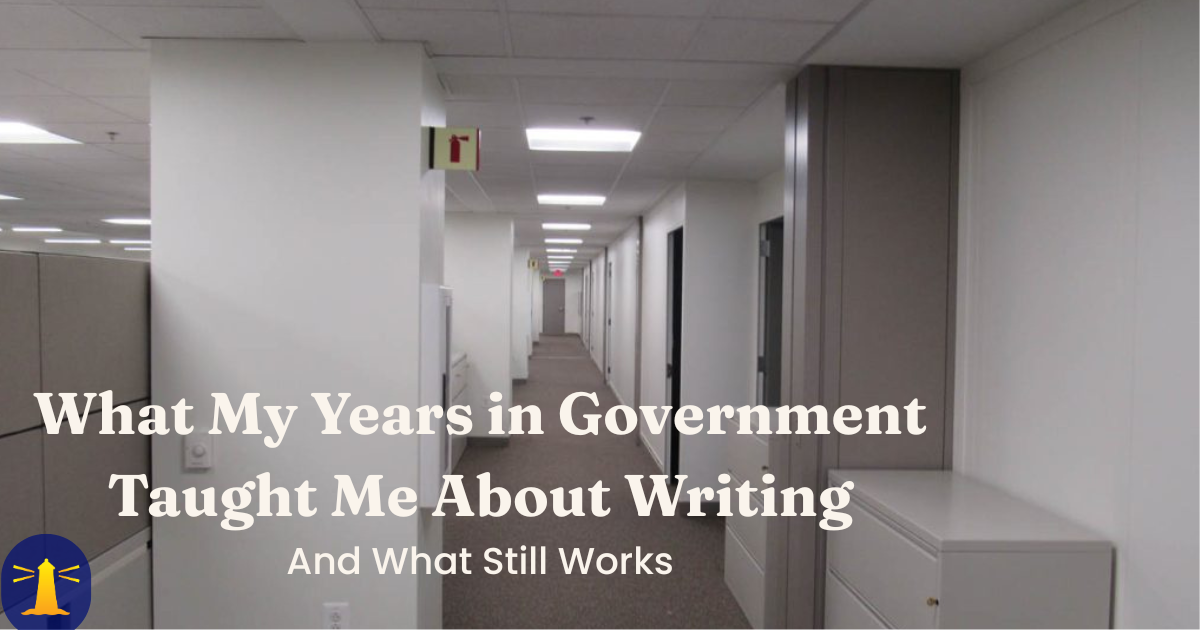
And the Friday at 4 p.m. calls are just part of the job. You call home to say you’ll miss dinner, and you settle in and focus for all you’re worth. You’re not going anywhere untill you’re done. The fluorescent lights really help you feel like time is standing still.
When I edit client work now, I’m listening for the same things I used to listen for then: loose claims, logic gaps, and sentences that collapse under a skim. I’m also watching for quiet risks: vague wording that seems harmless until someone reads it differently than you meant. To see how I spot those problem areas in real-world drafts, here’s a breakdown of three clarity issues I often fix before a document goes out the door.
When the stakes are high, plain language wins
I learned quickly that writing full of unnecessary words fails under pressure. It doesn’t “sound professional”; it sounds slippery. In policy and security contexts, people need to know what is true, what is likely, and what is unknown, without decoration.
Plain language doesn’t mean simplistic. It means the reader cannot miss the point. Even if the reader is reading while walking to the meeting your document is about and literally has four minutes to get the point.
In practice, that looks like this:
- Shorter sentences with strong sentence structure, one main idea at a time
- Concrete nouns (what, who, where), not abstract fog
- Clear verbs in active voice: decide, approve, require, not “provide support for”
- No hidden assumptions, because assumptions do not travel well
If you want a reference point, the Federal Plain Language Guidelines match what I saw in practice: writing that respects time and reduces errors.
For my clients, the benefit is direct: your readers don’t have to work so hard to understand you. That means fewer clarification emails, fewer misquotes, and fewer “Wait, what do you mean by …” meetings.
Deadlines force structure, not panic
A tight deadline can trigger two types of writers: the ones who freeze, and the ones who start typing to outrun the fear. Government deadlines taught me a third option: focus first on logical organization.
When time was limited, I didn’t chase perfect sentences. I built a simple frame:
That order still saves documents that I edit. It keeps a document from collapsing into a pile of facts with no spine. That frame doesn’t just create order, it creates calm. I have been told repeatedly that I bring calm to chaotic moments, and this is part of my secret sauce. It gets co-authors to stop scrambling for sentences and start moving with purpose.
Now, when I edit reports, grant proposals, research summaries, or leadership communications, I bring that same calm process. We get the structure right first. Then we tighten the language. Then we smooth the tone. The result reads steady, not rushed, even if it was written quickly.
Editing Isn’t About Commas. It’s About Judgment
Yes, commas matter. But that’s not the hard part.
The hard part is deciding what matters most in these government documents, for this reader, in this moment. Government writing trained me to treat editing as decision-making. Every change answers a question: Does this improve accuracy, reduce risk, or increase trust?
Sometimes, the work was just translation. Someone exhausted and furious would give us the raw truth: “We’re not doing that. F*** that.” And I’d turn it into something the reader could stay with: “We regret that we have to deny this request because….” That wasn’t censorship. It was clarity. It was keeping the door open for the next conversation. And it was such fun to defuse the anger into workable text, earning the trust of tired, angry subject matter experts.
I felt relief when my edits were taken seriously, because it saved pain for everyone. But when someone edited my work and inserted made-up facts or missed the point entirely, I imploded (silently, invisible at my desk until I calmed down). Not because it was personal, but because it was dangerous. They’d undone something carefully built.
That mindset carries over to client editing in a big way. I’m not trying to rewrite your voice into mine. I’m trying to protect your meaning, reduce avoidable misunderstandings, and strengthen your credibility. That includes knowing when to leave a sentence plain, even if I could dress it up. It means watching for places where tone might feel defensive or where a fact that isn’t wrong still causes confusion. It means asking, again and again, whether this draft protects the writer under pressure.
I focus on what changes meaning, trust, and risk
In high-stakes environments (imagine legal drafting, legislative drafting, and drafting policy), small wording choices can create large problems. I got used to looking for the edits that actually change outcomes.
Sometimes it’s a claim that sounds stronger than the evidence supports. Sometimes it’s a technical term that never gets defined, so two readers walk away with two different meanings. And if those readers have authority? If they give two different instructions based on what they thought the draft said? A downstream mess was just created, and it lands in the editor’s lap — mine. And there goes my credibility and loss of trust.
Sometimes the logic is almost there, but one missing sentence leaves the reader guessing. Guessing under pressure often leads to delay; or worse, to a decision based on the wrong assumption. I’ve seen both. It’s avoidable with one anchoring line that closes the gap. If you’ve ever felt that your writing is close but not quite landing, a clarity pass can help surface what’s missing.
Tone can be a hidden risk, too. A line that feels “confident” to the writer can feel dismissive to a stakeholder. A paragraph meant to be neutral can read defensive because of one loaded phrase.
Good editorial judgment makes edits feel targeted: not nitpicky, not mechanical, but necessary. The reader senses that the document is solid, even if they can’t name why.
- When a line could be misunderstood by two different decision-makers coming from different frames of reference
- When the logic almost lands, but the reader has to guess the intent
- When tone risks alienating someone we all still have to work with
- When a vague phrase softens a claim that needs to be firm. Or vice versa
- When a sentence misleads without technically being false
These aren’t cosmetic edits. They’re the ones that protect trust, support decisions, and prevent fallout. They’re worth the call, the comment, or the pushback.
Version control taught me how to handle important drafts
Drafts of documentation and intelligence reports move through many hands, and those hands don’t all share the same goals. That teaches you to treat revisions with care. You learn to track what changed, when it changed, and why it changed, because accountability matters.
You get used to someone circling back weeks later, asking why a change was made, and needing an answer that isn’t “I don’t know.” Or an angry senior executive ambushing your boss’s boss, needing to know exactly who approved a change to THEIR words. The ability to explain and document every single change becomes as important as the edit itself. Because your boss will cover your back … until your first instance of not being able to document.
That experience shaped how I work with clients now. I keep edits transparent. I want you to be able to see what moved, what was cut, and what questions remain. Especially when the stakes are high, all the writers involved need to know they won’t be blindsided by their own document. That trust is part of the edit. When a draft is important, that traceability isn’t just nice, it’s peace of mind. And in some environments, it’s the difference between backing your team and throwing them under the bus.
For anyone working with approvals, legal review, board review, or internal politics, this matters. A good edit doesn’t just change the draft. It clarifies the decision trail and provides data for audits.
The Reader Always Comes First
In government communication, I wrote plain language documents for federal agencies where people had too much to read and too little time. Leaders, analysts, partners, and reviewers all had different needs, and none of them wanted a long warm-up before the point. They wanted to scan page one and know whether to act, forward, ask questions, or kill it. That shaped my writing priorities really quickly.
That’s where I learned the simplest rule I know: the most important person in the document is the reader. I still remember answering the phone one afternoon. No hello, no setup. Just, “How would you like to save lives today?” The caller was dead serious. They needed help saying something important, fast, and in a way that didn’t break the rules. What they asked for wasn’t allowed by policy. But clarity was. That part was mine to solve.
In business writing, that reader focus pays off fast. Clear documents help people make decisions. They reduce back and forth. They cut meeting time. They move work forward.
I write and edit for the skim, then for the deep read
Most professional readers scan first. Even careful readers scan first. Especially in fast-moving organizations, people don’t re-read. They forward. They skim. They react. That means your real message has to land on the first pass, or it won’t have a chance to land at all.
So I shape documents in layers, keeping reading level accessible:
- A strong opening that says what this is and why it matters
- Headings that do real work (not cute titles, not vague labels)
- Paragraph order that matches how decisions get made
- Details go where they support, not where they interrupt
I also like plain signposts. “Here’s the recommendation.” “Here’s what we know.” “Here’s what we still need.” I’m not trying to be abrupt. I’m trying to be kind to the reader’s time and stress level. That kind of language isn’t stiff, it’s considerate.
If you want a quick, practical summary of this plain language approach, the Plain Language Quick Reference Guide is one of the better short documents I’ve seen.
Clarity is also fairness to your audience
Unclear writing pushes effort onto the reader. It asks them to decode, interpret, and sometimes rescue the meaning. That’s not just inefficient, it can be unfair, especially when the reader is making decisions that affect people. It’s easy to forget how much weight a reader might be carrying. If the writing leaves them guessing, they’ll either pause to clarify … or keep moving without the full picture. Neither outcome helps.
I think about clarity as respect. If I can reduce confusion with everyday words and personal pronouns, I should.
For clients, this is where expertise finally lands. You might know your topic inside out, but the document is the bridge. A clear bridge carries weight. A shaky one makes even strong ideas feel like guesswork. and no one bets on guesswork when stakes are high.

Good Writing Feels Respectful, Even When It Is Tough
Government culture taught me directness with restraint in professional writing. You can’t be dramatic. You can’t be vague. You have to be firm and factual, while still remembering there’s a human on the other end.
That’s also how I try to edit. I’ve had to say hard things in rooms where no one wanted to hear them. But saying it well — calmly, clearly, without cornering anyone — gave the document a chance. And, sometimes, gave the team a way forward.
Some documents (public speaking materials, speechwriting, or press releases) need hard feedback. A section may not work. A claim may be risky. A tone choice may be out of step with the audience. I won’t pretend otherwise. But I also won’t treat the writer like a problem to fix.
Direct does not mean harsh
Bluntness is easy. Clarity takes care.
When I give feedback, I stick to neutral wording and specific examples. I focus on the document’s goal, not the writer’s personality. And I offer options when there’s more than one valid path, whether for writing or public speaking. That doesn’t mean being soft. It means being accurate about what’s solid, what needs work, and what could go a different way without breaking the message. That’s editing with respect.
That approach builds trust, especially when the content is important. You should be able to improve a document without feeling flattened by the process. A good edit helps the work get better without making the writer feel smaller, and it honors what the writer already got right.
Frequently Asked Questions About Government Writing
Government writing is built for public record, review, and reuse. It favors plain language, clear structure, and careful wording, so the reader can act on it without guessing.
Clear purpose statements, strong organization, and tight sentences carry over very well. So does the habit of checking facts, naming sources, and choosing words that won’t be misread.
Start with the main point, then define key terms in simple words. Use headings and lists, avoid acronyms when possible, and add brief context for readers who are new to the topic.
It sounds calm and specific. It focuses on what happened, what the evidence shows, and what you recommend, without hype, sarcasm, or loaded language.
Editing removes vague phrases, checks claims, and tightens structure. It also fixes tone, so the writing sounds human, credible, and direct, not stiff or padded.
Bottom Line
Years of government work shaped how I write, how I edit, and how I listen. I learned to work fast without rushing, to protect meaning under pressure, and to make sure clarity reached the reader no matter how tired they were. That kind of writing isn’t fancy. It’s responsible. And it still shapes everything I do.
If your draft carries weight — policy, funding, leadership, public trust — I can help you make sure it holds up. Not just grammatically, but structurally, logically, and emotionally. When the pressure’s on, you need editing that doesn’t add noise. Just calm, clear support that gets the job done.
Start the Year with More Room to Think
If this post made you think about pressure-tested decisions and the cost of rushed edits, you might appreciate a quiet tool that helps reduce reactivity. The January 2026 Calm Calendar offers a light-touch way to protect thinking time, pace your writing work, and honor creative recovery, even in busy environments.
👉 Download the January Calendar (in the Freebie Library)
Need Your Draft To Hold Up Under Pressure?
If you’re writing for decision-makers, clients, boards, or external partners, you already know how much clarity matters. I offer editing that strengthens structure, reduces risk, and preserves your intent. Especially when the stakes are high.
Learn more about Editing Services
Ongoing editing or monthly retainer support is also available if you prefer steady partnership across multiple projects.

Thanks for reading — here’s to clearer writing and stronger ideas.
~~ Susan