
The worst emails I send as an editor are the ones that start, “So, I did a sample pass on your chapter, and I need to show you something ….”
Pages of avoidable grammar errors. Dialogue punctuation all over the place. Tense slipping around in the biggest emotional scene. Interior thoughts in quotation marks half the time and italics the other half.
Nothing tanks a writer’s mood faster than realizing an editor is spending their energy cleaning up commas instead of helping sharpen character, tension, and theme.
Key Takeaways
- Many smart authors miss recurring grammar errors because their “story brain” fills gaps and smooths over mistakes during revision.
- Clean, consistent dialogue grammar (tags, action beats, punctuation, ellipses, and dashes) is one of the fastest signals that a manuscript is ready for professional review.
- Subtle line-level issues like tense drift, point of view slips, comma splices, homophones, and unclear pronouns weaken clarity and pull readers out of the scene.
- Targeted editing passes, format changes, reading aloud, and a simple personal style sheet help you catch patterns before your editor does.
- A focused Grammar Mistake Finder checklist lets you fix common problems yourself so your editor can spend time on deeper story work instead of basic cleanup.
This post shows creative writers how to spot and fix common grammar patterns before an editor ever sees the draft. I want to walk you straight into those “how did I miss that?” moments before an editor has to flag them. I’ll stay close to what you actually write as a creative author: dialogue, interior thought, and tight point of view, and we’ll talk about mispunctuated dialogue tags, tense drift, overuse of ellipses and dashes, and those sneaky tiny words that flip your meaning.
At the end, I’ll point you to a simple, printable Grammar Mistake Finder checklist you can use on your next draft so your editor can focus on deeper story work, not cleanup.
Why Smart Authors Still Miss Sneaky Grammar Errors
I do not read your draft the way you do. Your brain is too close to the story, which is both a gift and a problem.
You see the scene you meant to write, not always the one on the page. Your mind fills in missing words, smooths over tense shifts, and assumes character thoughts are clear, much like it does when learning English. When you are revising after big structural edits, you are also tired, and tired brains are generous with their own work.
This is why very smart, experienced authors still ship manuscripts with consistent common errors. Not because they do not know the rules, but because story brain is running the show.
There is also a practical cost. The more time an editor spends stitching together commas, fixing homophones, and taming dialogue punctuation, the less time they have for deeper work. If you hire a professional, you are paying for that time. If you ask a beta reader for help, you are spending goodwill.
Good news: you can train your eye to work more like an editor’s. That’s where professional editing can help. You start to see patterns, not just individual mistakes, and you learn which rules you want to keep and which you want to bend on purpose.
Your Story Brain Hides Grammar Problems On Purpose
Your brain is trying to help you. It cares more about emotion than commas.
If I write, “He walked into the room, sat the chair,” most people read it as “sat in the chair” without even noticing the missing word. That is how you can read the same paragraph ten times and still not see that a word dropped out in the middle of a sentence.
This is also why reading in a different format works so well. When you:
- Print the pages,
- Change fonts or spacing,
- Or send the file to your e-reader,
you trick your brain into seeing the words as new again. Reading out loud helps even more. Your tongue catches what your eyes skipped.
Self-editing is not about perfection. It is about giving your brain a second chance to notice what it glossed over while it was busy visualizing the scene.
Why Creative Voice Can Blur the Line Between Style and Error
Fiction writing voice loves to bend grammar. That is part of the point.
In deep first person, I might write:
- “Too late. Way too late.”
That fragment works. It sounds like a thought, it matches the character’s urgency, and it is easy to understand.
Now compare:
- “The street, in the rain. Where she, running.”
That looks less like voice and more like something went wrong mid-sentence. The rhythm clunks, and the meaning blurs.
The tension here is simple. You want a natural, lived-in voice, but you also want clarity. A good editor is not trying to smooth your voice into some bland “correct” version. They are trying to keep your voice readable and consistent so readers never have to stop and decode your meaning.
If you want a deeper dive into how style and correctness interact, I like this breakdown of common fiction mistakes because it treats grammar as part of storytelling, not as a list of crimes.
When You Need More Than Spellcheck To Catch Grammar Errors
Spellcheck is fine for spelling errors in emails. It is, however, weak on story.
A Grammar Checker also misses:
- Homophones (a wrong word trap): “You’re whole life” instead of “your whole life,” a real error that slipped into a published novel.
- Tense slips: “She moved to the door and opens it.”
- Context problems in dialogue: “What,” he smiled.
Even advanced tools and AI helpers can flatten a strong voice. They may suggest rewriting every fragment, “fixing” deliberate repetition, or changing casual dialogue into stiff formal speech. Used blindly, they trade personality for correctness.
I am not against tools. I use them in their place in one of my passes, not as a final judge. I reject as many “suggested changes” as I accept. A trained editor can help you sort out which suggestions improve clarity and which ones strip away the character on the page. If you want another angle, the article on common writing mistakes by first-time authors touches on this from the bigger-picture craft side.

Photo by KATRIN BOLOVTSOVA
Dialogue Grammar Mistakes Your Editor Sees Right Away
Clean dialogue that follows standard English language conventions is one of the fastest signals that a book is “ready.” Messy dialogue can make a strong draft read like an early attempt.
When I open a manuscript, I can often tell within a page whether I am going to spend hours fixing:
- Dialogue tags that are punctuated like action beats and vice versa,
- Adverb-heavy tags (“he said loudly, angrily, softly”),
- Misplaced commas, apostrophes, and capital letters,
- Or a forest of ellipses and dashes in every conversation.
Let’s pull those apart.
Dialogue Tags vs. Action Beats: Where Grammar Errors Hide
A dialogue tag tells you who is speaking and how. “She said.” “He asked.” “They whispered.”
An action beat is a piece of action that stands on its own. “She folded her arms.” “He set the mug down.”
Grammatically, they behave differently.
With a dialogue tag, the tag is part of the same sentence as the dialogue:
- “I told you that already,” she said.
- “Are you serious?” he asked.
The comma or question mark stays inside the quotation marks, and the tag starts with a lowercase letter because it is the same sentence.
With an action beat, the action is its own sentence:
- “I told you that already.” She folded her arms.
- “Are you serious?” He put the mug down slowly.
Here are some common mistakes I see, with quick fixes:
- Wrong: “I hate this,” She folded her arms.
Right: “I hate this.” She folded her arms. - Wrong: “I am fine.” she said, looking away.
Right: “I am fine,” she said, looking away. - Wrong: “What,” he smiled, “do you mean?”
Right: “What,” he said with a tight smile, “do you mean?”
Smiling is not a way of speaking, so “smiled” does not work as a dialogue tag. That is a grammar problem wrapped inside an over-explained emotion. This shows up a lot in early drafts.
If you want more examples of how dialogue punctuation and tags go wrong, this article on common mistakes in fiction writing walks through several patterns that mirror what I see every week.
How To Punctuate Interrupted and Trailing-Off Dialogue
Interrupted or trailing dialogue looks fussy, but once you understand the basic pattern, it gets easier.
Use ellipses for trailing off, when a character lets the sentence drift into silence:
- “I thought you were going to call…”
- “If you had just told me… maybe it would be different.”
Use dashes for interruptions, when someone or something cuts the line off:
- “If you had just told me, I could have.”
“Enough,” she said. “We are not doing this again.”
Or:
- “I was trying to explain, but you never let me finish.”
The door slammed.
Some writers use ellipses and dashes interchangeably. I tend to reserve:
- Ellipses for hesitation, fading, uncertainty.
- Dashes for sharp breaks, conflict, or sudden shifts.
Whatever you choose, keep the punctuation inside the quotation marks:
- Wrong: “I just wanted to help”… she whispered.
Right: “I just wanted to help…” she whispered. - Wrong: “Wait” he reached for her arm.
Right: “Wait,” he said, and reached for her arm.
Or: “Wait.” He reached for her arm.
You get to pick the emotional effect. The goal is readable, consistent dialogue, not ticking every box on a style test.
Overusing Ellipses and Dashes in Character Speech
Ellipses and dashes are great seasoning. They are terrible as the whole meal.
Here is a “before” example that looks a lot like real pages I see:
“Look… I just… I do not know how to say this,” she said, turning away. “It is hard, you know, like… after everything that happened… it is just a lot – too much – and I cannot… I cannot keep doing this…”
Now a cleaned-up version using them only where they earn their place:
“Look, I do not know how to say this,” she said, turning away. “After everything that happened, it feels like too much, and I cannot keep doing this.”
Same emotion. Less visual noise. The rhythm is smoother, and the character does not sound eternally breathless.
Too many ellipses and dashes slow the pace, especially in tense scenes. They also make your work look less polished, because professional editors are trained to trim them. If you want to see other common habits writers fall into at the sentence level, the piece on everyday writing mistakes has some smart examples.
Quotation Marks, Thoughts, and Interior Monologue Confusion
Readers rely on quotation marks as a promise: this is spoken aloud.
Interior thoughts are not speech, so you have three common options:
- Thoughts in italics, often in first person:
What if he does not come back?
She met his eyes. No, he has to. - Free indirect style, no italics, folded into the narration:
He was not coming back. Of course he was not. She had known that the moment he left. - Occasional tags like “she thought” or “he wondered” to clarify.
The problems start when thoughts slide into quotation marks:
- Wrong: “He is not coming back,” she thought.
- Wrong: “Do not cry,” she told herself silently.
That looks like dialogue, and some readers will assume another character is present. Pick one clear method for thoughts and stick with it across the book. Your editor should not have to guess which lines are spoken and which are silent.
House styles vary here, so if you are aiming at a particular publisher, scan their books for how they handle thoughts. Your personal style sheet (we will get to that) is where you can capture those choices.
Subtle Line-Level Grammar Errors That Weaken Your Voice
Beyond dialogue, there are quiet line-level errors that chip away at clarity and voice without drawing big red circles around themselves.
I look for:
- Tense shifts in the middle of scenes,
- Sudden slips in point of view,
- Long sentences glued together with commas,
- Tiny words that send pronouns and meanings spinning.
These are not “gotcha” rules. They’re about keeping the reader inside the moment without stumbling.
Verb Tense Shifts and POV Slips That Pull Readers Out
Verb tense drift is common when the scene heats up. You start in past, then slide into present.
- Wrong: Sarah walked into the room and sees her old friend.
- Right: Sarah walked into the room and saw her old friend.
Or: Sarah walks into the room and sees her old friend.
Pick past or present and stay there unless you are making a very clear, intentional move.
Point of view slips are similar, often involving dangling modifiers or misplaced modifiers. In tight third person, you should not be able to see inside every head at once. Here is a subtle “head hop”:
Lena smoothed her dress, wishing she had chosen the blue one. Tom watched her, annoyed that she always took so long.
If we are in Lena’s close POV, we do not know Tom is annoyed. We can only see what Lena could notice:
Lena smoothed her dress, wishing she had chosen the blue one. Tom’s jaw tightened as he watched her. He always got like this when she was five minutes late.
Now the clues come through Lena’s lens.
When you revise, it helps to do a tense pass and a POV pass. Read each scene with one question in mind: “Did I stay in the same tense and inside the same skull?”
Your reader forgives the mistake. They remember the impression.
(If you caught the shift, you get the point.)
Comma Splices, Run-Ons, and Fragments: Style vs. Confusion
Some long sentences are fine. Some are just two (or three) sentences pretending to be one, disrupting sentence structure.
A comma splice happens when you join two full sentences with only a comma:
- Wrong: The storm rolled in, the lights flickered.
Right: The storm rolled in, and the lights flickered.
Right: The storm rolled in. The lights flickered.
A Run-On Sentence often skips punctuation or connectors entirely, sometimes ignoring parallel structure:
- Wrong: The storm rolled in the lights flickered and she grabbed the candles she knew they would go out.
Right: The storm rolled in, the lights flickered, and she grabbed the candles. She knew they would go out.
A Sentence Fragment is a group of words that looks like a sentence but is missing a subject or verb:
- Incorrect fragment: Because of the storm and everything that came after.
Possible fix: Because of the storm and everything that came after, she still flinched at thunder.
Fragments can work as style:
- “Too late.”
- “Of course he did.”
The test is simple: can a reader understand the thought at once, or do they have to reread?
Reading out loud is the best check. If you run out of breath, the sentence is probably carrying too much.
Pronouns, Homophones, and Tiny Words That Cause Big Confusion
Big problems often hide in small words.
Pronouns like he, she, and they can blur your meaning in scenes with multiple characters, leading to vague pronoun reference or noun-pronoun agreement issues:
- Confusing: He grabbed his coat before he could stop him.
- Clearer: Mark grabbed his coat before Ian could stop him.
Homophones (or homonyms) slip past spellcheck because they are spelled correctly, just the wrong word for that sentence:
- Wrong: Your the only one who knows.
Right: You’re the only one who knows. (Your/You’re) - Wrong: The shelf of books are already full.
Right: The shelf of books is already full. (Subject-Verb Agreement) - Wrong: She lost their keys over their.
Right: She lost their keys over there. (Their/They’re/There) - Wrong: The dragon let out it’s last breath.
Right: The dragon let out its last breath.
These seem small, but agents, reviewers, and thoughtful readers notice. Repeated tiny errors signal rushed work, even if your story is strong.
Wordiness, Redundancy, and Fancy Words That Muffle Impact
Sometimes the grammar is technically correct, but the sentence is padded with unnecessary adjectives and adverbs:
- Wordy: She whispered quietly in a soft, hushed tone.
- Cleaner: She whispered.
- Wordy: He absolutely, completely refused to totally acknowledge what had happened.
- Cleaner: He refused to acknowledge what had happened.
Then there is the “fancy word” problem. A ten-dollar word that does not match the character will always feel off:
- Stiff: “Your behavior is wholly unacceptable and egregious,” the twelve-year-old said.
- Natural: “This is messed up,” the twelve-year-old said.
Trimming is not about writing plain, bland prose. It is about letting the emotional moment hit without extra padding.
If you like seeing these issues in a broader storytelling writing context, this faculty article on fiction mistakes shows how language choices connect to pacing and plot.
How To Catch Grammar Errors Before Your Editor Does
Here is where we turn this from “good to know” into “doable in your next revision.”
You do not need to catch everything at once. In fact, “fix all grammar” is such a big task that most people give up after one tired pass.
Instead, treat grammar cleanup as a series of short, focused checks, with help from a simple style sheet and a checklist.
Use Targeted Passes Instead of One Massive Proofreading Attempt
I like to break grammar passes into small, repeatable rounds:
- One pass for dialogue punctuation and tags,
- One pass for tense consistency,
- One pass for POV slips,
- One pass for spelling errors,
- One pass for ellipses and dashes,
- One pass for pronouns, Their/They’re/There, and homophones.
You can do this one chapter at a time. If you have a deadline, set a modest daily target: one focused pass on one section. This feels lighter than trying to carry the whole book in your head.
This is exactly how the Grammar Mistake Finder checklist is set up: short, focused questions you can print or keep beside your document while you revise.
Read Aloud, Change Formats, and Listen for Clunks
Reading out loud is still one of the best editing tools we have.
When you read your own work aloud, you’ll feel:
- Missing words,
- Odd rhythms,
- Sentences that go on too long,
- Dialogue that does not sound like a person speaking.
If reading out loud isn’t possible, try:
- Printing pages;
- Changing font, spacing, or margins;
- Sending the file to an e-reader and reading it like a “real” book;
- Using text-to-speech to listen while you follow along.
Pay attention to the spots where you wince or stumble. There’s usually a grammar or clarity issue under that feeling.
Train Your Eye With a Simple Style Sheet
Editors rely on style sheets to keep long projects consistent. You can use a lighter version for your book.
A basic style sheet might include
- How you spell names, locations, and terms;
- Whether you use italics or free indirect style for thoughts;
- How you handle inner monologue tags;
- Your preferred use of ellipses and dashes;
- Any deliberate grammar choices you want to keep for voice.
The point is not to trap you. It’s to turn “random habits” into “intentional choices.”
When you hand a manuscript to an editor, a style sheet also tells them, “These choices are on purpose.” That makes collaboration smoother and saves time on back-and-forth questions.
🐾 Finnegan Break
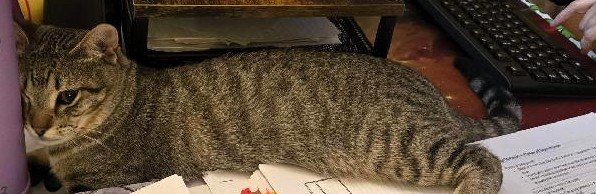
Finnegan has entered a new phase of helpfulness.
This week, he learned that the surest way to support my writing is to sit squarely on the notebook I am trying to reference. He does this with great enthusiasm and a very firm belief that he is improving my process.
Yesterday he positioned himself across a stack of printed manuscripts, stretched out luxuriously, and began kneading them like bread dough. It made me laugh and reminded me of what I often tell writers: you do not have to make perfection your first priority. Sometimes the page improves the moment you give it a little warmth, a little softness, a little permission to be held rather than judged.
Finnegan, as always, leads by example.
FAQ
Experienced authors miss grammar problems because their brains are locked into the story, not the sentence. When you know what you meant to write, your mind fills in missing words, skips over tense shifts, and smooths out clunky lines. During heavy revision or after structural edits, you’re often tired, and that tired “story brain” is generous with your own work. The result is a manuscript with repeated grammar patterns that you technically understand but did not see on the page.
Dialogue is one of the fastest signals of readiness for an editor, agent, or reviewer. When dialogue tags, action beats, and punctuation are clean and consistent, the manuscript reads as polished and intentional. When tags are punctuated like action beats, adverbs crowd every “said,” and ellipses and dashes fill every line of speech, even a strong story reads like an early draft. Clean dialogue grammar shows that you can control the sentence-level work, which builds trust in your story-level work.
A dialogue tag is part of the same sentence as the spoken line and identifies who is speaking and how. For example, “I told you that already,” she said. The comma sits inside the quotation marks, and the tag starts with a lowercase letter. An action beat is a separate sentence that shows what the character does around the speech, like “I told you that already.” She folded her arms. In that case, the spoken line ends with a period, and the following action starts as its own sentence with a capital letter. Treating action like a tag, or using actions like “smiled” as if they are speaking verbs, creates grammar problems and confusion.
Readers expect quotation marks to mark speech that is heard by other characters. Interior thoughts work better when you keep them visually and grammatically distinct. You can use italics in first person (What if he does not come back?), fold thoughts into close narration without italics (He was not coming back. Of course he was not), or use occasional tags like “she thought” or “he wondered.” The trouble starts when thoughts appear inside quotation marks, for example, “He is not coming back,” she thought. That looks like spoken dialogue. Pick one clear method for thoughts and use it consistently so the reader always knows what is said aloud and what stays in a character’s head.
Treat grammar cleanup as several short, focused passes instead of one huge proofread. For example, do one pass for dialogue punctuation and tags, one for tense consistency, one for point of view, one for ellipses and dashes, and one for pronouns and homophones. Read the work in a different format, such as printed pages, a new font, or an e-reader, and read out loud or use text-to-speech to spot clunky sentences and missing words. Create a simple style sheet that records your choices for thoughts, voice quirks, and punctuation so you stay consistent. A checklist like the Grammar Mistake Finder turns this into a repeatable process you can use on every draft.
Conclusion
Errors aren’t a sign that you’re a bad writer. They’re a sign that your brain was busy doing its real job, holding an entire story world in place while you wrote.
Tools like a grammar checker can help, but they don’t know your voice the way you do. A mix of smart self-editing habits, a simple checklist like the Grammar Mistake Finder, and, when you’re ready, professional editing gives your pages the best chance of landing clean and confident.
In the end, respecting grammar in your writing is about respecting the reader’s experience. When the sentences are clear, the voice consistent, and the dialogue easy to follow, your story gets to speak at full strength.
Free Resource: Grammar Mistake Finder
If this helped you see your own writing with a gentler, clearer eye, you might like having a small tool beside you while you draft. The Grammar Mistake Finder checklist gives you a simple way to spot the patterns your story brain keeps smoothing over.
👉 Download the Grammar Mistake Finder (in the Freebie Library)
And if you are noticing places where a thoughtful editorial partner would save you time, I’m here for that.
You can start with a simple estimate, and we’ll map the right level of editing together.
🧭 Request a thoughtful estimate

Thanks for reading — here’s to clearer writing and stronger ideas.
~~ Susan