
Do your sentences wander, puff, or stall just when you need them to move? You are not alone. Strong writing is not magic; it is a handful of small edits applied with care. These tweaks lead to stronger sentences that engage and inform.
Here is the plan: five fast edits that help you write better sentences in minutes, not hours. Stronger sentences are clear, concise, and energetic. These fixes boost flow and reader trust by refining sentence construction for more impactful lines. Each one comes with quick tests and tiny before and after examples you can use right away.
Ready to edit smarter? Let’s make your sentences pull their weight while enhancing clarity.
Key Takeaways
- Use active voice to make sentences direct and clear.
- Cut filler words, then tighten prepositional phrases to reduce wordiness.
- Choose strong verbs instead of weak verbs plus adverbs.
- Replace vague adjectives with concrete details readers can picture.
- Vary sentence length to create rhythm and keep attention.
Quick fixes you can use today to edit smarter
Small moves, big impact. Start by trimming what you do not need, then power up the verbs that carry meaning. You will feel the text breathe.
Fix 1: Cut filler words for clean, tight lines
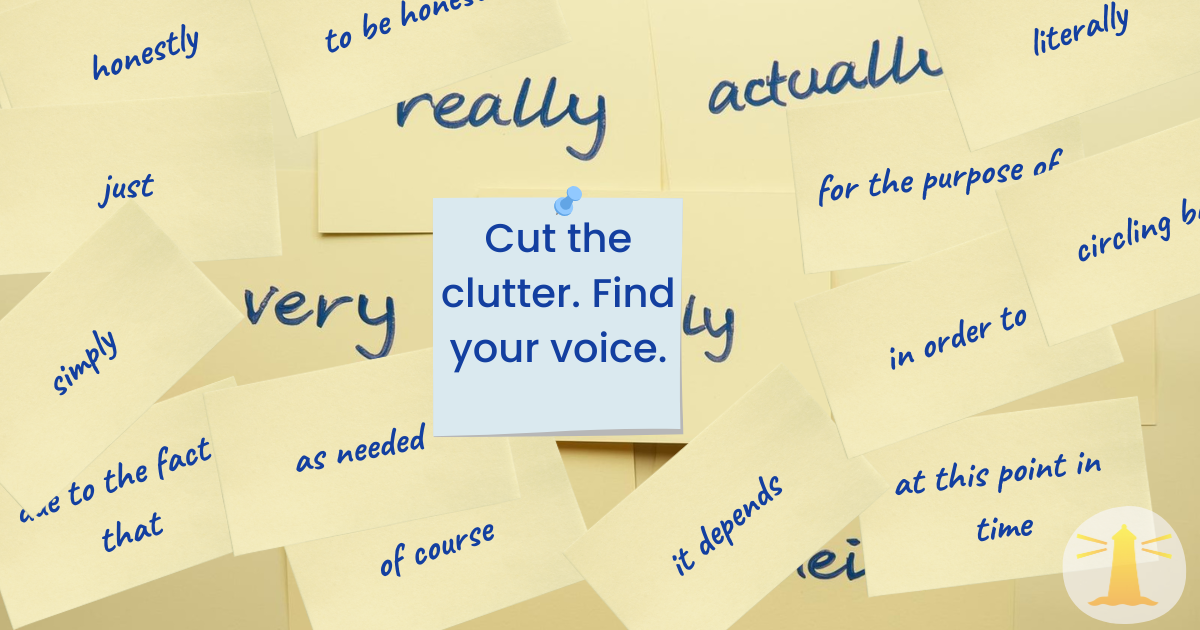
Filler words are the lint of prose. They collect fast and dull your point. To trim deadwood, target common culprits: that, really, very, just, actually, quite, in order to, there is, there are, it is. Watch for stacked prepositional phrases, hedge words, and fillers too.
Cringe Alert: Stacked Prepositional Phrases
Business Writing Offenders
❌ “In the report on the trends in revenue across the regions during the fourth quarter…”
→ You’ve lost your reader in a maze of folders.
❌ “At the meeting with the team from the office in New York on the third floor…”
→ Who’s where with what now?
Academic Writing Offenders
❌ “In the analysis of the data from the study on student behavior during the pandemic…”
→ By the time they get to “pandemic,” they’ve forgotten what was being analyzed.
❌ “Within the framework of the methodology applied in the context of the literature on resilience…”
→ That sentence should come with a campus map.
AI/Tech Writing Offenders
❌ “In the output of the model trained on data from the forum on generative tools in education…”
→ Even the model would throw a syntax error.
❌ “With the implementation of the API in the context of the platform built for use by developers at scale…”
→ You’re not explaining. You’re nesting.
Quick tests:
- To omit needless words, read the sentence without the word. If meaning holds, cut it.
- Replace weak openers like “There is” with a concrete subject.
- Prefer simple verbs over verb-noun stacks.
Fast flips:
- Academic: “There is evidence that the data actually suggests…” → “The data suggest…”
- Business: “We are really just trying to…” → “We aim to…”
- Fiction: “She was very, very cold” → “She shivered.”
Mini checklist:
- Remove one filler per sentence.
- Replace “There is/are” with a real subject.
- Swap verb-noun phrases for a single verb.
Benefit: fewer words, stronger, more concise meaning.
Want a deeper guide to trimming wordiness and prepositional sprawl? The UNC Writing Center’s advice on writing concisely gives clear examples you can borrow for any draft. For extra help trimming the fat from your sentences, check their full handout. Want personal guidance instead of just examples? Here’s how I help authors cut clutter while preserving their voice.
Fix 2: Swap weak verbs for precise, vivid verbs
Weak verbs hide in plain sight: forms of be, have, do, get, make, go. Also watch for heavy verb plus noun phrases, like make a decision or give a presentation. The upgrade is simple. Find strong verbs that do the job.
Quick conversions:
- “Make an improvement” → “Improve.”
- “Was responsible for” → “Led.”
- “Did an analysis” → “Analyzed.”
More examples:
- Fiction: “She was in possession of the key” → “She held the key.”
- Academic: “The results are indicative of” → “The results show.”
- Professional: “We will do a review” → “We will review.”
Mini test: If your verb needs a noun to carry the meaning, try a stronger single verb.
Benefit: sharper tone, fewer words, more authority. Using stronger verbs also helps the reader create a vivid picture.
For structure tips that support clean sentences, Purdue OWL’s guidance on improving sentence clarity is a trusted reference, especially when you are revising complex paragraphs. I’m a Purdue grad (3 degrees!) and know all their tricks for complex paragraphs (I know hard science AND social science complexities). So I can offer personal guidance instead of just examples. Start here.

Make your meaning crystal clear in seconds
Clarity is about placement and focus. Put the main idea where eyes land first, and prefer active voice unless passive truly helps. These changes reduce friction and help readers follow you without strain.
Fix 3: Put the main idea first so readers never get lost
The problem: long windups hide the point. Optimal sentence structure demands a clear subject and verb up front. Add detail after the core idea.
A quick method:
- Ask, Who or what is this sentence about?
- Put that noun at the start.
- Use a direct verb to create the subject verb combination.
Examples:
- Academic: “In light of multiple constraints, it is important to note that we” → “We faced several constraints.”
- Business email: “For the purpose of alignment, it would be best if the team” → “The team should align.”
- Fiction: “After a long day filled with setbacks, there was a feeling” → “After a long day, hope returned.”
Tip: Put new or heavy info at the end of the sentence for emphasis. (Not at the end of the paragraph!) Correct sentence structure also prevents errors like sentence fragments. When revising sentence placement, check for dangling modifiers.
Benefit: readers grasp your point fast.
If you publish online, clarity also supports discoverability. Here is a friendly take on why clear structure pays off in content marketing: see how we frame editing for clarity in blogging.
 Photo by Suzy Hazelwood
Fix 4: Prefer active voice, use passive only when it helps
Active voice names the doer. Passive voice hides it. Both have a place.
Quick test: add “by zombies” after the verb. If it fits, the sentence is passive.
Switch it up:
- Passive: “The grant was approved” → Active: “The committee approved the grant.”
- Passive is fine when the doer is unknown or unimportant: “The samples were refrigerated overnight.”
- Academic nuance: use passive when you need object focus or must match journal style.
Tip: If every line is passive, readers tire. Balance is best.
Benefit: active voice boosts clarity and confidence.
Caution: Don’t confuse passive voice with past tense or past participle. Here’s a deep dive post I wrote.
For rhythm and sentence variety ideas, these sentence tips are practical and easy to try: Write Better Sentences: 9 Tips.
Polish for flow and rhythm readers feel
Polish your writing rhythm so readers feel the flow. Sentence flow improves fast when you shorten long lines and vary sentence length. Give readers a clear beat to follow. Then add a simple practice that makes these edits second nature.
Fix 5: Split long sentences to boost pace and comprehension
Here’s your target: aim for an average of 15 to 22 words. You don’t need to count every line; just keep sentence length in that ballpark. A fast way to tell without counting? Try Gorby Text Analyzer. Paste your draft, and you’ll instantly see the average words per sentence and which sentences are dragging the pace.
If your paragraphs are a single sentence, you’re in some deep water. Let’s fix it together →
Where to cut: at a natural pause, before a clause, or after a list item. Consider the rule of three when structuring lists or balancing ideas in these splits to create a rhythmic pattern.
Three breaks:
- Academic: “Our findings, which were collected over three years in changing field conditions, suggest caution.”
Better: “Our findings suggest caution. We collected them over three years in changing field conditions.” - Business: “We plan to scope, resource, and launch the beta in Q1 to meet demand” → “We will scope, resource, and launch the beta in Q1. Demand is high.”
- Fiction: “He walked through the storm with memories pounding like drums, which made him wonder if turning back was wise” → “He walked through the storm. Memories pounded like drums. He considered turning back.”
Reminder: vary sentence length for music on the page. Vary sentence length for musicality, and aim for sentence variety and parallelism as a refinement goal when creating clean, balanced splits. Let short sentences snap and long ones glide.
If you like quick, elegant ideas for rhythm and variety, these sentence craft suggestions are a nice skim: Tips for more interesting and elegant sentences.
Read aloud and use a 60-second checklist to edit smarter
Here is a simple routine you can apply to any draft in one minute. Start by tackling overloaded sentences that bog down the pace:
- Read the sentence aloud. If you need to gulp air, split it. (LOL, easy to remember.)
- Underline the main subject and verb. If they are hard to find, rewrite. (If the writer can’t find them, the audience sure won’t.)
- Cut one filler. Replace one weak verb.
- Check voice. Make it active unless passive serves the point.
- End on meaning. Put new or key info at the end of the sentence. (Not at the end of the paragraph!)
Tiny before and after run:
- Draft: “It is important to note that the team was responsible for the delay, which was caused by scope changes and, in order to address this, we are going to make an improvement next sprint.”
- Step 1, find subject and verb: “The team delayed delivery because of scope changes.”
- Step 2, cut filler and heavy verbs: “Scope changes delayed delivery.”
- Step 3, add action and clean close: “Scope changes delayed delivery. The team will adjust scope early next sprint.”
This habit works even better when you speak the words. For a full walkthrough, try our guide on reading aloud to catch editing errors. It shows how your ear can find pacing bumps your eyes miss.
🐾A small muse named Finnegan
Finnegan is a silver tabby young cat (kitten no more!) who loves warm keyboards. During a five-minute sprint last week, he parked one paw on the space bar and turned my sentence into a dotting of words. I laughed, copied the clean pieces, and kept going. That tiny interruption gave me a reset, and the next pass was leaner, helping me refine my writing voice without losing its natural spark.
Here is the simple habit I took from it: take micro breaks. Pet the cat, stand up, breathe, then make one small change per pass. Short breaks help the brain reset focus, so you can spot minor errors like wan intensifiers or writing crutches such as filler words. Set a timer for 10 minutes, fix one thing per read (perhaps trimming first, then trying sentence expanding for fresh clarity), then reward yourself with a Finnegan break. Your draft will feel lighter, and your patience will last longer.

FAQ
A strong sentence uses active voice, a specific subject, and a precise verb. It avoids filler words and vague descriptors. The reader should understand who did what, and why it matters, without re-reading.
Look for a form of “to be” plus a past participle, often followed by “by.” For example, “The report was written by the team.” Flip it to active voice: “The team wrote the report.” If the doer is missing, add it.
Delete filler words like very, really, just, that, and in order to. Replace weak verb phrases with single strong verbs, for example, “make a decision” becomes “decide.” Trim stacked prepositional phrases, such as “in the process of” to “during” or “while.”
Aim for 15 to 22 words on average. Mix short and medium-length sentences to create flow. If a sentence passes 25 words, look for a natural split or a tighter verb. Try Gorby Text Analyzer to find long sentences quickly.
Weak: “The results were very impactful and were achieved by the team.”
Strong: “The team improved results by 18 percent.”
Weak: “We are in the process of making updates.”
Strong: “We are updating the site.”
Conclusion
Here is your five-line recap for stronger sentences: cut filler, choose strong verbs, lead with the main idea, prefer active voice, and split long lines. Tiny moves add up to concise, clear, confident prose. Try the 60-second checklist on your next email, article, or chapter and you will edit smarter without extra stress. Your voice stays yours, only cleaner. Keep writing, enjoy the process, and let each pass build clarity one choice at a time.
Ready to take the next step but want the form that fits?
I’ve designed three different paths for authors and experts, depending on your world:
- 🎨 Creative or voice-driven writer? Explore Creative Editing Services →
- 🎓 Academic writer or scholar? Learn about Services for Academic Authors →
- 🧑💼 Business/gov writer or thought leader? Services for Business Authors →
Or if you’re not quite sure, I can offer guidance →

Thanks for reading — here’s to clearer writing and stronger ideas.
~~ Susan