I’ve been talking about AI writing, and Evan Edinger says that one indication of AI-sourced writing is frequent em dashes. I don’t disagree with him … but what’s an em dash, anyway, and do humans ever use them? For what? How do you even type an em dash? Choosing the right punctuation mark signals skill and builds trust in your writing. So here’s an in-depth look for both the curious and the grammar geeks like me … and a Beginner Dash Quiz in the freebies block below.
Understanding the Differences: Hyphens, En Dashes, and Em Dashes
Writers often mix up dashes and hyphens, yet these marks are like tools in a well-organized toolbox. Each one has a clear role. One preliminary point: I’ll follow the Chicago Manual of Style (CMOS) for this post. I want to keep the CMOS folks and the Associated Press (AP) aficionados from jumping me. If you’re aiming for clarity and impact, whether you’re drafting a thesis or polishing a business proposal, knowing which mark to grab helps every sentence land the right way.
Hyphens: The Connector
Think of hyphens as the small but reliable bridges in your writing. They connect words to show they belong together, forming compound adjectives or numbers. CMOS says to use a hyphen for creating:
- Compound adjectives before a noun (fast-paced meeting, well-known author)
- Compound numbers from twenty-one to ninety-nine
- Prefixes in some cases (ex-president, self-aware)
When in doubt, hyphens help your reader understand that certain words are working together, not separately. Conveniently, the hyphen key is right there on your keyboard, near the underline.
En Dashes: The Range Marker
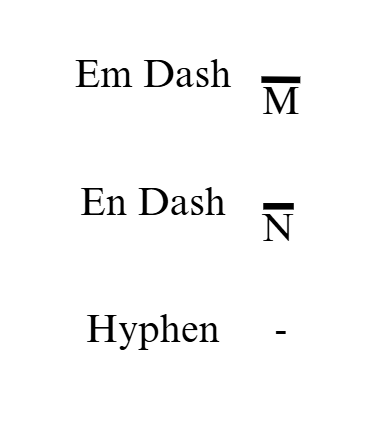
En dashes are longer than hyphens but shorter than em dashes. Their main job is to signal ranges or relationships. Need to show a span of pages, years, or even an ongoing partnership? Reach for the en dash.
Use en dashes for:
- Ranges (pages 34–55, 2019–2022)
- Connecting values (New York–London flight, cost–benefit analysis)
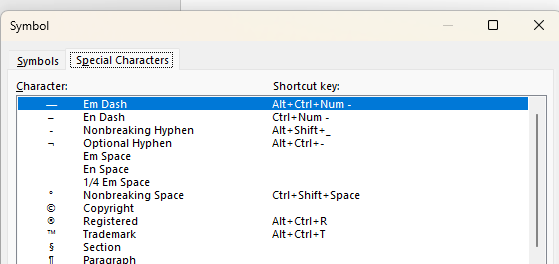
CMOS reminds us that en dashes replace the word “to” in many contexts. They’re subtle but important, especially for scholarly, business, or technical writing where precision builds trust. To type an en dash in Word, you must go to the insert menu, choose symbols, select the second tab, and there it is! With other grammatically complicated devices.
Em Dashes: The Interrupter
Em dashes are the longest of the group. If your sentence needs a dramatic pause, a side comment, or an abrupt break, em dashes step in. They’re flexible; think of them like parentheses or commas, but with a stronger visual punch.
According to Chicago, use em dashes for:
- Setting off a phrase or clause for emphasis
- Interrupting thought or dialogue
- Adding an aside or afterthought at the end of a sentence
But don’t overdo it because too many em dashes make your writing look scattered. If you had to model the way humans actually speak, interrupting themselves, backing up, wouldn’t you use em dashes? But I wish the AI would use more commas, semi-colons, or just separate sentences to vary from the flood of em dashes that litter their writing. No human writes with that many em dashes, or with that many interruptions.
Quick Comparison Table
Here’s a handy cheat sheet you can bookmark for future reference:
| Mark | Keyboard Shortcut | Main Uses | Example |
|---|---|---|---|
| Hyphen (-) | - | Compound words, numbers | well-written, twenty-three |
| En dash (–) | Alt+0150 (Windows) / Option+- (Mac) | Ranges, connections | 2018–2023, cost–benefit |
| Em dash (—) | Alt+0151 (Windows) / Shift+Option+- (Mac) | Emphasis, interruptions, asides | The point is clear—use punctuation well. |
Big hint: CMOS says no spaces on either side of any of these punctuation marks.
Let’s dig a little deeper, starting with the smallest but most versatile mark: the hyphen.
When to Use a Hyphen: Connecting Words and Modifiers
Hyphens are the workhorses of clear, readable writing, so they get explained in more depth. They may look modest next to em dashes and en dashes, but their job is essential: linking words and numbers so your meaning never gets tangled. If you’ve ever wondered why “well-read professor” is hyphenated but “the professor is well read” skips the mark, you’re not alone.
Hyphens in Compound Modifiers
When two or more words come together to describe another word, use a hyphen if the compound appears before the noun it modifies. This keeps your readers from tripping over your meaning. But the rule drops away if the words come after the noun. You’d write, “Her research is high quality,” with no hyphens needed.
Compound modifiers can get tricky, especially if you’re dealing with industry terms that change over time. Certain compounds evolve—open, then hyphenated, then closed. Editorial consistency matters here, as does checking your preferred style guide.
If you want to dive deeper into how editorial teams keep track of these changes, the post on Copyediting vs line editing vs proofreading: key differences has a brief nod to style manual differences and how they emerge.
In brief, CMOS tells us three main uses for hyphens.
- Numbers, Fractions, and Ages. When ages or numbers come after the noun or are not acting as a modifier, skip the hyphen: “The child is 6 years old.”
- Prefixes and Suffixes
- Words That Shouldn’t Be Hyphenated
En Dashes in Complex Compounds
Sometimes, you need to connect two elements that each contain more than one word. This is where the en dash truly shows its worth. When a compound adjective contains an open phrase (such as “New York” or “post–World War II”), an en dash keeps everything glued together.
Here are some classic Chicago Manual of Style examples:
- New York–London flight
- Pre–World War II architecture
- Cost–benefit analysis
The en dash does what a hyphen cannot in these cases, holding multi-word ideas together without crowding your sentence. This is especially handy in academic and business writing, where precision matters and you may need to join layered concepts. And only the sharpest of proofreaders will catch the tiny difference between an en dash and a hyphen.
Additional Resources
Writers looking to dig deeper might find the following official and expert guides useful:
- Chicago Manual of Style Q&A: Hyphens, En Dashes, Em Dashes
- SF Bar Blog on En Dash Usage
- Hyphens and Dashes: A Refresher
Em Dash vs. Parentheses and Commas: Impact on Tone and Clarity
The em dash, parentheses, and commas each bring their own mood and level of clarity to a sentence. When deciding among them, keep your goal in sight—do you want to sound crisp, casual, or formal?
Here’s a simple comparison table that can help you see the differences:
| Punctuation | Effect on Tone | Best For | Example |
|---|---|---|---|
| Em Dash | Lively, direct | Emphasis, abrupt breaks, side notes | The report had one major flaw—nobody checked the facts. |
| Parentheses | Whispered, offhand | Asides, background info | The report (which was rushed) had one major flaw. |
| Commas | Smooth, neutral | Light interruptions, added detail | The report, rushed as it was, had one major flaw. |
Using the em dash feels bold; it pulls the reader’s focus and can replace semicolons, colons, or even parentheses when you want a stronger pause. Parentheses are softer and suggest the extra info is not vital; they let your reader peek behind the curtain. Commas are smooth and blend in, perfect for small interruptions.
Too many em dashes can disrupt your flow and make prose feel choppy. If you see several on a single page, dial way back. Most writing can go an entire book and never use a single em dash, after all.
AI Grammar Tool Reminders
AI grammar tools can help catch hyphen errors, but they’re not always perfect, especially with context or evolving compound words. Lean on them, but verify with style guides or a professional editor. It helps to remember that these tools can alert you to issues, but you must rely on your judgment for the final call. That is your voice.
Looking for more rule-by-rule guidance? The Chicago Manual of Style’s hyphen FAQ is a trustworthy place for clarifying the finer points.
Common Pitfalls and How AI Grammar Tools Can Help
Even the most experienced writers trip over punctuation. Mixing up hyphens, en dashes, and em dashes is common, and the rules in the Chicago Manual of Style are detailed enough to stump anyone on a deadline. If you’ve ever wondered why “New York–London flight” isn’t “New York-London flight,” or swapped an em dash for a hyphen, you are not alone. Many writers, from doctoral candidates to novelists, stumble into these classic traps. Let’s look at the usual pitfalls.

Photo by Ron Lach
Easy-to-Make Mistakes with Hyphens, En Dashes, and Em Dashes
Writers often make the same simple errors, especially during fast drafting or late-night edits. Here are a few of the most frequent pitfalls:
- Using hyphens in place of en dashes for date or number ranges (e.g., 2012-2016 instead of 2012–2016)
- Forgetting to use an en dash with open compounds (e.g., New York–Paris rather than New York-Paris)
- Overusing em dashes, making a page feel fragmented or abrupt
- Missing hyphens in compound adjectives before nouns (e.g., quick-thinking kitten becomes quick thinking kitten)
How AI Grammar Tools Step In
An AI tool dedicated to grammar acts like a second pair of eyes—or, perhaps, an assistant editor who never gets tired. These tools now check for many dash-related mistakes:
- Range detection: AI spots hyphens where en dashes belong in things like page numbers or spans of years.
- Compound confusion: They flag awkward compounds and prompt you to check whether a hyphen or en dash is the right choice.
- Em dash overload: Many AI grammar programs warn when you sprinkle too many em dashes in a paragraph, suggesting you swap some for commas or parentheses for better flow.
AI grammar lets you catch mistakes that are easy to overlook on screen, especially those small, nearly invisible marks. And while AI grammar tools may flag dashes, human writers use all these punctuation marks with intention.
Psst—want to see how well you know your dashes?
Scroll down to the “Helpful Freebie” block below to grab the Beginner Grammar Geek Quiz that goes with this post. It’s short, fun, and 100% punctuation-powered.
🐾Finnegan’s Corner
Around here, even the kitten is growing into his punctuation. Finnegan has been eating prodigious amounts of kitten food, and every morning he looks either taller or longer, and a little more sure of himself. If he ever grows into those giant back paws, he’ll be a bruiser.

Watching him reminds me that writing habits grow the same way: bit by bit, day by day. At first the rules for hyphens, en dashes, and em dashes feel like oversized paws: awkward and maybe unnecessary. But with practice, you grow into them, and suddenly your writing moves with more balance and confidence.
FAQ
Hyphens connect two or more words that work together as a single idea. Use them in compound adjectives before nouns, like “well-known author” or “high-speed train.” Hyphens also help divide words at the end of a line, but with modern digital text, you probably won’t need to worry about that. Don’t use hyphens for word ranges or separating clauses.
An en dash is about as wide as the letter “n” and links numbers or words that show a range. Use it for things like “pages 10, 15, or 20–25.” It also connects related items, like “New York–London flight.” The en dash works when you’d say “to” or “through” in your head.
Use an em dash to set off something extra in a sentence, create a strong break, or signal a sharp turn in thought. For example: “She was ready, cake in hand, all smiles.” It’s also good when commas would make a sentence chunky or confusing. Keep spaces out of em dashes, according to Chicago style.
No, it’s best not to. Hyphens are not the same as en or em dashes in function or appearance. Most writing software lets you insert the right dash using shortcuts or menu options. Using the wrong one can distract careful readers.
Chicago style says don’t put spaces before or after em or en dashes. Type “word—word” or “word–word,” not “word — word.”
Think short for hyphens (linking parts of words), medium for en dashes (connecting ranges or related items), and long for em dashes (inserting or emphasizing extra info).
Yes, em dashes can take the place of parentheses or commas to add emphasis or help with clarity. They add a bit more drama or pause than the other marks.
Avoid stacking dashes in long or formal writing where clarity matters. Stick to commas or parentheses if your sentence is already hard to follow or packed with ideas.
Yes. American English (Chicago style) usually uses unspaced em dashes for breaks in a sentence. British writers often use spaced en dashes or only use them for ranges.
You might see this in novels or plays to show interruption or a break in thought. In most non-fiction, stick to quotation marks and regular punctuation.
Look at the second comment thread of Evan Edinger’s You Tube video to see real writers’ comments. My take is that they feel rather dismayed.
Conclusion
Knowing when to use hyphens, en dashes, or em dashes helps your writing feel strong, clear, and credible. The Chicago Manual of Style makes the rules straightforward: hyphens connect words, en dashes show ranges and complex compounds, and em dashes insert emphasis or interruption. Small marks, big difference.
AI grammar tools add peace of mind and catch many small errors, but true confidence comes from pairing those tools with solid style knowledge. When you combine careful punctuation choices with trustworthy AI support, your work stands out for all the right reasons.
Practice these punctuation skills to boost your own writing, and remember that even seasoned pros rely on reminders to keep things polished. Every time you make one of these choices, you are building habits that lead to clearer, more professional work.
Thanks for reading. And here’s to clearer writing and stronger ideas.
~~ Susan