Introduction: A Platform That Works While You Sleep
Marketing strategies come and go. Algorithms change. Platforms rise and fall. But blogging? It’s still here and still powerful. Not because it’s trendy, but because it works.
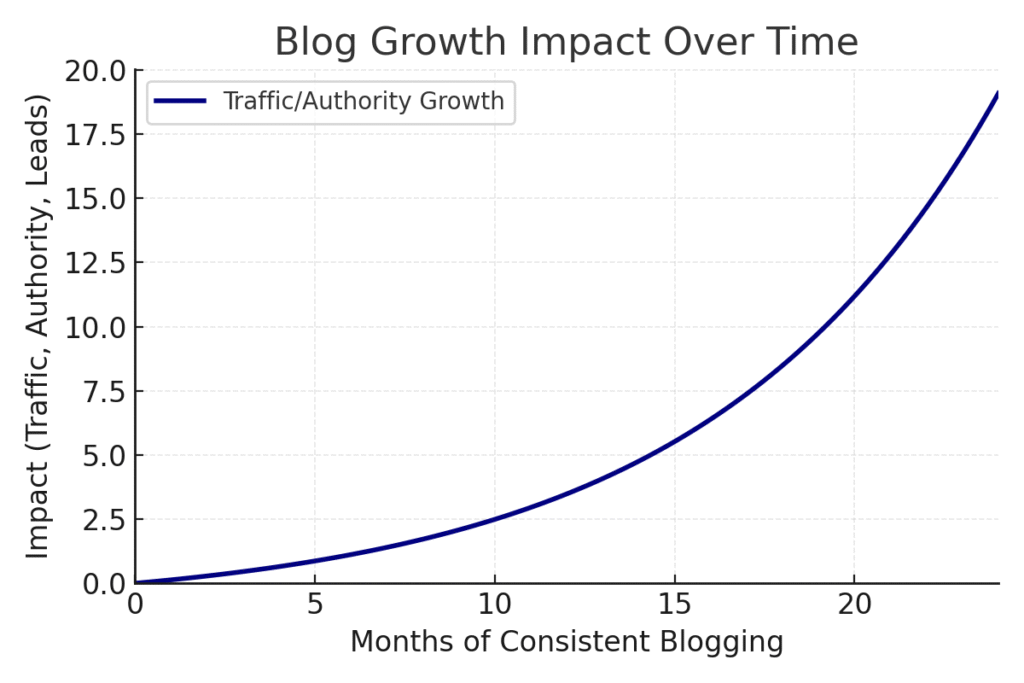
Blogging is the only marketing channel that builds authority, discoverability, trust, and depth at the same time. It works for you when you’re off the clock. It welcomes visitors when you’re busy. And when it’s done right, blogging compounds, gaining value and reach over time, instead of vanishing after 24 hours like a social post.
This post explains why blogging still matters in 2025, how the compounding effect works, and what it means for your visibility, credibility, and client flow.
Section 1: If Blogging Is Dead, Why Does It Still Work?
Every few months, someone on LinkedIn or TikTok declares that blogging is dead. That it’s outmoded, outpaced, irrelevant. You’ll hear the same arguments every time:
- “Nobody reads anymore.”
- “Video is king.”
- “The algorithm doesn’t favor long-form content.”
- “You need Reels. Or Shorts. Or TikToks.”
And yet, blogging still works.
Not in a vague, nostalgic way. Not just for recipe influencers or SEO spam farms. Blogging still works for real professionals who want real clients. Because it’s built on fundamentals that haven’t changed in decades:
- Value delivered through words,
- Indexed content that earns long-term traffic, and
- Ownership of your message and platform.
A 30-Year-Old Strategy That Still Outperforms
Blogging has been around since 1994. That makes it more than 30 years old, a full generation older than Instagram, YouTube, or TikTok. It began as an internet diary (Justin Hall’s links.net) and became a backbone of the early web. By the early 2000s, platforms like Blogger and WordPress democratized blogging, and the business world quickly realized what that meant.
When Google released its first algorithm update prioritizing content quality (Florida Update, 2003), blogs were uniquely positioned to win. They were keyword-rich, long-form, and constantly refreshed, exactly what search engines wanted to reward. And that advantage hasn’t disappeared.
Why It Still Matters in 2025
Let’s be honest: blogging isn’t trendy. It’s not sexy. You won’t go viral.
But virality doesn’t build pipelines. Trust does. And blogs still outperform social posts and video in three critical ways:
- They compound over time.
A blog you wrote last year can still show up in search tomorrow. A tweet you posted last week? Gone. - They build trust through depth.
Social posts hook attention. Blogs prove your authority. If a stranger is considering hiring you, they’re not scrolling your Reels. They’re reading the post where you laid out your philosophy, your process, or your client results in detail. - They belong to you.
TikTok belongs to ByteDance. YouTube belongs to Google. Instagram belongs to Meta. When you blog, you’re not at the mercy of a shadowbanned account or a sudden algorithm shift. You own the words, the hosting, the audience path.
That doesn’t mean blogging is the only strategy. But it remains the only long-form, searchable, owned-content format that the internet has reliably rewarded for three decades straight.
“But What About AI and the Changing SEO Landscape?”
Yes, AI is shifting how content is written, indexed, and found. But it’s not eliminating long-form writing. It’s flooding the market with generic long-form writing.
That makes good writing, the kind that’s genuinely human, insightful, and grounded, even more valuable.
Google’s Search Quality Evaluator Guidelines (SQEG), updated most recently in 2023, emphasize E-E-A-T: Experience, Expertise, Authoritativeness, and Trust. None of those come from AI mass generation. They come from you. Your stories, your voice, your clarity.
And guess where those things live best? In a well-written blog post.
Citations for Section 1:
- Justin Hall, links.net (1994).
- Moz, SEO History Timeline; Content Marketing Institute, “History of Content Marketing”. SEOmoz Blog (2003–present).
- Moz, “Google Algorithm Update History,” SEOmoz Blog (2003–present).
Section 2: How SEO and Google Changed the Game
Let’s unpack what happened next.
By the early 2000s, blogs were gaining traction, and Google was becoming the world’s primary search engine. What began as personal journaling or hobbyist writing was now being indexed, ranked, and surfaced by algorithms. Suddenly, how you wrote mattered just as much as what you wrote.
That shift changed everything.
Where once blogging was simply an extension of personal voice, it now became a technical game. Early search engine optimization (SEO) techniques began to dominate strategy: inserting the right number of keywords, writing for readability scores, and carefully crafting titles that mirrored search behavior.
For marketers, this was a gold rush. Google AdWords launched in 2000, monetizing clicks and offering unprecedented tracking of user behavior. Around the same time, advertisers began shifting budgets away from print (especially newspapers and magazines) and into digital spaces. Blogs became central to what would later be called “content marketing.”
Instead of purchasing a banner ad or sponsoring a radio segment, brands could now publish a blog post that lived forever, showed up in search, and led readers through a sales funnel.
The side effect? Blogging became professionalized. Templates emerged. Pillar posts and listicles and SEO plug-ins (like Yoast) became the norm. Somewhere along the way, the spirit of experimentation gave way to efficiency.
But it’s worth remembering: the foundation of blogging wasn’t tactics. It was trust.
Citations for Section 2:
- Google AdWords Launch: Google launched AdWords in October 2000. Source: Google Blog Archive
- Shift of Ad Spend from Print to Digital: Pew Research Center reported in 2011 that newspaper ad revenue had fallen dramatically, citing online ad migration as a factor. Source: Pew Research Journalism Project
- SEO Timeline: Moz SEO History Timeline
- Content Marketing Emergence: Content Marketing Institute History
Section 3: The Cost of Optimization
The rise of SEO plugins and “best practices” introduced clarity, sure. But also conformity.
Instead of letting topics evolve from what a writer noticed or cared about, bloggers were now expected to reverse-engineer their ideas from keyword reports. Entire industries developed to track what people were searching, when they searched it, and what kind of post structure would rank best.
To be visible, a blog needed:
- Keywords in titles, headers, and URLs
- Internal links to anchor pages
- External links to high-authority sources
- SEO-friendly images (with alt text, captions, and filenames)
- A readability score between 60–80
- And ideally, a featured snippet placement
These weren’t creative choices. They were algorithmic demands.
None of these tactics are inherently bad. They work. But they came at a cost: the erosion of originality.
In a rush to be seen, many blogs stopped saying anything new.
Where once you had a blogroll filled with individual voices, now you had interchangeable advice. The 100th post on “morning routines for entrepreneurs.” The 200th take on “10 productivity hacks you haven’t tried yet.”
Even personal blogs began to feel engineered.
Section 4: Why Authentic Blogging Still Works in 2025
Despite all the algorithmic manipulation, SEO strategies, and AI-generated fluff, one thing hasn’t changed.
Readers are still people. They crave connection. They seek clarity. And they remember writing that made them feel understood.
That’s why authentic blogging, where a real person is thinking aloud, connecting dots, sharing hard-won knowledge, still breaks through.
We’ve been taught to optimize for Google, but readers don’t care how many times a keyphrase appears. They care whether the post made sense. Whether it helped them see something new. Whether it gave them language for something they didn’t know how to say yet.
And ironically, that’s exactly the kind of content search engines are now trying to reward again.
Google’s 2022 “Helpful Content” update marked a major shift: away from content that’s designed to perform well in search, and back toward content that’s designed to help humans. (They said that with a straight face, after 15 years of incentivizing the opposite. But we’ll allow it.)
Even as platforms evolve, this core truth remains: authentic voices build trust.
And trust is what turns a reader into a subscriber, a subscriber into a client, a client into a partner.
Blogging isn’t just about traffic. It’s about building credibility over time. The good kind of long game.
What Marketers Don’t Want You to Know
If you’re wondering why authenticity is making a comeback, here’s the cynical truth: faking authenticity is getting harder.
AI can rewrite content in a hundred voices, but it still struggles with lived experience. SEO tricks still work, but readers bounce when they smell fluff.
You can outsource thought leadership, but most people can tell when you do.
The only sustainable content strategy left is to be … you.
That’s what keeps people reading.
Citations for Section 4
- Keyword stuffing: Repeating a target phrase excessively to rank higher in search engines. It worked in the early 2000s, until Google’s Panda update penalized low-quality content.
- Panda update: A 2011 Google algorithm change that devalued thin or low-quality content in search rankings.
- Helpful Content Update (2022): A shift in Google’s ranking priorities toward content written “by people, for people,” deprioritizing SEO-gamed or AI-fluff content.
Section 5: When and Why to Ignore SEO Advice
Search engine optimization is not the enemy. But it’s not the boss of you, either.
The truth is, most small business blogs don’t compete in high-volume keyword arenas, and they don’t need to.
If your business is based on trust, clarity, and service, your best asset isn’t search volume. It’s resonance.
And that’s where rigid SEO advice can do more harm than good.
We’ve all seen the checklists:
✅ Use your keyword in the title.
✅ Use it again in the first 100 words.
✅ Sprinkle it in headers.
✅ Repeat every 200 words.
✅ Don’t exceed 300 words per paragraph.
✅ Use “transition words” like therefore and however and in conclusion.
✅ Hit a readability score of 60–80.
These rules weren’t made for writers. They were made for machines.
Machines that scan for patterns. Machines that reward consistency. Machines that will absolutely tank your post if it sounds like an actual human having actual thoughts. So should you ignore the rules?
Not entirely. Some of them help the reader too—like clear subheadings, focused paragraphs, and images with descriptive alt text. But others will wreck your voice if you follow them too literally. That’s where judgment comes in.
If a sentence sounds clunky, but Yoast gives it a green light… rewrite it. If a long paragraph flows well, even though it’s 370 words… keep it. If the keyword is “editor for small business blog content pricing strategy” and you’re trying to say something thoughtful… don’t cram that into your first sentence.
SEO is a tool. Use it to enhance clarity, not replace it. Search engines might bring readers in, but good writing is what keeps them there.
Citations for Section 5
- SEO readability score (60–80): Yoast recommends a Flesch Reading Ease score between 60 and 70 for optimal readability. Yoast
- Transition word scoring and paragraph limits: Yoast SEO – Readability analysis
- Keyword stuffing backfires: Google Panda Update – Search Engine Journal
Section 6: Clarity Is a Selling Point, Not Just a Style Choice
We’ve talked about clarity as a craft goal and an editorial standard. But let’s not skip the most pragmatic reason to care: clarity sells.
If you’re an author or entrepreneur writing online, the most useful question you can ask about your content is, “Will the reader understand this immediately, and will it motivate them to act?” That’s not about dumbing things down. It’s about respecting your reader’s limited time, patience, and cognitive bandwidth.
A Clear Page Wins the Click
SEO’s obsession with readability scores may feel artificial, but it reflects a deeper truth about online behavior: people skim. They scroll, hunt, glance, and bounce. On average, you have 15 seconds to capture someone’s attention before they move on. So your headline, your opening line, even your paragraph shape — all of it either draws people in or drives them away.
Clean structure, crisp sentences, and helpful transitions give readers confidence. They can follow your thinking without re-reading. They trust you’re not wasting their time.
And trust converts.
When Clarity Converts, Complexity Pays Off
Here’s the paradox: when you do the hard work of making complex ideas clear, your readers are more likely to attribute intelligence to you, not less. It’s the old “Einstein effect”: people who can explain difficult things in plain terms tend to be seen as smarter, not dumber.
In fact, clarity is what allows you to get away with complexity. You can introduce deep models, nuanced arguments, or layered emotions if you give your reader enough footholds to climb with you.
That’s the real power of editing: not simplification, but access.
Editing Is UX for the Brain
Writers often think of clarity as a surface polish, a tone choice or a stylistic goal. But in digital writing, it’s more than that. Clarity is user experience.
Your text is the interface between your ideas and your reader’s mind. If that interface is clunky, confusing, or inefficient? The reader bounces. If it’s smooth, responsive, and well-paced? The reader keeps going.
Put differently: clarity isn’t a luxury. It’s infrastructure.
Citations for Section 6
- 15-Second Rule: 55% of visitors spend fewer than 15 seconds on a page. Time.com
- Trust & Legibility: Readers trust pages that are scannable and structured. NNG Group
- Einstein Effect: Simple explanations enhance perceived intelligence. Cognitive science consensus.
- Editing as UX: Kristina Halvorson, Content Strategy for the Web.
Section 7: What Marketers Won’t Tell You About “Writing for the Algorithm”
Most SEO guides tell you to optimize your content with keywords, headings, and meta tags, and, sure, that’s part of the game. But what they often don’t tell you is this: “writing for the algorithm” mostly just means writing well.
The algorithm is trained to recognize what humans like. So clarity, structure, usefulness, and flow. Those are not only good writing traits, they’re algorithmic signals.
It’s not about tricks. It’s about trust.
The algorithm wants what people want.
Google’s algorithm updates over the years (like Panda, Hummingbird, and Helpful Content) have all aimed at the same goal: rewarding content that genuinely helps people. That means:
- Answer the question early.
- Structure your post with clear headings and subpoints.
- Use language your audience actually uses.
- Back up your claims with citations and clarity.
Keyword stuffing and filler fluff don’t work anymore. If your page reads like a real human made it for other real humans, then you’re already halfway to SEO.
Citations for Section 7
- Keyword Stuffing: Google Guidance
- Panda Update (2011): Moz timeline
- Readability Score: Readable.com
- Hummingbird & Helpful Content Updates: Search Engine Journal
Section 8: So… Should You Learn SEO?
This is the part where you’d expect a hard sell. “Yes, and buy my course!” But that’s not what this post is about, and frankly, you don’t have to master SEO to benefit from it.
Understanding how the algorithm works just helps you make better decisions:
- When you format your blog post clearly, it’s easier to read and easier to rank.
- When you explain a term cleanly, you’re serving your reader and reducing bounce rate.
- When you link out to reputable sources, you’re helping people and earning trust from search engines.
You’re Probably Already Doing It Right
If you write with your reader in mind, answering their questions, organizing your ideas, and trimming excess fluff, you’re practicing good SEO. You just might not know it yet.
And if you’re working with a professional editor? They don’t need to be an “SEO mastermind” either. They just need to preserve your clarity while optimizing for scan-ability, structure, and rhythm. Clarity is SEO. Structure is SEO. Editing is SEO.
Citations for Section 8
- Helpful Content Guidance: Google stresses “people-first” writing. Google Search Essentials
- Bounce Rate: Clear, user-friendly content reduces bounce rate. Semrush
- E-E-A-T Framework: Google raters look for Experience, Expertise, Authoritativeness, Trust. Google Rater Guidelines
Section 9: What to Look for in an Editor If You Care About Visibility
If you’re writing to be seen, on Google, LinkedIn, Substack, wherever, you need an editor who can preserve your voice while strengthening your structure.
That’s not always the same as “fixing errors.”
Look for an editor who:
- Thinks in outlines, not just sentences
- Understands where Google looks for meaning (headers, intros, links)
- Helps you format for skimmability, without diluting your style
- Doesn’t chase trends or ruin your tone for SEO’s sake
A good editor will make your post more searchable, more shareable, and more satisfying to read. And they’ll do it without ever mentioning an algorithm.
Because clarity works, whether you’re writing for humans, robots, or both.
Citations for Section 9
- E-E-A-T: Google’s evaluators use Experience, Expertise, Authoritativeness, and Trust to rank content. Google Support
- Header Structure: Proper use of H1/H2/H3 helps Google parse meaning. Moz: Title Tags & Headers
- Human-Focused Editing: Ann Handley’s Everybody Writes emphasizes clarity and empathy as the ultimate content strategy. Ann Handley
🐾 Finnegan Update

Our editorial assistant is growing like a weed.
Every morning, Finnegan seems a little longer, a little taller, and a little more convinced that he runs the place. He’s outgrowing his favorite nap spots, leaping to new heights (sometimes without permission), and offering increasingly confident opinions on sentence structure—usually by walking across the keyboard.
It’s a reminder that growth doesn’t always feel dramatic while it’s happening. But when you show up consistently—whether in kittens or blog posts—the results compound.
Slowly, then suddenly.
What started as a comfy spot for an old cat and a new kitten now barely fits their momentum.
FAQ
Yes. Not because it’s trendy — because it works. Blogging remains one of the only long-form, searchable, owned platforms that builds both trust and visibility. Algorithms change. Your blog stays searchable.
A blog post doesn’t disappear 24 hours after you publish it. Unlike a tweet or Reel, it can keep getting found through search, linked by others, and read by new visitors weeks, months, or even years later. That’s the compounding effect: value that grows instead of evaporates.
Sure, video captures attention fast. But blogging builds depth and trust. When someone is deciding whether to hire you, they’re more likely to read your long-form post about your process than scroll your Reels.
They’re flooding the internet, but they aren’t replacing good writing. AI can mimic tone. It can’t mimic lived experience, human nuance, or insight. That’s why Google’s Search Quality Guidelines reward Experience, Expertise, Authoritativeness, and Trust (E-E-A-T), all things real writers still do best.
Nope. Learn the rules so you can use them with judgment. Some SEO advice helps with clarity and structure. But others? They’ll flatten your voice if you follow them too literally. Optimize, don’t over-optimize.
Yes, when it’s done right. Blogging isn’t a sales pitch. It’s proof of credibility, clarity, and authority. When people find your blog and feel understood, they’re more likely to trust you, subscribe, and eventually hire you.
Consistency matters more than volume. A well-written post every two weeks will beat daily fluff. The goal is quality that lasts, not content that burns out.
Not necessarily. If you understand your audience and write clearly, you’re already doing half the job. And if you’re working with a good editor, they’ll help with structure and flow that pleases both readers and search engines.
Someone who preserves your voice while strengthening clarity. A strong editor helps with structure, pacing, and reader experience, not just grammar. Look for someone who can think like a strategist and read like a human.
Closing
Blogging has been declared dead for decades. But it’s still here, and still working, because clarity doesn’t go out of style.
The tools change. The platforms come and go. The algorithms spin up and collapse. But people still want writing that respects their time, answers their questions, and earns their trust. That’s what clarity does. And clarity is the point.
If you want to see what that looks like in practice, I’ve begun building a series of posts on practical clarity checklists — small, concrete steps any writer can use to make their work more readable, more useful, and more trustworthy.
Because visibility doesn’t come from tricks. It comes from writing that’s strong enough to stand on its own.
Thanks for reading — here’s to clearer writing and stronger ideas.
~~ Susan