
You’ve reviewed the essentials about editing and proofreading. If you need a refresher on the differences, start with my companion guide, Editing vs. Proofreading: A Clear Guide to Editing for Authors, Academics, and Professionals. Now it’s time to get clear on what you actually want from your own editing experience. When you know your goals and can express them with clarity, you’ll get better feedback, more precise proposals, and a smoother editing process from start to finish.
This guide is your checklist. Spend ten focused minutes here, and you’ll make the rest of the editing process much easier (and often less expensive).
1. Pin Down Your Main Goal
Every editing job should start with a clear destination. Editing comes in many forms, each with a different focus.
Helpful overviews of editing types:
- Editorial service types and typical rates (EFA): https://www.the-efa.org/rates/
- Professional standards and definitions (CIEP): https://www.ciep.uk/
- Quick guide to types of editing (Reedsy): https://blog.reedsy.com/guide/editing/
Ask yourself: What does success look like for this piece?
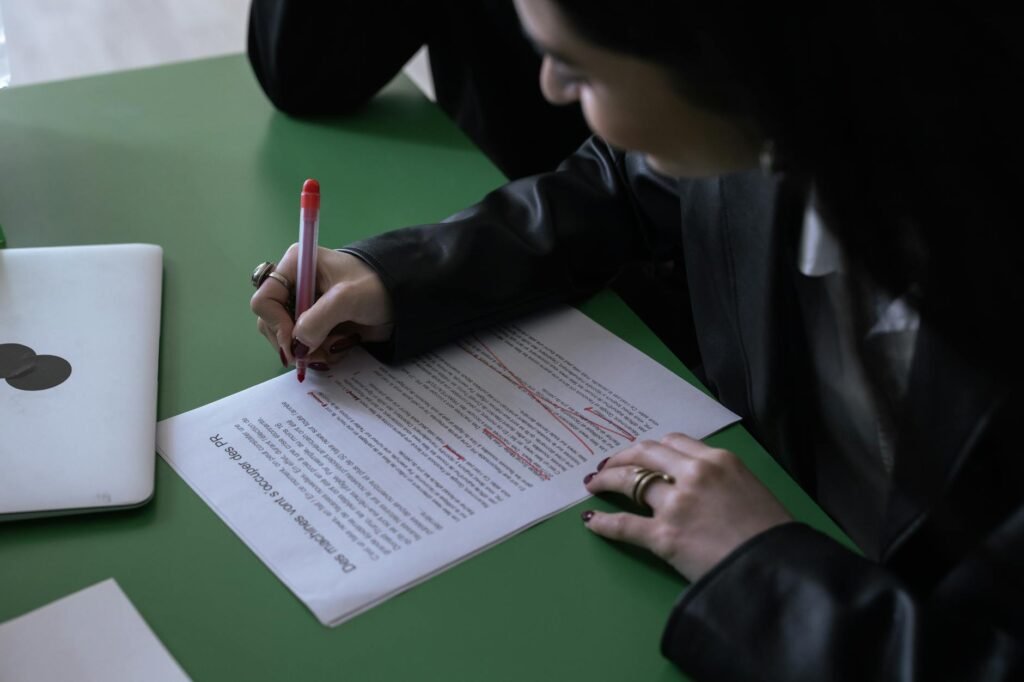
Examples:
- Pitching to a publisher? Focus on overall structure and strong, consistent voice.
- Prepping for self-publishing or professional release? Aim for a polished, on-brand result ready by your deadline.
- Writing for academic review? Make your arguments sharp and your citations reliable.
- Preparing internal business materials? Use language that’s clear and precise for decision-makers.
Quick reference:
- Developmental editing: Structure, main arguments, and content order
- Line editing: Flow and consistency at the sentence level
- Copyediting: Grammar, style, and consistency
- Proofreading: Last check for typos and small formatting issues
Action: Write a single sentence describing your goal for this project. For example, “I want my 2,500-word article accepted by Journal X on the first try,” or “I need a ready-to-launch e-book that matches our voice and is ready before December.”
That statement serves as your anchor.
2. Know Your Audience
A clear picture of your readers leads to more effective editing. Consider:
- Their knowledge level
- Why they’re reading (to learn, make a choice, approve, or just scan)
- Preferred tone (formal, casual, persuasive)
- Any barriers (time limits, skepticism, need for details)
Useful tools and guides:
- Plain language guidelines and checklists: https://www.plainlanguage.gov/guidelines/
- Audience and usability insights (Nielsen Norman Group): https://www.nngroup.com/articles/
- Quick readability check (Hemingway App): https://hemingwayapp.com/
- Flesch-Kincaid and other readability tests: https://readabilityformulas.com/free-readability-formula-tests.php
A Readability Story (Real Life Edition)
I once reviewed a manuscript aimed at everyday readers, but the readability score landed around grade 19 — full of long sentences and jargon. When I recommended a developmental edit, the author hesitated. “Someone I trust read it,” he said. “They thought it was fine.”
Turns out, that reader had an advanced degree in the same field.
The author’s actual audience didn’t.
Examples:
- For the general public, keep your language clear and avoid jargon.
- Academic reviewers expect logical organization and exact citations.
- Executives need sharp, concise text and key points at the top.
Action: In two lines, describe your audience and the tone you want. For instance, “My main readers are department heads. Tone: direct but friendly.” Or, “Target: journal reviewers. Tone: formal, precise, accessible.”
3. Set Your Priorities and Scope
Editors can help in lots of ways, but your top three priorities will direct the focus.
Common focus areas:
- Structure and flow
- Voice and tone
- Clarity and readability
- Logic and supporting evidence
- Style (APA, Chicago, in-house guides)
- Grammar and polish
Be specific. “Make everything perfect” is too broad and leads to disappointment. The more precise you are, the more helpful your editor can be.
Action: Rank your needs in a list, like:
- Plain language for non-experts
- Better transitions between sections
- APA formatting review
This list helps keep you and your editor in sync.
4. Be Honest About Where You Are
Clarity about your draft’s stage will guide the editing process.
- Early draft: Open to big changes (developmental edits are most useful now)
- Stable draft: Ready for polishing at the sentence and word level
- Final draft: Only needs final checking for errors (proofreading)
Editing too early wastes effort. Editing too late can undo valuable polish.
Workflow resources:
- Editing workflow and best practices (CIEP resources): https://www.ciep.uk/resources/
- Version control for writers: https://bernoff.com/blog/version-control-for-authors-and-ghostwriters-or-how-not-to-drive-yourself-and-your-collaborators-nuts
Action: Spell out your current stage and flexibility. For example: “This is our third draft and we’re open to structural feedback.” Or, “Final version, just needs last review — no changes to content.” Note big constraints, like tone, legal checks, or word limits.
Editing workflow and best practices (CIEP resources): https://www.ciep.uk/resources/
5. Send a Sample or Summary
Editors give accurate and practical feedback when you share real content. A quick sample or a summary saves time for both of you.
- Send a 1-2 page excerpt that represents the typical writing style
- Include a project brief: working title, main goal, audience, draft stage, top three needs, constraints, word count, and timeline
- Point out preferences or styles you want (APA Style 7th edition, branded language, etc.)
- Share your timetable, including any interim deadlines
What a good editor provides:
- Clear suggestion of service level
- Defined scope of work
- Milestones and timeline
- Transparent pricing
- Notes on anything unusual

Template for your project brief:
- Working title:
- Goal: (e.g., approval, publication by date)
- Audience & tone:
- Current stage:
- Top 3 priorities:
- Constraints (style guidelines, legal checks, brand voice, word count):
- Word count:
- Timeline:
- Sample attached (yes/no)
Sample “vision sentence”:
“I want this to be clear for non-specialists but not lose important technical detail, with improved flow between sections.”
Quick Self-Check
Consider:
- What’s the one thing your reader should remember?
- What would cause this draft to fall short? (Too long or too technical?)
- Have test readers given you feedback? Look for repeated themes.
- Where do you stumble when reading aloud?
- What do you want your reader to do after finishing?
Your answers add clarity to your project brief and will help your editor understand what matters most.
Talk Budget, Timeline, and Fit
Be upfront about budget and timing. Some editors can split work into phases. Allow time for your own review, not just for edits. Look for someone who can edit a sample page—see if their approach and feedback match your needs. A good editor respects your voice and helps your project shine.
Not Knowing Where to Start Is Surprisingly Normal
Most writers reach a point where they feel lost in their own draft. Maybe it feels messy, or you aren’t sure what “developmental editing” or “line editing” even mean. That’s okay. You don’t need the right terminology or a perfect plan — just someone who can listen, ask a few questions, and point you toward the next step. That’s part of a good editor’s job.
What usually helps is a short conversation about what you’ve written and what your goals are. From there, I’ll recommend the kind of support that makes sense for you. You don’t have to figure it out on your own.
Think of me as a guide: I’ll meet you where you are, help name what stage you’re at, and outline the next step. Together we’ll turn “I don’t know where to start” into a clear plan.
Real Life Is Welcome Here
If we connect on Zoom, you might see my cat Finnegan wander across the screen. He helps remind us that editing is a human process. We’ll focus and keep things moving, but also stay open, curious, and patient. Together, we’ll make your writing better, one step at a time.
Want Help Defining Your Goals, Audience, and Tone Before You Revise?
Download the Pre-Edit Vision Worksheet — a short, practical tool to clarify what you’re trying to say and how you want to say it. Click here to grab the worksheet.
FAQ
That’s perfectly normal. You don’t need to know all the industry terms; that’s what your editor is for. This article is meant to help you reflect on your project’s stage, goals, and priorities. If you can describe what you want the outcome to be, who your audience is, and what kind of help you’re looking for (big-picture feedback, sentence-level clarity, or just a final polish), an experienced editor can suggest the right service level.
Yes, ideally. Editors give more accurate quotes when they can see real, representative material, not just your word count. A short excerpt lets us assess the style, complexity, and likely effort involved. It also gives you a preview of how we approach your work. Even 1–2 pages plus a brief summary is enough to start a thoughtful, fair conversation.
You can, but it may lead to disappointment. Proofreading is for final, publication-ready drafts. If your draft still needs help with structure, clarity, or flow, proofreading alone won’t get it there. It’s like painting the walls before you’ve finished building them. Take five minutes to reflect on your goals and your draft’s condition. You’ll get better results and possibly save money by starting at the right stage.
Be honest about it upfront. Most editors appreciate clarity around timing and resources, and some can stage the work: starting with a structural memo, for example, then doing a final polish later. Sharing your limits early helps us give you realistic expectations, and we may even suggest a lighter-touch option if it fits your goal.
That’s fine! Editors work on a wide range of content: onboarding guides, speeches, websites, funding proposals, slide decks. Even thought leadership posts like this one. What matters more than format is function. Tell us what the document is meant to accomplish, who it’s for, and where you’re stuck. Once we understand its job, we can tailor the edit to fit that purpose.
Ready to Put This Into Practice?
You don’t have to be 100 percent clear before reaching out. Bring what you have—a short project brief and a few sample pages. That’s enough to begin a focused, low-stress chat about your project and where to start.
To keep building your editing knowledge, check out some trusted external resources like ACES: The Society for Editing and The Chicago Manual of Style Online.
And if you want to understand the differences between editing types before moving ahead, see my companion guide, Editing vs. Proofreading: A Clear Guide to Editing for Authors, Academics, and Professionals: https://blog.futureperfectservices.com/editing-vs-proofreading/.
When you’re ready, send over your brief. We’ll find the right fit for your project—with clarity, purpose, and a little friendly support.
Gentle edits, honest feedback, zero stress. Every writer deserves clarity and a partner who cares about the finished work.
Thanks for reading — here’s to clearer writing and stronger ideas.
~~ Susan